- Structure
of the Heart

heart
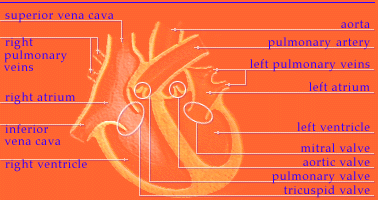
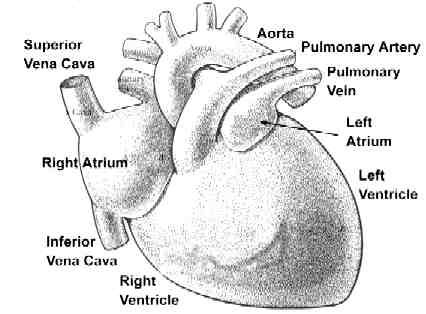
cavities are called atria. The other two are called ventricles. The two atria form the curved top of the heart. The ventricles meet at the bottom of the heart to form a pointed base which points toward the left side of your chest. The left ventricle contracts most forcefully, so you can best feel your heart pumping on the left side of your chest.
The left side of the heart houses one atrium and one ventricle. The right side of the heart houses the others. A wall, called the septum, separates the right and left sides of the heart. A valve connects each atrium to the ventricle below it. The mitral valve connects the left atrium with the left ventricle. The tricuspid valve connects the right atrium with the right ventricle.
The top of the heart connects to
a few large blood vessels. The largest of these is the aorta, or main artery,
which carries nutrient-rich blood away from the heart. Another important
vessel is the pulmonary artery which connects the heart with the lungs
as part of the pulmonary circulation system. The two largest veins that
carry blood into the heart are the superior vena cava and
the inferior vena cava. They are
called "vena cava" because they are the "heart's veins." The superior is
located near the top of the heart. The inferior is located beneath the
superior.
The heart's structure makes it an
efficient, never-ceasing pump. From the moment of development through the
moment of death, the heart pumps. The heart, therefore, has to be strong.
The average heart's muscle, called cardiac muscle, contracts and relaxes
about 70 to 80 times per minute without you ever having to think about
it. As the cardiac muscle contracts it pushes blood through
the chambers and into the vessels.
Nerves connected to the heart regulate the speed with which the muscle
contracts. When you run, your heart pumps more quickly. When you sleep,
your heart pumps more slowly.