Masterpieces of
Leonardo Da Vinci

  Here are some masterpieces of Leonardo Da Vinci :


Click the image to see a larger one

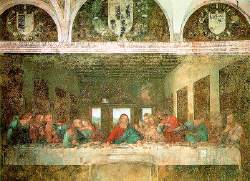
The Last Supper

1498
Fresco 460 x 880 cm
Convent of Santa Maria delle Grazie (Refectory), Milan
Leonardo completed his most famous work - the "Last Supper" - just before his patron, Duke Lodovico Sforza, died in 1499. At the time Leonardo was in the Duke's service, he learned a great deal about mechanics, science, mathematics and physics. Da Vinci would later use this knowlegde to invent the first flying machine. 

Click the image to see a larger one
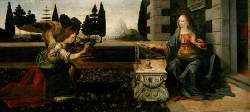
Annunciation

1472-75
Tempera on wood, 98 x 217cm
Galleria degli Uffizi,Florence

The work came to the Uffizi in 1867 from the monastery of San Bartolomeo of Monteoliveto, near Florence. The sacred scene is set in the garden of a Florentine palace, with a landscape on the background wich is already peculiarly Leonardesque, for the magic and unreal atmosphere created by mountains, water and sky. Leonardo's personality is pointed out also in the beautiful drapery of the Virgin and the Angel, while the marble table in front of her probably quotes the tomb of Piero and Giovanni dei Medici in the church of San Lorenzo sculpted by Verrocchio in this period.

Click the image to see a larger one

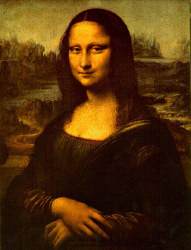
Mona Lisa (La Gioconda)

c. 1503-5
Oil on panel, 77 x 53 cm
Muse Louvre, Paris
After the fall of his patron in 1499, Leonardo left Milan to find employment. In April 1500 he stopped in Florence, traveling back to Florence in 1503, Da Vinci completed several significant projects including the "Mona Lisa."
Mona Lisa (Louvre, Paris), also known as La Gioconda, is a portrait of the wife of Francesco del Giocondo, painted by Leonardo da Vinci between 1503 and 1505. 
This figure of a woman, dressed in the Florentine fashion of her day and seated in a visionary, mountainous landscape, is a remarkable instance of Leonardo's sfumato technique of soft, heavily shaded modeling. The Mona Lisa's enigmatic expression, which seems both alluring and aloof, has given the portrait universal fame.

Click the image to see a larger one

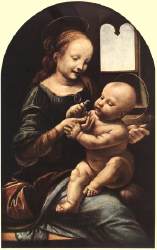
Madonna with a Flower (Madonna Benois)

c. 1478
Oil on canvas transferred from wood, 50 x 32 cm
The Hermitage, St. Petersburg
The painting was also called the "Madonna Benois" because of the family who owned it. This canvas demonstrates the newly developed method of "chiaroscuro" - a lighting/shading technique that made the figures appear three dimensional. It entered the Hermitage in 1914.

Click the image to see a larger one

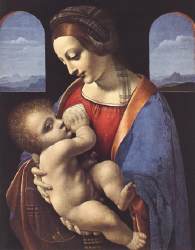
Madonna Litta

c. 1490-91
Tempera on canvas, transferred from panel, 42 x 33 cm
The Hermitage, St. Petersburg
Leonardo Da Vinci, not only painted but also held positions as a civil and military engineer, a mapmaker, scientist, and writer. This picture was completed before Leonardo moved back to Florence in 1500 and was at a time when he was experimenting with different mediums. 


Click the image to see a larger one

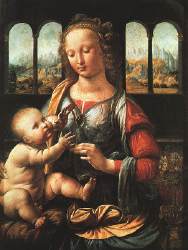
The Madonna of the Carnation

1478-80
Oil on panel, 62 x 47,5 cm
Alte Pinakothek, Munich
This painting is a free variant of the Benois Madonna in the Hermitage, being more complex in its composition and spatial arrangement, though perhaps somewhat highflown and less spontaneous. How it arrived at the Alte Pinakothek in Munich, after its acquisition by a private German collector, is unknown to us. What is certain is that after a comprehensible, temporary attribution to Verrocchio or his shop, art critics subsequently almost universally assigned the painting to Leonardo, a judgement backed up by the most recent research.

Click the image to see a larger one

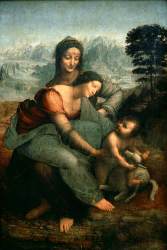
The Virgin and Child with Saint Anne

1510
Oil on wood,
168.5x130 cm
Muse Louvre, Paris
The theme of the Christ Child on the knee of the Virgin, who is herself seated on St Anne's lap, is fairly rare. The painting was commissioned by the Servites in Florence. It is unfinished; perhaps it was abandoned because of the artist's sudden interest in mathematics, and his engagement as engineer in the service of Cesare Borgia. Another hand seems to have finished the lamb which he had perhaps only sketched in; the landscape, St Anne, the Virgin and the Child Christ are the work of Leonardo himself. The paint is applied thinly, it is limpid and transparent, so that in some places the underlying sketch is visible. This has become apparent since the very dark varnish was lightened and some overpainting removed in 1953.

Click the image to see a larger one

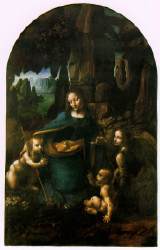
Virgin of the Rocks

1503-1506
Oil on wood, 
189.5 x 120 cm
National Gallery, London
There are two versions of the Virgin of the Rocks. This version shows some details generally neglected by Leonardo in the other version: the haloes of the figures, the child Saint John's cross of reeds. Another differences is th pose of the angel, who no longer points his finger towards the little Paraclete, and his face, whose gaze no longer seeks out the spectator, but is directed inwards. The drapery, too, which in the Paris version was heavy and concealed the body, is lighter here, revealing the anatomical structure. Also the rocks seem painted in a more plastic fashion; the light does not glide over them, creating dewy areas of semi-darkness, but leaves strong contrasts of light and dark. The flesh of the children here is less tender, and though the shadows are insistent, the children's faces seem flatter and less sweet than those of the two sublime creatures in Paris. The intervention of followers on the painting already sketched by Leonardo has made the portrayal less vibrant, more banal, though it retains a compositional authority and an originality in its variants that make this work not a copy but an autonomous version, of high quality, of the unequalled masterpiece in the Louvre. 

Click the image to see a larger one
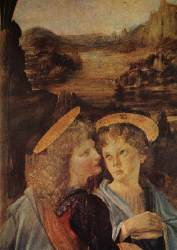
The Baptism of Christ (detail)

1472-75
Oil on wood, 177 x 151 cm (full painting)
Galleria degli Uffizi, Florence

When Leonardo worked under Verrocchio he participated in many works including this painting of two angels.
  Leonardo painted the angel on the left, which differs stylistically from its companion on the right. 


Click the image to see a larger one

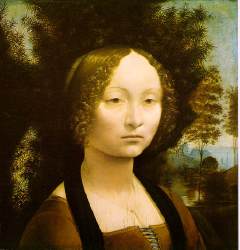
Portrait of Ginevra Benci

1474-1476
Oil on wood, 42 x 37 cm
National Gallery of Art, Washington
This painting is rather traditional, it includes details such as Ginevra's curling hair that only Leonardo could achieve. The sitter born into a wealthy Florentine family, was married to Luigi Niccolini in 1474 at the age of sixteen. It was a customary practice to have a likeness painted on just such an occassion. 
 Leonardo has painted a sensitive and finely modeled image of Ginevra. The undulating curls of her hair are set against her pale flesh, the surface of the paint smoothed by the artist's own hands. Leonardo's portrait was cut down at the bottom sometime in the past by as much as one-third. Presumably the lower section would have shown her hands, possibly folded or crossed, resting in her lap.