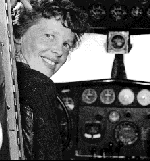
Amelia Earhart: Life History
Despite a few privileged years living with her grandparents in Atchison, Kansas, Amelia
Earhart's childhood years were fairly transitional. Her father's job took him to Des
Moines, where the family joined him a few years later. In 1913 they moved to St. Paul,
Minnesota, where times were hard for the family. A year later, Amelia, her mother and
sister, moved to Chicago and Amelia finished school at Hyde Park High School. Amelia began
college at Ogontz School in Rydal, Pennsylvania, but during Christmas vacation in 1917,
she visited her sister Muriel at St. Margaret's College in Toronto. World War I had begun
and Amelia saw the returning wounded, she was greatly touched by their need for help. She
took a first aid course and worked as a nurses aide at Spadina Military Hospital. During
her spare time she watched airplanes take off from a nearby airfield.
After the war, Amelia enrolled as a pre-med student at Columbia University in New York.
During summer vacation, she visited her parents in Los Angeles. After her first airplane
ride there, she was determined to learn to fly. She drove a truck and worked at the
telephone company to earn the $1,000 for lessons. Neta Snook taught her to fly at an
airfield on the outskirts of town, reached by taking the bus to the end of the line and
walking four miles. Her first solo flight was in 1921.
On her 25th birthday, with the financial help of her mother and sister, Amelia brought her
first airplane, a bright yellow Kinner Canary. In October, 1922, she invited her family to
an air meet at Rogers Air Field in Los Angeles, where she set the women's altitude record
of 14,000 feet.
In 1924, Amelia's parents divorced.
Amelia sold the Canary and bought a yellow Kissel "Goldburg" roadster in
which she drove her mother to Connecticut to live with Muriel and her family. Amelia took
a job at Massachusetts University Extension Program instructing foreign students in
English. She supplemented her income working at Boston's Denison House, which helped
children from Ireland, Syria and China adjust to life in the United States.
Until 1928, no woman had crossed the Atlantic by airplane. Having established herself as
an avid flyer, Amelia was selected as "an American girl of the right image" to
complete the "Friendship" flight between America and Great Britain. With Wilmer
Stutz as pilot and Lou Gordon as mechanic, the "Friendship" arrived in Wales on
June 18, 1928 and Amelia Earhart became the first woman to cross the Atlantic.
Amelia was embarrassed when the public began to call her "Lady Lindy." She felt
it inappropriate because, in her words, she had only been "baggage" and had not
piloted the plane.
Amelia spent the rest of 1928 and 1929 touring, lecturing and writing "20 HRS. 40
MIN., Our Flight in the
Frienship." She accepted a job writing a column for Cosmopolitan magazine and bought
a Lockheed Vega. With this plane, she entered the Women's Air Derby, the first formal
competition for women and dubbed the "Powder Puff Derby" by male pilots. She
placed third in this eight-day flight from Santa Monica, California, to Cleveland, Ohio,
because Ruth Nichols crashed on the last day out and Amelia stayed behind to see if Ruth
was alright.
In 1929, Amelia met with a group of other women pilots in a hangar at Curtiss Field on
Long Island. They formed an organization of women pilots and named themselves The
Ninety-Nines because there were 99 charter members (out of the 117 licensed women pilots
flying in the U.S.). Amelia was elected their first president.
Since the "Friendship" flight, Amelia had been acquainted with publisher and
promoter George Palmer Putnam. Putnam proposed marriage to Amelia six times before she
finally agreed to marry him. They were married February 7, 1931 and lived on his estate at
Rye, N.Y. Amelia was committed to flying and made certain prior to the wedding that
"GP" understood she would not be a traditional housewife and mother.
Amelia went on to set numerous altitude, speed and distance records. On April 8, 1931 she
set an altitude record of 14,000 feet in an autogiro. On May 21, 1932, four years after
the "Friendship" flight, she flew the Atlantic alone in her Lockheed Vega, which
had been altered to hold more fuel and give less wind resistance. The windshield had been
removed and her only visibility was through two small side windows. She carried a thermos
of hot soup and a can of tomato juice. She encountered lightning, rain, instrument
failure, ice on the wings and fuel leaking into the cockpit before, 15 hours and 18
minutes after takeoff, she landed in a farmer's field on the coast of Ireland. Many honors
were bestowed on Amelia after this flight. President Herbert Hoover presented her with the
National Geographic Gold Medal and Congress honored her as the first woman to receive the
Distinguished Flying Cross. On January 1, 1935, Amelia became the first person to fly from
Hawaii to California and later that year she became the first person to solo from Los
Angeles to Mexico City and from Mexico City to Newark. Between 1935 and 1936, Amelia
served as an aeronautical adviser and women's career counselor at Purdue University and
made plans to conquer her last frontier - a 27,000-mile flight-around-the-world at the
equator. After setting out from Oakland on March 17, 1937, Amelia's first attempt to fly
around the world ended in a runway crash in Honolulu that set back the project several
months and caused reorganization. On June 1, 1937, she set out again from Miami, Florida,
with only Fred Noonan as navigator. The new route included stops in Brazil, Africa,
Karachi, Burma, Singapore, Australia, New Guinea, Howland Island and Hawaii before ending
in California. On July 2, on what was nearly the last leg of her historic flight, she took
off from New Guinea for Howland Island, a tiny island in the South Pacific. There would be
no landmarks for the 2,566 miles and no radio contact after 500 miles. A trailing,
250-foot wire antenna had been removed because it was awkward to reel out and in while
flying. This meant the plane would be out of radio contact for two to three hours over the
Pacific until they reached Itasca, a ship stationed near Howland Island.
On July 2 the world was listening and
the crew aboard the Itasca watched the sky. At 7:42 a.m., the radioman
aboard the Itasca heard Amelia broadcast, "We must be on you but cannot see you and
fuel is running low. Been unable to reach you by radio. We are flying at altitude 1,000
feet." Amelia's last communication was heard at 8:45 a.m., "We are running north
and south." The most extensive search ever made for civilians at sea was unable to
locate any trace of Amelia and Noonan, their plane or its wreckage.
