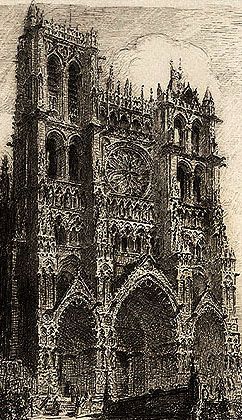
Gothic Cathedrals
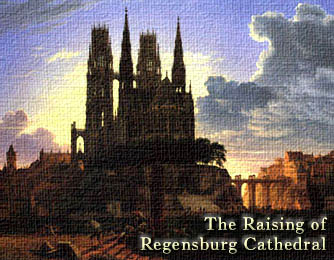
Gothic Cathedral
Cathedral
During the
middle of the twelfth century, in the region surrounding Paris, several innovative art and
craft forms began to coalesce within the renovations of existing church structures.
Initially consisting of hybrid elements within earlier buildings, primarily the Romanesque
abbeys, the new style soon accentuated its own merits. Before passing from favor, the
expression we know today as Gothic Art would dominate European architectural development
for the nearly four hundred years.
The churches and cathedrals of the Gothic era are
currently enjoying a renewed interest and reverence. It is a great understatement to say
that this was not always true. Throughout the centuries Gothic structures have suffered
far more than disinterest and neglect. Periodic turns of popular taste have at times
inspired movements for the outright annihilation of these grand structures.
Architecture
is what we think of most as the expression of the Gothic age. Its first forms arise within
the 12th century, seemingly from the very heart of their Romanesque forebears. As the
paramount builder of the Middle Age centuries, the church provided this new
creative/technical form with its greatest avenue of manifestation. It would not be until
the 'Neo-Gothic' era of the nineteenth century that the style would make an expression
through secular structures on any broad scale.
Contrary to popular perception, Gothic style refers
to more than cathedral structures. The label applies to art, sculpture, glass works,
decorative pieces and illuminated manuscripts from the mid 12th through the early 16th
century.
|
Gothic Cathedrals |
|