More serious offenders could be required to visit a number of distant churches, such as those in Rome. As with all penances, failure to comply was considered a sign of relapsed heresy which brought the death penalty.
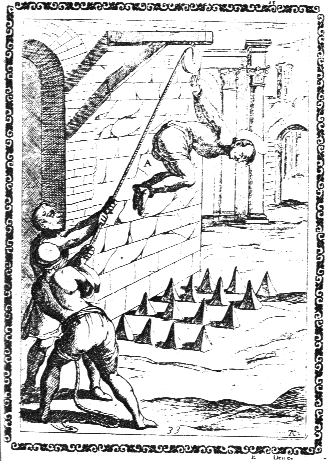
a hanging
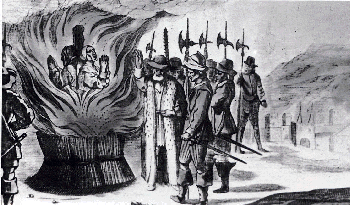
a burning
Punishment
~The usual punishments were penance, fine, and imprisonment. A verdict of guilty also meant the confiscation of property by the civil ruler.~
Heretics
~People who go against the church~
The sentencing was a very public ceremony, in contrast to the secrecy of the accusations and interrogations. In Spain it reached the proportions of an elaborate public festival, the auto-de-fa, which instilled a sense of awe and fear in the populace. In the sentencing, the Inquisitors would start with the least serious convictions and then move toward the more serious. Technically, the Inquisitors(people questioning the heretics) only had jurisdiction over those heretics who had confessed and repented of their heresy. The obstinate heretics were turned over to the secular authorities for execution.
The punishments administered to the "repentant" heretics were handed out in the form of penances. These varied from mild to severe, depending on the level of cooperation given to the Inquisition and the severity of the offense.
Mild
A mild form of penance might be a series of required pilgrimages to nearby
churches. The repentant heretic would be required to carry a letter from the
Inquisitor which would be signed off as he visited the proscribed churches.
| Mediocre More serious offenders could be required to visit a number of distant churches, such as those in Rome. As with all penances, failure to comply was considered a sign of relapsed heresy which brought the death penalty. a hanging
|
|
Serious
Far more serious was the Sign of Infamy. Here the penitent was required to
wear a yellow cross on the shoulder and on the chest for the rest of his life. This
caused public humiliation for both the individual and his family.
Inquisitors Profit
Confiscation was a very common form of "penance" during the Inquisition.
The heretics house or lands would be seized with a third going to the
Inquisitors. Those convicted of offenses less than the full charge of heresy
would have a portion of their goods seized. This was naturally a very popular form
of punishment among Inquisitors. It is partly responsible for the popularity of
posthumous trials in which a wealthy "heretic" is exhumed and tried in order to
seize his property.
Imprisonment
The nominal punishment for a repentant heretic was life imprisonment. The
majority of such prisoners were sent to the "murus largus" which was the more
lenient form of confinement. Some freedom of movement was tolerated, visitors were
allowed, and conditions were generally tolerable. On the other hand, those heretics
regarded as more serious offenders were sent to the "murus strictus" in which
conditions were more harsh and survival problematic. The prisoners would be chained
and held in solitary confinement and not allowed outside contact.
 |
The minority of heretics who confessed or were proven heretics and still refused to repent were turned over to the secular authorities. The punishment which the Roman Catholic Church deemed appropriate for them, the animadversio debita, was death. This was normally carried out by a public burning at the stake. |