Torture
~When the Inquisitor felt that the
suspect was lying or holding back information, he would resort to special means
of~ ~interrogation~
As barbaric as this seems, it could
be justified in the Inquisitor's mind as a way of saving the heretic's soul by bringing
him to confession and repentance. It is likely that the vast majority of suspects
sought to avoid torture by confessing early on in the interrogation process.
Nevertheless, the annuls of the Inquisition reveal that the practice was very
common. Those unfortunates who reached this stage were in a very bad situation.
If they confessed under torture, their story would have to satisfy the
Inquisitor as to its truthfulness. If not, or if they held back the names of their
fellow heretics, torture could be resumed. The means of torture were so brutal that
most people must have readily confessed, but their was always the problem of coming up
with a satisfactory confession. Torture could drag on for many days, broken up by
periods of unconsciousness or imprisonment back in the cell. Some prisoners could
not survive the process which left the Inquisitors guilty of murder. For this reason
the interrogations were conducted by two priests who were permitted by the pope (Alexander
IV 1256) to absolve one another.
There was quite a number of
different techniques used to torture suspects, including water torture, fire, the wheel,
the rack, and the strappado. The Inquisitors could, of course, apply multiple
techniques as necessary.
Water
Torture
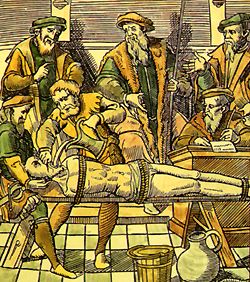
Water torture involved forcing the suspect to swallow water, creating a sensation
of drowning. A cloth might be inserted in the mouth and then soaked with water.
Additional water could be poured on the cloth or the nostrils blocked until
the suspect was ready to talk.
an example of water
torture

|
 |
Fire
Torture
Fire torture was an effective method in which the suspects feet were coated with
grease and brought near a fire. The feet would be inserted in the flames or against
the coals temporarily and then removed while questioning took place. They would be
re-inserted in the flames as necessary to obtain the desired confession.
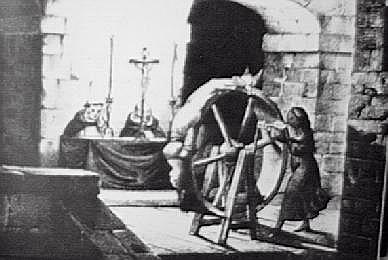
Wheel Torture
The wheel torture was a combination of physical beating and disorientation.
The suspect was tied to a wheel which was then spun around while the Inquisitors performed
their interrogation. They or their assistants would strike the individual to further
assist the confession.
The Wheel
|
|
The Rack
The rack is a familiar medieval torture. The suspect is laid on a horizontal
rack with the hands and ankles tied to rollers on opposite ends. The Inquisitors
would perform the interrogation while turning the rollers, stretching the body of the
suspect and causing immense pain.
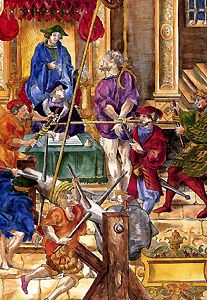
The
Strappado
The strappado could be described as a very unpleasant form of medieval bunge
jumping. The suspect had his ankles strapped together and wrists tied behind
his back. A rope was then dropped from an overhead pulley and fastened to his
wrists. Assistants would pull the rope on the other end of the pulley to
raise the suspect off the floor. The interrogation would proceed and, if
unsatisfactory answers were given, the suspect would be raised up to the ceiling.
The torturers then released the rope with enough length that the suspect dropped almost to
the floor. The sudden jarring was devastating to the body and the suspect would
have to endure it repeatedly until he confessed. Unfortunately, the strappado was a
very common form of Inquisition torture.The strappado |
 |
After all this, if the suspect
confessed he would be returned to prison for a couple days. He was then brought back
to the Inquisitors and asked to repeat his confession freely without the threat of
torture. This seemingly humane gesture was really only a facade of justice. If a
suspect recanted his confession it was not taken as a sign of his innocence, but rather,
of obstinate heresy which brought the death penalty.
Back