PAGE2Volcanoes
are not randomly distributed over the Earth's surface. Most are
concentrated on the edges of continents, along island chains, or beneath the sea forming
long mountain ranges. More than half of the world's active volcanoes above sea level
encircle the Pacific Ocean to form the circum-Pacific "Ring of Fire." In the
past 25 years,
scientists have developed a theory--called plate tectonics--that explains the locations of
volcanoes and their relationship to other large-scale geologic features.
The
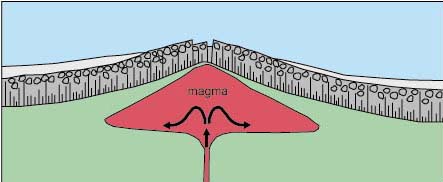
most simple answer is that volcanoes are caused by the fact that magma is produced in the
upper mantle of the Earth.
Magma is what geologists call molten rock before it makes it to the surface. Magma is
produced in 3 main locations. One is
subduction zones where one of the Earth's plates dives under another. The sediments and
the plate itself give off gases which
rise through the overlying mantle and help to cause it to partially melt, producing the
magma that then erupts. These are often
called arc volcanoes because they lie along arcuate lines that parallel the subduction
zones. Another place where significant
magma is produced is at spreading centers. Most of these are in the oceans, but some are
on continents. Here, two tectonic
plates spread apart. Mantle material wells up to fill the space, and in the process it
partially melts in the lower pressure it finds
itself in. This produces magma which can well up to the surface and erupt to produce new
crust. Another place where lots of
magma is produced is at hotspots. We don't really understand hotspots very well. We know
that they don't care that the plates
are moving around up on the surface so almost certainly they are deep structures. We also
know that they can last a long time -
the Hawaiian hotspot has been active for at least 70 million years.
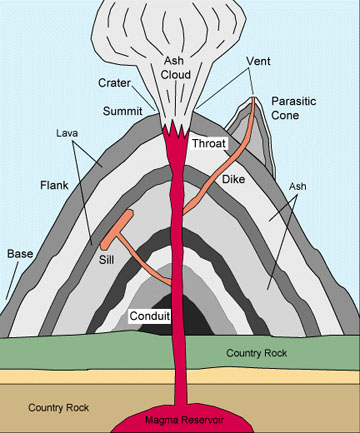 yyThis cross-section shows the parts of a volcano. A conduit feeds magma to
the surface. Near the surface, the gas expands and
yyThis cross-section shows the parts of a volcano. A conduit feeds magma to
the surface. Near the surface, the gas expands and
fragments the lava into ash. Some magma passes through dikes to feed vents. Some magma
intrudes parallel to layers to make
sills.
More than 80 percent of the Earth's surface -- above and below sea level -- is of volcanic
origin. Gaseous
emissions from volcanic vents over hundreds of millions of years formed the Earth's
earliest oceans and
atmosphere, which supplied the ingredients vital to evolve and sustain life. Over geologic
eons, countless volcanic
eruptions have produced mountains, plateaus, and plains, which subsequent erosion and
weathering have sculpted
into majestic landscapes and formed fertile soils
About 500 active volcanoes are known on Earth, not counting those that lie beneath the sea.
The Earth's crust, on which we live and depend, is in large part
the product of millions of once-active volcanoes
and tremendous volumes of magma that did not erupt but instead cooled below the surface.
Such persistent and
widespread volcanism has resulted in many valuable natural resources throughout the world.
For example,
volcanic ash blows over thousands of square kilometers of land increases soil fertility
for forests and agriculture by
adding nutrients and acting as a mulch. Groundwater heated by large, still-hot magma
bodies can be tapped for
geothermal energy. And over many thousands of years, heated groundwater has concentrated
valuable minerals,
including copper, tin, gold, and silver, into deposits that are mined throughout the world
The largest eruption in the world this century occurred in 1912
at Novarupta on the Alaska Peninsula. An
estimated 15 cubic kilometers of magma was explosively erupted during 60 hours beginning
on June 6 -- (which is
equivalent to 230 years of eruption at Kilauea (Hawaii) or, about 30 times the volume
erupted by Mount St.
Helens (Washington) in 1980.)