The Australian Mist
 The
Supurr Australian Mist was created by a Sydney ecologist, Dr. Truda Straede
of Nintu Cattery who developed the breed from the idea to full register
over ten years from 1976. Sound husbandry and selection, combined
with the perseverance of the experimental breeders has led to a pleasingly
uniform, but genetically broad-based population of cats which are now recognised
Australia-wide.
The
Supurr Australian Mist was created by a Sydney ecologist, Dr. Truda Straede
of Nintu Cattery who developed the breed from the idea to full register
over ten years from 1976. Sound husbandry and selection, combined
with the perseverance of the experimental breeders has led to a pleasingly
uniform, but genetically broad-based population of cats which are now recognised
Australia-wide.
The latest development is the
change of name to Australian Mist from the original Spotted Mist. This
took place in June 1998 after the development of a new pattern- the Marbled
Mist- from recessive genes carried in the Spotted Mist. It has the same
colours and characteristics as the Spotted Mist but has a tabby pattern
instead of spots.
The breed has a large gene
pool of over 30 foundation cats. Half were Burmese and a quarter were Abyssinian
with the final quarter Domestic Tabbies. Burmese contributed the dilution
of colours, the "laid-back" temperament, four of the colours and some spotting
as well as general size and conformation. From the Abyssinians came the
beautiful ticking to develop the spots, two more colours, and a touch of
lively intelligence. Domestic tabbies contributed to the best spots but
primarily to vigour, with a dose of "uncossetted" cat genes improving teeth,
kidneys, mothering qualities, and helping to stabilise litter sizes around
the feline average of four.
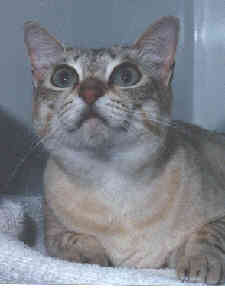
There is nothing extreme about
the Australian Mist; they are of moderate size, medium boned, rounded of
head, with large eyes and ears. The coat is short but resilient, the tail
is plumply furred. The colours are warm brown, blue, chocolate, lilac,
gold and peach; the pattern is of delicate spots against a misty ground,
with legs and tail ringed and barred, and the face lined. Eyes are large
and expressive in a range of greens. The nose, chin and whisker pads are
broad giving the face a generous expression.
They make excellent mothers,
are moderate breeders, and superlative studs.
Temperament is such that many
males are able to live in small groups with other males. Desexed
cats, females and kittens fit in easily with all sorts of other cats, being
neither aggressive toward them, nor allowing themselves to be upset by
the unfriendliness of others. Less frequent calling and later maturation
of both males and females is being selected for, in an attempt to increase
the pleasure of the small breeder, and to control the rate of growth of
the population.
Their people-centredness contributes
to their willingness to remain indoors between dusk and dawn or to be wholly
indoor pets. This is an essential characteristic for Australia where some
Governments have placed curfews on cats in order to protect native wildlife.
While it is not possible to alter the inherent behaviours which enable
the cat to hunt, these characteristics can be redirected towards interacting
with people. Selection will continue to enhance these qualities further,
creating a truly companionable pet, which quickly becomes a member of the
family.
