The Balinese
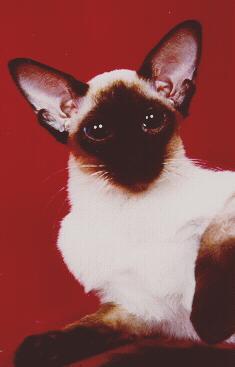 Balinese, breed of longhaired cat of uncertain origin. One theory holds
that the Balinese developed from a natural mutation—a change in breed characteristics
that occurred naturally rather than through selective breeding—among Siamese
cats. These mutant longhaired cats were then bred together to further develop
these characteristics. Another theory suggests that this breed resulted
from crossing Siamese cats with cats of Persian ancestry that had a recessive
gene for long hair.
Balinese, breed of longhaired cat of uncertain origin. One theory holds
that the Balinese developed from a natural mutation—a change in breed characteristics
that occurred naturally rather than through selective breeding—among Siamese
cats. These mutant longhaired cats were then bred together to further develop
these characteristics. Another theory suggests that this breed resulted
from crossing Siamese cats with cats of Persian ancestry that had a recessive
gene for long hair.
The Balinese has an elegant appearance, with
a strong but lithe body. Because the back legs are longer than the front
legs, the rear end appears higher than the rest of the body. The neck is
long and slender, and the wedge-shaped head has a long, straight nose.
Medium-sized, almond-shaped, vivid blue eyes slant toward the nose. The
wide-set ears are large and pointed. The long, thin tail with a plume of
hair tapers to a point.
The Balinese displays the
characteristic coloring of the Siamese—a light body with contrasting dark
color points on the ears, nose, paws, and tail—but the Balinese has long,
silky fur. Unlike other longhaired cats, it does not have a collar of fur,
called a ruff, around the neck. The Balinese has a distinctive loud cry,
but generally uses its voice less often than the Siamese.
The Balinese was introduced
in the United States in the late 1940s or early 1950s. Mary Smith, an early
breeder of Balinese, named these cats for their exotic appearance, which
reminded her of the dancers of the South Pacific island of Bali. Most cat
associations did not recognize the breed until 1970, and then recognized
only the traditional Siamese colors of seal, blue, chocolate, and lilac
point.
