The Persian
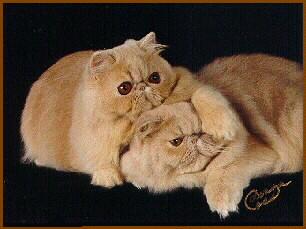 Persian, popular breed of longhaired cat. More Persians are registered
with the Cat Fanciers' Association, the largest feline registering body
in the United States, than any other breed of cat. Persians are aristocratic
but by no means delicate, with long, plush coats and heavy bones. They
have broad, massive skulls with round faces and a domed forehead; small
rounded ears; and broad, snub noses with a decided break. The coat is long
from head to tail, with an immense ruff and frills between the front legs.
The Persian comes in a broad range of colors, with blue, black, and white
being the most popular.
Persian, popular breed of longhaired cat. More Persians are registered
with the Cat Fanciers' Association, the largest feline registering body
in the United States, than any other breed of cat. Persians are aristocratic
but by no means delicate, with long, plush coats and heavy bones. They
have broad, massive skulls with round faces and a domed forehead; small
rounded ears; and broad, snub noses with a decided break. The coat is long
from head to tail, with an immense ruff and frills between the front legs.
The Persian comes in a broad range of colors, with blue, black, and white
being the most popular.
Persians probably originated
in Asia Minor; they were introduced to Europe in the 1700s, where they
were called French cats or Angoras. When short, stocky longhaired cats
from Iran (formerly known as Persia) were incorporated into the gene pool,
the breed became known as Persians. They became popular in Britain during
Queen Victoria's reign; she and other members of the royal family kept
blue Persians. They have been exhibited in cat shows as a recognized breed
for more than a hundred years; the first cat show in Britain, in 1871,
included black, blue, and white Persians. The Persian has changed significantly
since then; early Persians had much longer bodies, larger ears, smaller
eyes, and longer faces than today's short-faced, round-eyed Persians. This
is because the longer, more slender Angora type gradually went out of favor
after the compact, sturdy Iranian type was introduced.
The modern Persian is closely
related to two other breeds; the Himalayan and the Exotic Shorthair. The
Himalayan is identical to the Persian except for its color, which is pointed
like a Siamese. The Exotic Shorthair is a shorthaired Persian. Most cat
associations permit kittens from any combination of these breeds to be
registered as purebred, pedigreed cats.
