The Birman
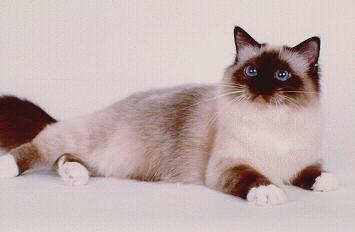 Birman, breed of longhaired cat, sometimes called the sacred cat of Burma.
The distinctive, predominately white birman traces its origins to pre-Buddhist
times.
Birman, breed of longhaired cat, sometimes called the sacred cat of Burma.
The distinctive, predominately white birman traces its origins to pre-Buddhist
times.
According to legend, 100 all-white sacred cats
lived in a temple honoring a blue-eyed, golden goddess named Tsun-Kyan-Kse,
who watched over souls of the dead as they changed to a higher form. The
temple was attacked one night and a priest, who prayed nightly to a statue
of the goddess, was mortally wounded. One of the sacred cats, Sinh, watched
over the dying priest, placing his paws on the priest's body while facing
the statue of the goddess. The cat's eyes turned blue, his coat took on
a golden sheen, and his face, legs, and tail turned a velvety brown to
reflect the beauty of the goddess. Only the cat's feet remained white as
a sign of the purity of the slain priest's soul. By morning, all the cats
in the temple had taken on this coloring—now the standard for birmans.
The birman has a stocky body,
with a heavy bone structure that adds to its sturdy, imposing appearance.
The broad head is round, with full cheeks and prominent cheekbones. A heavy
collar of fur, called a ruff, encircles the neck. Large, round blue eyes
are set wide apart and at a slight angle. The nose is of medium length
and width, and the wide-set, medium-size ears are slightly rounded. The
medium-length tail has a plume of long silky fur.
The pure white feet and colorpoints
(characteristic large spots of darker fur on the face, ears, legs, and
tail, contrasting with a lighter body coloring) of a birman distinguish
the breed. The glovelike color pattern on the front paws extends in an
even line across each paw up to the second or third joint, where the paw
bends when the cat stands. The gloves on the back legs end slightly higher.
A white lace pattern, shaped like an inverted V, extends up the back of
the legs. The back and sides of the long fur coat have a faint golden tint,
while the colorpoints may be one of several contrasting colors. All cat
associations recognize the birman with seal, blue, chocolate, or lilac
colorpoints; other colors exist but are not allowed in competition.
By 1925, birmans were well
established in France, and had been introduced in Great Britain and the
United States. However, only in the late 1960s did British and American
cat associations recognize the birman.
