The Burmese
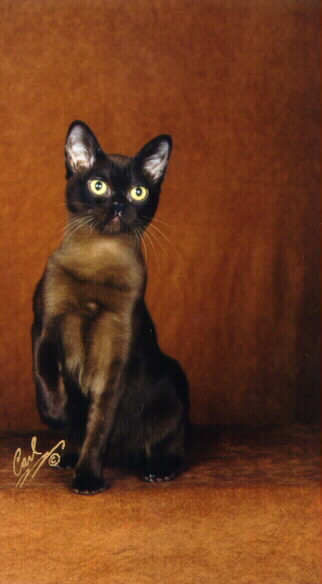 Burmese (cat), breed of shorthaired cat, originally developed by crossing
a brown cat from Myanmar (formerly known as Burma) with a Siamese. All
modern Burmese cats are descended from a walnut-brown female, Wong Mau,
who was brought to the United States in 1930 from Yangon (formerly known
as Rangoon), the Myanmar capital. Wong Mau's unusual color intrigued her
owner, Dr. Joseph Thompson, who began a careful breeding program to investigate
her genetic makeup. Dr. Thompson's work confirmed that a distinct gene,
dubbed the Burmese gene, produced Wong Mau's unique coloration. Dr. Thompson
and other U.S. breeders developed the Burmese as a pedigreed breed; it
was officially recognized by the Cat Fanciers' Association in 1936.
Burmese (cat), breed of shorthaired cat, originally developed by crossing
a brown cat from Myanmar (formerly known as Burma) with a Siamese. All
modern Burmese cats are descended from a walnut-brown female, Wong Mau,
who was brought to the United States in 1930 from Yangon (formerly known
as Rangoon), the Myanmar capital. Wong Mau's unusual color intrigued her
owner, Dr. Joseph Thompson, who began a careful breeding program to investigate
her genetic makeup. Dr. Thompson's work confirmed that a distinct gene,
dubbed the Burmese gene, produced Wong Mau's unique coloration. Dr. Thompson
and other U.S. breeders developed the Burmese as a pedigreed breed; it
was officially recognized by the Cat Fanciers' Association in 1936.
The Burmese is now recognized
in the U.S. in a variety of colors, including sable (brown), champagne
(beige), blue, and platinum. In Europe, the Burmese is recognized in additional
colors, including lilac and tortoiseshell. The eyes are gold; green eyes
are considered to be a fault. The cat is medium-sized, muscular, and surprisingly
heavy for its size. Its head is rounded and in profile displays a noticeable
break at the nose. The Burmese is calm and adaptable, with a quiet voice
and an affectionate nature.
A related breed, the Bombay,
was created in 1958 by breeding a Burmese to a black American shorthair.
The Bombay resembles the Burmese, but has a shiny black coat and round
copper eyes. Another related breed, the Tiffany, is a longhaired variety
of the Burmese. Most cat associations do not recognize the Tiffany for
championship competition.
