The Chartreux
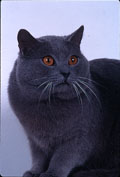 Chartreux, breed of French cat, sometimes called the blue cat of France,
the monastery cat, and the smiling cat. Ancestors of the Chartreux probably
originated in the Middle East and were transported to Europe over 450 years
ago.
Chartreux, breed of French cat, sometimes called the blue cat of France,
the monastery cat, and the smiling cat. Ancestors of the Chartreux probably
originated in the Middle East and were transported to Europe over 450 years
ago.
Monks of Le Grande Chartreux monastery near Grenoble,
France, may have developed the Chartreux in the 16th century. The monks
favored this cat for its skill as a hunter, and used it to protect the
abbey's stores of grain from rats and mice. At one time, the Chartreux
may have been exploited for its fur, which, when dyed, resembles otter
pelts. The first official breeders of the Chartreux were the Leger sisters
in Bretagne, France. After perfecting this breed, they entered it in a
French cat show in 1931.
During World War II (1939-1945),
many Chartreux were killed for their coats or died from starvation, and
the breed almost disappeared; the breed was restored during the 1950s.
Breeders strengthened the Chartreux by crossing it with other blue-colored
cats, which produced a cat similar to the British blue, a type of British
shorthair.
The Chartreux has a large,
sturdy, well-proportioned body, and weighs up to 7 kg (15 lb). The neck
is short and strong, and the large, well-rounded head has full cheeks and
a medium-size, straight nose. The round, wide-set eyes are brilliant in
color, ranging from gold to copper. The ears are small- to medium-size
with rounded tips. The distinctive blue-gray fur of the Chartreux has a
silver sheen, and the dense, wool-like coat spreads apart like a sheepskin
around the neck and upper legs.
