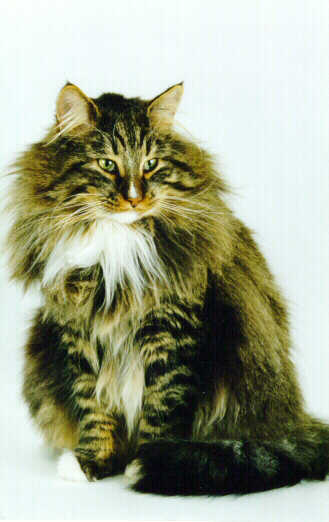
 Norwegian Forest Cat, also known as Skogkatt, or Wegie, first longhaired
breed of cat from Norway, similar to the Maine Coon Cat. The Norwegian
forest cat is thought to have descended from shorthaired and longhaired
cats brought to Norway by the Vikings and the Crusaders. It developed from
a mutation, a change in breed characteristics that occurred naturally rather
than through a selective process by cat breeders.
Norwegian Forest Cat, also known as Skogkatt, or Wegie, first longhaired
breed of cat from Norway, similar to the Maine Coon Cat. The Norwegian
forest cat is thought to have descended from shorthaired and longhaired
cats brought to Norway by the Vikings and the Crusaders. It developed from
a mutation, a change in breed characteristics that occurred naturally rather
than through a selective process by cat breeders.
Norse mythology mentions huge Norwegian cats in its lore about the gods. In one fable, two of these cats pulled the chariot of Freya, a goddess of fertility. The Norwegian forest cat originally inhabited Norway's forests and was known by local farmers as a large, hardy animal with superior hunting skills. Breeders did not raise the cat until after World War II (1939-1945), by which time it had nearly disappeared. The breed was introduced in the United States in 1979.
The male Norwegian forest cat is larger than the female. Both sexes take up to five years to mature. The muscular, large-boned body is box shaped. The back legs are longer than the front legs, which elevates the rump higher than the shoulders. The chest is full and the muscular neck is short. The head is triangular with a square muzzle and straight nose. Wide-set, almond-shaped green or gold eyes angle slightly upward at the outer corners. Medium- to large-sized upright ears tilt forward slightly and are rounded at the tip.
The Norwegian forest cat has a long, soft top coat of smooth hair. A woolly undercoat is covered with long, water-repellent hair. The fur is longest around the neck, where it forms a collar or ruff, and on the full, flowing tail, which is as long as the body. The coat can be almost any color and pattern.