The Ragdoll
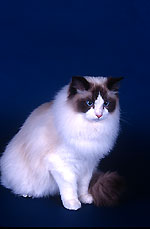 Ragdoll, breed of longhaired cat with colorpoints (characteristic large
spots of darker fur on the face, ears, legs, and tail, contrasting with
a lighter body coloring), known for its habit of going limp when held.
The ragdoll appears to be fearless and unaware of danger, and often does
not show when it feels pain.
Ragdoll, breed of longhaired cat with colorpoints (characteristic large
spots of darker fur on the face, ears, legs, and tail, contrasting with
a lighter body coloring), known for its habit of going limp when held.
The ragdoll appears to be fearless and unaware of danger, and often does
not show when it feels pain.
The ragdoll was developed
by a California cat breeder in the mid-1960s by crossing a white, longhaired
female cat with a male Birman cat. One of the kittens later was bred to
his mother to produce ragdoll kittens. Cat geneticists believe the ragdoll's
tendency to go limp is related to its gentle nature.
The largest of the domestic
cats, a ragdoll takes up to four years to reach full maturity. Males weigh
about 6.5 to 9 kg (about 15 to 20 lb), while females weigh about 4.5 to
5 kg (about 10 to 13 lb). This tall cat has a large, long body with a full
chest and muscular, heavy hindquarters. The legs are large-boned, and the
back legs are longer than the front. A short, heavy neck supports the medium-sized,
broad, wedge-shaped head, which has a round muzzle and well-developed chin.
Large, oval-shaped eyes are blue. Broad-based, medium-sized ears have rounded
tips and tilt forward slightly. The long tail tapers slightly at the tip
The ragdoll's long, thick
fur is plush and silky, and forms a ruff, or collar, around the neck. The
fur grows longest on the neck and tail. Short, thick hair covers the front
legs, and long, thick yet feather-like hair grows on the back legs. The
fur is shortest on the face.
Ragdoll colors are seal point,
chocolate point, blue point, and lilac point. These colors have three coat
patterns: bicolor, colorpoint, and mitted (mitten- or glovelike coloring
on the feet).
