Cornish
Rex
Devon Rex
Selkirk Rex
The Cornish
Rex
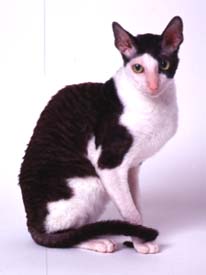 Cornish Rex, breed of wavy-haired cat, the result of a natural mutation
(change in breed characteristics that occurred naturally rather than through
a selective breeding process).
Cornish Rex, breed of wavy-haired cat, the result of a natural mutation
(change in breed characteristics that occurred naturally rather than through
a selective breeding process).
The first Cornish rex was
a cream-colored male, born in a litter of five barn kittens in Cornwall,
England, in 1950. The breed was named Cornish for the kitten's birthplace
and rex for the rabbits the owner once had raised. The Cornish rex was
discovered to be distinctive from the Devon rex cat when attempts to cross
the two breeds failed to produce wavy-haired offspring.
The Cornish rex is a small-
to medium-sized, small-boned cat. The body, legs, and neck are long and
slender, and the hips are muscular. Its back curves upward in a natural
arch, and its stomach tucks up underneath. The breed's small head is narrow
and egg-shaped, and the cheeks are lean and muscular. Adding to the angular
look of this cat's face are the medium- to large-sized oval eyes, which
slant slightly upward. Full, erect ears sit high on the head.
The eyes of the Cornish rex
are varying shades of green. Coat colors include black, blue, cream, red,
and white, which appear in solid, bicolored, smoke, and multicolored patterns.
The soft, wavy fur feels like crushed velvet. Even this cat's whiskers
and eyebrows curl. Because the Cornish rex lacks the long protective hairs
found in the fur of most cats, it sheds less often, making it a good pet
for people with allergies.
British cat associations first
recognized the Cornish rex in 1963. All North American registries now accept
this breed.
~top~
The
Devon Rex
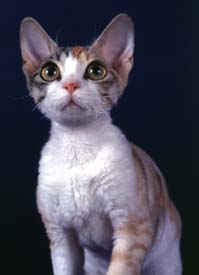 Devon Rex, breed of wavy-haired cat, the result of a natural mutation (change
in breed characteristics that occurred naturally rather than through a
selective breeding process).
Devon Rex, breed of wavy-haired cat, the result of a natural mutation (change
in breed characteristics that occurred naturally rather than through a
selective breeding process).
The first Devon rex was a
male born near Devonshire, England, in 1960, one of a litter of wild kittens
with a wavy-haired father and a straight-haired mother. Breeding this cat
with a Cornish rex cat produced only straight-haired kittens; cat breeders
then distinguished the wavy-haired Devon rex as a separate breed.
The Devon rex is slender, with a muscular body,
a broad chest, and a flat abdomen. Males can be up to 25 percent larger
than females. The legs are long, and the back legs are longer than the
front legs. The small, wedge-shaped head—with prominent cheekbones and
large, rounded ears set low and wide apart—gives the Devon rex a pixielike
appearance. Large, wide-set eyes are oval and slant up toward the outer
edges of the ears.
The eyes of the Devon rex
are varying shades of green. Coat colors include black, blue, chocolate,
red, lavender, and white, which appear in solid, bicolored, shaded, smoke,
and multicolored patterns. The short, curly hair makes a dense, soft coat.
The fur is shorter than that of the Cornish rex, and not as plush or wavy.
The American Cat Fanciers' Association recognized
this breed in 1972. All cat associations accept the Devon rex for competition.
~top~
The Selkirk
Rex
The Selkirk rex has a wavy
coat that can be either short or long. A third curly-coat mutation causes
the wavy coat; the gene differs from the Cornish rex and the Devon rex
genes in that the Selkirk gene is dominant, whereas the other two are recessive.
The new mutation appeared in the American state of Wyoming in 1987; the
curly-coated kitten was sent to a Persian breeder in Minnesota who eventually
developed the breed. The Selkirk rex is a large, sturdy, muscular cat,
unlike the other two rex breeds, which are smaller and more delicate. It
is relaxed, outgoing, and people-oriented.
