The Siamese
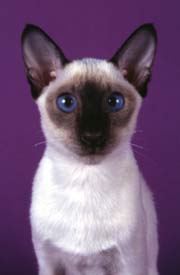 Siamese, breed of shorthaired cat that originated in Thailand (formerly
Siam) more than 200 years before the first specimen was shown in England
in 1871. The distinctive Siamese coloring—a light body with darker points
(face, ears, tail, lower legs, and paws)—is due to a recessive gene. The
formation of pigment varies with the temperature; fur on cooler areas of
the body, such as the ears and paws, is darker than the fur on warmer areas
such as the belly. Siamese kittens are born nearly white, and the points
darken as they get older. Siamese in cool environments tend to be darker
than those in warm climates. As the cat ages, its pale body color may darken
considerably due to poorer circulation. Originally, the Siamese came in
only one color, seal point, in which the points are a deep brownish black.
The modern Siamese can be found in a wide variety of pointed colors, including
blue, chocolate, lilac, red, cream, and tortie points, as well as lynx,
or tabby, point variations of these colors.
Siamese, breed of shorthaired cat that originated in Thailand (formerly
Siam) more than 200 years before the first specimen was shown in England
in 1871. The distinctive Siamese coloring—a light body with darker points
(face, ears, tail, lower legs, and paws)—is due to a recessive gene. The
formation of pigment varies with the temperature; fur on cooler areas of
the body, such as the ears and paws, is darker than the fur on warmer areas
such as the belly. Siamese kittens are born nearly white, and the points
darken as they get older. Siamese in cool environments tend to be darker
than those in warm climates. As the cat ages, its pale body color may darken
considerably due to poorer circulation. Originally, the Siamese came in
only one color, seal point, in which the points are a deep brownish black.
The modern Siamese can be found in a wide variety of pointed colors, including
blue, chocolate, lilac, red, cream, and tortie points, as well as lynx,
or tabby, point variations of these colors.
The ideal Siamese is elegant
and svelte, with hard, dense musculature. The tail is long and thin. In
contrast to the round-headed Siamese of the early 20th century, the modern
Siamese has a long head tapering to a fine muzzle. The ears are strikingly
large. Although the blue eyes slant toward the nose, squinted or crossed
eyes, like kinked tails, are considered defects. Among the distinctive
characteristics of the Siamese are its great leaping ability and its loud
voice; it loves people and will often carry on a running conversation with
its owner.
Back
to Floor Four