The Sphynx
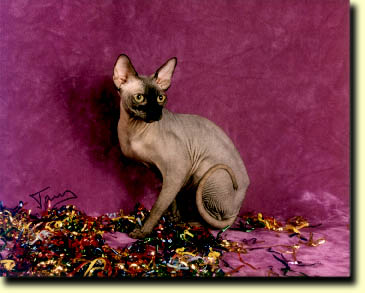 Sphynx, breed of mostly hairless cat, the result of a natural mutation—change
in breed characteristics that occurred naturally rather than through a
selective process by cat breeders.
Sphynx, breed of mostly hairless cat, the result of a natural mutation—change
in breed characteristics that occurred naturally rather than through a
selective process by cat breeders.
The first Sphynx was born
in Ontario, Canada, in 1966. Hairless cats had been seen before, especially
in the early 20th century when a cat known as the New Mexican hairless
appeared in exhibitions. But efforts to develop the hairless cat as a breed
did not begin until after this Canadian cat was born.
The adult male Sphynx is about
25 percent larger than the adult female. Both sexes have a medium-long,
compact body with a barrel chest. The legs are muscular, with the back
legs longer than the front legs. The cat appears slightly bowlegged. Its
paws are unusually thick and look like little air cushions. The rounded,
well-muscled neck supports a wedge-shaped head with prominent cheekbones.
Large, lemon-shaped eyes slant up toward the outer corner of the ears.
Large, upright ears are broad at the base. The long tail tapers to a slender
tip.
The Sphynx has a higher body
temperature than other cats, and its skin feels warm and soft, like suede.
An extremely short, fine down covers much of its body. The face, feet,
ears, and tail have a soft fur. A ridge of short, wiry hair may grow on
the spine. Many Sphynx have no whiskers or eyebrows, but some have short
or broken strands of these facial hairs.
The skin of the Sphynx carries
the pigmentation normally seen in the coats of other cats, and this cat
comes in many of the colors and patterns found in other cats. A Sphynx
kitten has wrinkled skin, which becomes taut and smooth as the cat matures.
Only the face retains the wrinkles. Unlike other cats, the Sphynx sweats.
But like most cats, the Sphynx secretes natural skin oils. Because this
cat does not have a fur coat to absorb these secretions, its skin must
be bathed or wiped down with a towel regularly. The lack of a coat also
means the Sphynx can not tolerate extreme temperatures. Because it is mostly
hairless, the Sphynx makes a good pet for people with allergies.
The Cat Fanciers' Association
gives the Sphynx only provisional recognition because of concerns about
its health. Many cats of this breed have weak immune systems and are prone
to illness. The Sphynx is rare outside of North America.
Back
to Floor Four