 Turkish Van, breed of longhaired cat from Turkey, also known as the Turkish
swimming cat because of its affinity for water. This cat is named for Lake
Van in the eastern highlands of Turkey where it originated. According to
legend, these cats swam into Turkish harbors to greet returning fishing
boats.
Turkish Van, breed of longhaired cat from Turkey, also known as the Turkish
swimming cat because of its affinity for water. This cat is named for Lake
Van in the eastern highlands of Turkey where it originated. According to
legend, these cats swam into Turkish harbors to greet returning fishing
boats.
Although crusaders probably brought the ancestors of the Turkish Van from the Middle East to Europe during the Middle Ages, deliberate breeding of this cat started in 1955 in Great Britain.
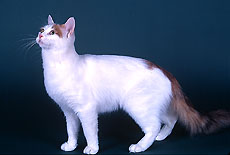
The male Turkish Van is a large, imposing cat while the female is petite by comparison. Both take up to five years to mature fully. The long, sturdy body has a broad chest and a muscular neck and shoulders. The medium-length legs are longer in the back. The wedge-shaped head has high cheekbones, a long nose, and a rounded chin. Its large, expressive eyes are round, and may be either angled slightly or level. The eyes are light yellow, amber, or blue, and its large upright ears sit close together, high on the head.
The Turkish Van's coat has a distinctive pattern of white fur with a blaze of color on its head, a patch of color on its rump extending to the tip of the tail, and one or more random spots of color on its body or legs. The colored patches can be black, blue, tortoiseshell, red, or cream, but for registration the cat is allowed only one color in addition to the predominant white. The long, silky fur is water repellent. Hair on the face is shorter than on the rest of the body. Feathery tufts grow on the ears and between the toes, and long, thick fur covers the tail. A male Turkish Van also has a full ruff, or fur collar, around its neck.