March, life in the Arctic begins a new. Those animals in hibernation, protected in their hideaways against the fierceness of the winter weather, are stirred by the warmth of spring and prepare to emerge. Early sandpipers - the first of the bird migrants - arrive from the south. Seals move to their breeding sites. The southern edge of the pack ice breaks apart and melts again into sea water. Each day lasts three minutes longer than the previous one - more daylight to find food, attract a partner, mate and bring up a new generation of Arctic life.
MOVEMENT IN THE SNOW
On one of the Norwegian Arctic islands of the Svalbard group, on the leeward slope of a snow-covered hillside, something moves below the snow. A moist, black snout pokes a small hole and sniffs the air. Detecting no danger, the animal pushes through , and in a flurry of powdery snow, a large female polar bear breaks out of her self-imposed winter internment. Other polar bears -young females and males - spent the very short days and long dark nights of winter wandering to and fro across the thick, constantly moving ice of the permanently frozen Arctic Ocean, searching for the scant supplies of food. During the worst of the blizzards, they made temporary dens and slept out the storm. At its passing, they stretched, yawned, shook off the snow and ambled away on their hairy-soled feet (good for gripping ice) with the pigeon-toed gait that earned the polar bear the name of 'the farmer' from early Arctic explorers.
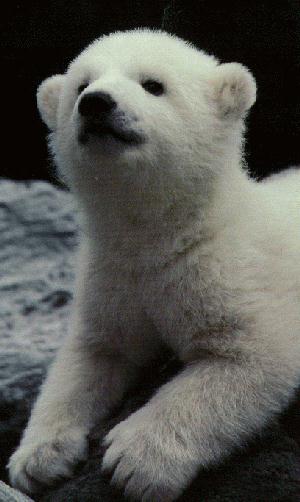
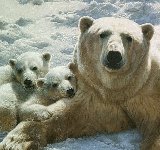
But last November this female bear dug herself a more permanent den in which to sit out the entire winter, for she was pregnant. Her den, dug initially into the frozen ground, became covered by snow-which is a good insulator -and stayed at a temperature up to 21�c (37�F) higher than the air outside. Only a narrow air tunnel linked it to the outside world. On this March morning, three small white heads appear at the breach in the den wall. The cubs were born in the snow den in December, blind, naked and helpless, and each weighing about 1lb (450g). Polar bears usually have one or two cubs - trip-lets are highly unusual. Their mother encour-ages the three-month-old 251b (11 kg) cubs out into the crisp morning air for their first sight of the icy kingdom where they must learn to wrest a living, but for several months "ill depend on their mother for everything. She will continue to suckle them for a month or so, and then they will gradually share her meals of seals and fish. As they leave their winter home, the mother sets out to look for food, followed by the cubs. Since last autumn she has lived solely off her body fat, put on the previous summer, and suckling the triplets with her fat-rich milk since December has severely depleted her reserves.
In the past six months, she has lost at least half of her summer body weight. The triplets tumble down the slope, wrestling together. Their mother cheeks that there is no danger close by, then leads them towards the sea ice. Seals, especially ringed seals, are a favourite food, and during March these seals are having pups in dens on the ice. The mother catches the scent of seals below the snow, and leaps onto the roof of the seal den, shattering it with the weight of her body to reveal the chamber below. With a lightning swipe of her enormous forepaw, the bear scoops out a white-coated seal pup, her first meal of the year. For the rest of the spring and summer, mother and cubs "411 travel as Arctic nomads. Life for the cubs will not be easy. Nearly three-quarters of all polar bear cubs do not survive to be two years old, the age at which they leave their mother and fend for themselves. By the lime they are adult they will measure 8-10ft (2.4-3m) from nose to tail and weigh on average around 70 stone (445kg). Males vie with their Alaskan cousins, the Kodiak grizzly bears, for the title of the world's largest living land carnivore. Female polar bears take their first partner when they are four or five years old, and have cubs every three years, commonly twins. A female may have only eight cubs during perhaps 30 years of life. A mother bear is wary of other polar bears, because a hung adult bear will readily eat helpless cubs.
Mating takes place in April or May. Several bears gather at a temporary meeting place, often a site close to a large congregation of seals. The normally solitary bears are intolerant of each other, and the males have to fight for the right to mate. Competition is fierce, for each spring there are more males than females ready to breed. The size of the males is significant. The bigger and more powerful the male, the better his chances of "inning a female. A triumphant, dominant male chases his chosen partner away from the fray in order to mate without interfer-ence. Afterwards, they part and travel their separate ways. The male takes no further paternal interest in his offspring - indeed, he may even kill them. There are several distinct polar bear populations confined to particular areas of the polar lands and frozen sea. Apart from Svalbard, populations are found in Alaska, northern Canada, Greenland and Siberian islands such as Zemlya Frantsa-losifa (Franz Josef Land). Polar bears do not guard a home range as other carnivores do. The shifting pack ice and ice floes make it too difficult. But their wander-ings are not indiscriminate, as was once thought. Each bear rarely moves more than 100 miles (16okm) from its population centre, although occasionally Svalbard bears have been known to travel long distances from their normal range, ending up near the North Pole or off the coast of Greenland. Some of these bears were fitted with radio transmitters and tracked by satellites as they travelled up to 2,5 miles (4okm) a day over the pack ice. Alaskan bears have been known to go 50 miles (80km) in a day. Polar bears endure the biting polar winds and the icy water with the help of a thick fur coat. Although the hairs of the coat look solid and white, they are in fact hollow and colourless, but reflected light gives them the appearance of fine white fur. Some bears are stained yellow from the fats and oils of their seal prey. Polar bears in the San Diego Zoo in the USA once even turned green because algae began to grow in the hollows of their hairs.
When polar bears pick up a meal in town
Cats and dogs, pigeons and rats, are familiar scavengers in many towns. In Churchill, one of Canada's most northerly towns, the scavengers are polar bears. Churchill lies on the western shore of Hudson Bay, and as the bears travel north in September from their summer feeding grounds along the Nelson river, the town's rubbish dumps offer them food with none of the effort it normally takes to hunt seals. The annual invasion attracts many tourists to the town, although the bears are a nuisance to local people. Particularly aggressive bears are marked with dye so that people know to keep well away from them, and some are tran-quillised and transported out of town. Some bears have fallen victim to poisons picked up from the refuse they eat. As the bears loom on the outskirts of town, winter is already setting in. Sea ice is forming around the edge of Hudson Bay, and when the water freezes over the bears will move out to sea in search of seals. Around 500 bears spend the winter in the bay, forming one of the largest concentrations of polar bears in the world. Camouflaged against the snow by their creamy-while fur, polar bears hunt by stealth, often lying in wait beside blowholes in the ice for seals to come up for breath. As well as patience, the bears have an acute sense of smell, and are said to be able to sniff out seal pups hidden in dens 3ft (1m) beneath the snow. A polar bear occasionally hunts on land, perhaps taking a young musk ox.. Its movements on land are surprisingly swift and agile. On flat ice it can run at 25mph (4okm/h), and at speed can jump over snow hummocks as high as a man's shoulder and leap across distances twice that measure. A polar bear pursued by hunters has been known to take a flying leap of more than 5Oft (15m) into the sea from the top of an iceberg. Unlike other bears, polar bears have fur on the soles of their paws and this helps them to move over slippery ice. Their powerful claws allow them to grip so effectively on hard-packed ice that they can climb steep ice walls.
'Reproduced with the permission from Reader's Digest from the book The Wildlife Year'



[email protected] Katrina