Do you like to go to the beach in the summer, to swim, to play in the sand? I know i do .
and when i go to the beach everything
is fun except one thing:
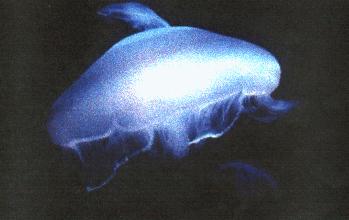
The Jellyfish!
All the time get burned from them
& it destroys all the fun.
So i thought, wouldn't it be nice
if we could know more about them?
That is why i decided to do this
article.
The Jellyfish
Anatomy
The diagram above shows that the jellyfish has a large internal digestive
cavity with
only a single opening. This means that food must enter, and waste and
sex cells
must leave through the same opening. The opening, or mouth is more
or less a
cross shaped, as is the cavity into which it opens. Colia in this cavity
help to
circulate water and dissolved substances throughout.
Below and surrounding the mouth are usually four oral arms; in some
giant Jellyfish,
these oral arms may be enlarged to as much as 40 meters long, trailing
behind the
bell as it pulses through the water. There are also smaller tentacles
fringing the bell
of the medusa. The oral arms bear the infamous stinging cells called
cnidocysts,
which are used both for defense and for paralyzing prey. many jellyfish
cnidocysts
have little effect on humans, but some may injure swimmers, causing
fever,
cramping, or even death. In some cases, the first exposure creates
hypersensitivity
to the sting, such that later exposure results in shock. Even beached
Jellyfish can
be dangerous, since the cells are activated by pressure contact, and
are not
controlled by the jellyfish itself.
Life Cycle
Jellyfish lead a double life, first attached as polyps with tentacles
stretching
upwards, and later as drifting bells with trailing tentacles. Follow
the life of one kind
of jellyfish to see this amazing transformation.
Adult - The adult body is called a Medusa. In adult Moon Jellyfish,
the
clover shaped ring of sex organs in the bell has a pinkish tinge to
it. Males and
females produce sperm and eggs.
Fertilized Egg - Females release eggs fertilized with sperm from male jellyfish.
Planula - Fertilized eggs produce a slipper shaped form, which has beating
hair like
cilia to help it swim. It moves around to find a solid spot on which
it settles.
Polyp - Polyps develop from settled planula, they look like anemones,
with
tentacles pointing upwards. Polyps can survive for several years and
make exact
copies of themselves ( cloning ) by budding new individuals from their
sides.
Because of this asexual reproduction, one fertilized egg can go on
to become many
polyps.
Strobila - This is a polyp which is forming many tiny Jellyfish, like
a stack of
pancakes, on its top. As these break free, the polyp is strobilating.
Each of the many
polyps that could have arisen from the one fertilized egg can pop off
many tiny
Jellyfish.
Ephyra - Only 1/8 inch across, this tiny Jellyfish is often carried
far from its source by
currents. During this stage it begins to develop its feeding structures.
Juvenile - A young Jellyfish is still developing oral arms and tentacles
but looks like
a miniature version of the adults.
Jellyfish as Pets
Jellyfish do not make good pets. Although they have been in the media
recently as
a new trend in aquarium keeping, they are just not suited for family
life. These
animals are very delicate and best suited to a pelagic ( open ocean
) life style.
They require some specially modified aquariums called Crysols, that
are usually
very expensive and complicated.
To minimize damage to the Jellyfish, the water flow in these aquariums
not only has
to keep the Jellyfish in constant suspension, but also be discharged
in a very broad
and evenly distributed manner. Water leaving this aquarium must be
done in a
fashion that does not allow the Jellyfish to be drawn into these exits.
Filtration is similar to a Reef System and water must be free of nutrients
and
particulate matter. Since jellyfish are an invertebrate they will not
tolerate any forms
of toxic metals, especially copper. Water temperature of most Jellyfish
ranges
between 58 and 62 degree's, thus requiring a refrigeration system or
chiller.
Jellyfish require a huge amount of live food. In nature, they eat plankton
and algaes.
In captivity this food must be cultured, and these jellyfish need to
be fed a variety of
algaes ( greenwater ), and enriched brineshrimp called Artemia.
It is best that Jellyfish, for the moment, be left to Public Aquariums.
Although, as
captive breeding and methods for generating the live foods are improved
the time
may come when Jellyfish may be available to the advanced hobbyists.