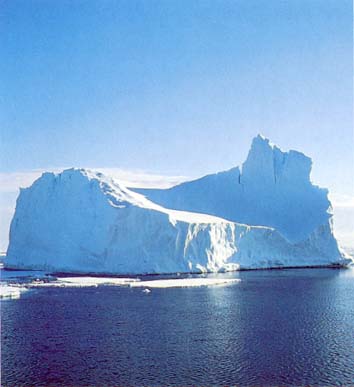
Besides veiling most of the continent with its austere whiteness, the ice cap also forms icebergs when it breaks, owing to tidal motions. As icebergs are massive blocks of ice, their formation is a cataclysmic event. This process is known as calving, where the iceberg breaks off from the ice shelf. The shapes and sizes of icebergs vary greatly, depending on how they calved and its subsequent melting. Their shapes are usually indicative of their age, and can be classified into tabular, irregular or rounded.
Of the massive numbers of icebergs that calve from the Antarctic ice shelves each year, many last for years without melting, although most do eventually. Those that drift northwards melt quickly due to the higher temperatures.
The remarkable shapes of irregular and rounded icebergs are due to their melting below the water surface, and when the berg rotates the sculptured forms show up. Other erratic shapes like castellations may be formed by erosion of waves. Some icebergs also have beautifully coloured bands of ice, in the shades of blue or jade.