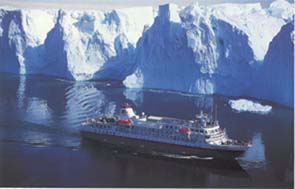
Moving into the new millenial calendar, besides seeking to progress technologically and socially we should not forget to slot in the issue of conservation.
Moving into the new millenial calendar, besides seeking to progress
technologically and socially we should not forget to slot in the issue
of conservation.
The Antarctic is the planet’s last great unknown wilderness, almost
completely untouched by human influence. However, things are rapidly changing,
not exactly for the better, as tourist levels rise dramatically and the
continent finds itself thronged with increasing numbers of visitors each
year. A decade ago, the figure stood at a mere 500 people, last year, numbers
were expected at an astonishing 15 000 and more.
The ecosystem of Antarctica is a fragile one, consequently any disturbance
is likely to be long-lived.
Because of its extreme conditions that renders growth
excruciatingly slow, Antarctica's terrestrial life is radically
sensitive to change. Moss that is trampled by visitors and dies may
take 20 years to fully recover its original size. Footprints left
on the ground can be preserved for decades. Such is the vulnerability
and susceptibility of the driest, highest, coldest and windiest continent.
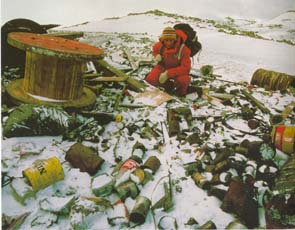 Already
the continent is suffering the impact of human influence, as investigation
teams leave behind piles of junk and garbage. Areas occupied by whaling
stations in the early 19th century are most affected. Today the abandoned
stations, rusty, derelict and weatherbeaten, are relics of the immense
human exploitations of the Antarctic.
Already
the continent is suffering the impact of human influence, as investigation
teams leave behind piles of junk and garbage. Areas occupied by whaling
stations in the early 19th century are most affected. Today the abandoned
stations, rusty, derelict and weatherbeaten, are relics of the immense
human exploitations of the Antarctic.
Taking steps to protect the Antarctic also means making an effort to guard the Antarctic wildlife. Previously the whale and fish stocks were almost completely depleted by commercial fishing activities and are only slowly beginning to recover recently due to concerted conservation efforts of some developed nations. As the millenium approaches we should take care not to repeat the mistakes of the Industrial Age --- of relentlessly taxing the natural environment to the point where it stands no chance of recovery.
By bringing the issue of Antarctica into the limelight, the expedition
helps Singapore learn the vast importance of conservation as a whole. The
dangers of global warming and ozone depletion remind us that what Antarctica
suffers is not merely a localised, isolated problem, but a worldwide,
planetary issue. The breathtaking beauty of the land combined with
the knowledge of its vulnerability and subsequently mankind's ability to
ravage it will most definitely inspire a love for the natural environment.