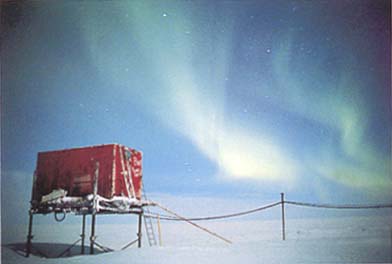
Besides being one of the best places for sky-watching, Antarctica is also home to the spectacular southern auroral lights, the aurora australis. This event is equivalent to the aurora borealis, which occurs in the North Pole. What is it? Scientific research has attributed this to the interaction of solar winds and the Earth's magnetic field. When subatomic particles of the solar wind reach Earth, they interact and excite subatomic particles in the earth's magnetosphere and atoms in the lower thermosphere. Collision causes them to stream down the magnetic axis of the earth, inducing electric disturbances which generate the rainbow-coloured lights of the aurora. Depending on the particular atomic composition of the particles, the aurora takes on different hues of indigo, violet and green.