More Yellowstone National park | |||||||||||||||||
| Wildlife of Yellowstone National Park | |||||||||||||||||
|
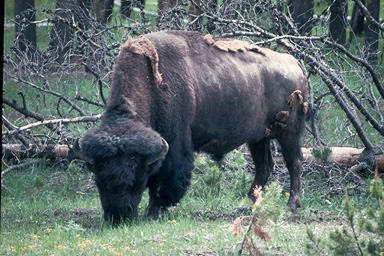
Yellowstone's wildlife is as spectacular as the hydrothermal features. Because of the park's remote location, and because of its large size, animals roam freely and are able to live in a natural way much as their kind have lived for centuries. Large animals in the park are not hunted, herded or fed. Because there are many areas within the park with panoramic views or where meadows break up forested areas it is relatively easy to see the wildlife in its natural state. Many kinds of animals have little fear of people and can be approached fairly closely. The animal which comes first to mind when Yellowsont is mentioned is probably the buffalo, the largest land mammal in North America. [see picture, left]These animals, such as the one pictured at the leftpeacefully munching grass, can be seen all over the park, in herds with many other animals or alone. Moose can also be seen along waterways and in clearings. These large animals may weigh up to 1400 pounds, stnad seven and one half feet at the shoulder, and have antlers which may spread up to five feet. They feed on willows and aquatic vegetation, such as water lilies. The bull below was sighted in the northern section of the park. Wapiti, or elk, are also numerous; about 38,000 of these animals currently roam the park, as their progenitors have done for 12,000 years. Male elk typically weigh 600-1100 pounds and stand five feet at the shoulders. Females weigh from 450-600 pounds. | ||||||||||||||||
| Flora of Yellowstone | |||||||||||||||||
|
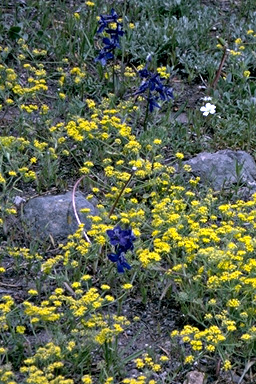
There are lots of wildflowers int he park, particularly late in the spring and early in the summer. The patch of flowers to the left includes lupine and other flowers, such as: Heartleaf Arnica and a Northern Fiary Candelabra. The picture on the left is lupine, seen throughout the west in many national parks. The most numerous of various species of trees in the park is lodgepole pine. This due to the plant adaptations to the climate in the Greater Yellowstone area. Lodgepole pines constitute 75% of all the trees in Yellowstone, which itself is covered by 75% forests, and are amoun the first to colonize open areas after fire. In this picture in a thermal area only the lodgepole pine seems able to survive in adverse conditioins. The importance of the maintentnence of the forests is crutial to the ecology of the park. Naturally occuring forest fires help to aid in this process. In recent memory the even whcih had the greatest effecton Yellowstone National Park is undoubtedly the great fires of 1988. Following one of the driest summers in park history, a number of separate fires were ignited, largely by lightnening. These fires burned across approximately half of the 2.2 million acres in the park, and their remnants are visible everywhere. Amazingly, none of the park's famous attractions were damaged in the fire. The two pictures below, the first near the 600 foot deep Lewis River Canyon and the second of the canyon itself, give some small idea of the magnitude of the devastation. The fires were so powerful they were able to leap across breaks such as provided by this canyon. 9500 firefighters participated in the effort to quell the conflgration, which finally burned out largely from natural causes and the onset of winter. In addtion to the loss of vegetation, some 257 wapiti, 9 bison, 4 deer, and 2 moose were killed, a surprisingly small number given the magnitude of the blaze. However, it is important to understand that forest fire is a normal, natural event and one which is necessary for the health of the ecosystem. Fires of this magnitude occur periodically, if infrequently (the last comparable one occurred in the 1750's). Some vegetation, such as the lodgepople pine, thrives in burned over areas. The seeds of trees like the lodgepole pine are actually released by the heat a fire brings. The degree of regeneration of burned over areas in the time since the fire is very impressive. As a result a huge number of lodgepoles have sprouted, and the clearing of forests have breated opportunities for plants to grow which in turn has created food for elk, moose, bison, and other animals. The aftermath of a forest fire provides snags for birds, recycles nutrients and kills pathogens in soil while changing its properties. | ||||||||||||||||
| The Pituresque Yellowstone River: Hydrology of Yellowstone National Park | |||||||||||||||||
|
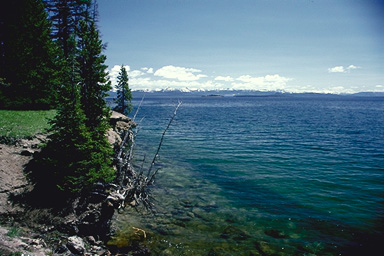
The legendary Yellowstone River inspires awe and reverence. From its source waters high in the Absaroka Mountains to its rendevous with teh Missouri River in North Dakota, the great Yellowstone River remains an uninterrupted free-flowing river for over 600 miles. The Yellowstone River feeds the Yellowstone lake, the largest lake in the world, at 7,000 feet (its exact altitude is 7,733 feet). There are lots of creeks and riversint the park, which can be attributed to the many mountain ranges surrounding the park. Because of the abundant runoff from the geothermal features n this area the river is very warm year round. Never freezing during the winter, it is a popular gathering place for wildlife during that season when the park is dominated by freezing temperatures and deep snow. Cascades and waterfalls are abundant as well. In the central portion of the park is Yellowstone Lake, the largest lake in the world over 7,000 feet (its exact altitude is 7,733 feet). The coast of this lake is over 100 miles in length. The view [see picture, left] looks southwest across the lake toward the Absaroka Mountains in the background. Although the lake was onece twice its present size, it still averages 137 feet in depth with a maximum depth of 320 feet. It is so large that it takes eleven years for all of the water in the lake to be completely recycled. Isa Lake, int he pass between Yellowstone Lake inthe east and the Upper Geyser Basin in the west, lies precisely on the continental divide. Water flows out of the lake both toward the Pacific as well as the Atlantic, although surprisingly (because of the orientation of the lake and the divide here) it is the water at the west end which heads toward the Gulf and at the east towards the Pacific. The canyon and cliffs are basalt columns which are formed as lava cools and contracts. Tower falls, where Toweer creek joins the Yellowstone River southeast of Tower-Roosevelt, is another impressive cascade on the Yellowstone. The water drops 132 feet in this location. The Firehole River: The Firehole River has been a main attraction of the Yellowstone area since its first discovery by explorers. It is famous world-wide as an outstanding trout stream, but it is a trout stream of unusual character, ince it is also a river subject to great thermal "pollution". The Upper Geyser Basin the Firehole is a cold mountain stream, but by the time it reaches Firehole Falls below the Lower Geyser Basin its temparture has been raised almsot 15 degrees C (27 degrees F) as a result of the massive thermal inputs it receives. The single effluent from Ecelsior Geyser Crater in teh Midway Basin increases the teperature of the whole river by 3-4 degrees C (5-7 degrees F). Addtion of thermal water results in marked biological effects. Algae, bacteria, and invertebrates all grow faster and to higher numbers in the heated portions of the river. Although it is commonly assumed that trout cannot live and reproduce in warm waters, they are in fact well established in the Firehole, even in the warmest parts. | ||||||||||||||||
| |||||||||||||||||


|
This page has been visited
|