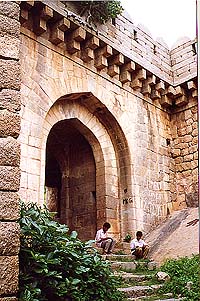
Forts made of rock never crumble away. Bhongir is a small rock fort perched on a massive dome of granite in A.P.State, India.
In medieval times a strategically located fort could easily dominate the surrounding countryside. Firearms and cannon were still in the future, sometime in the 10th century, when a huge dome of massive granite rock with sheer sides was made into a fortress. The rock of Bhongir juts out of the landscape some 50 km from Hyderabad, the capital of Andhra Pradesh state in India.
Way back in the 10th century the area was well forested on all sides. The ancient Buddhist trade route across the peninsula passed by Bhongir rock.
A king named Tribhuvana Chalukya built the fort of Bhuvana giri (Bhuvana's hill ) on the rock in the 11th century a.d. This became Bhongir. He built a stone wall which is still standing, and laid steps through heavy archways and gates right to the top. A deep gash in the rock was dammed up at several places, thus creating a series of reservoirs collecting rain water. Lotuses still grow in the pools today.
Crumbling stucco ruins of a later age still stand, while old
Kannada and Telugu inscriptions vividly bring to light
the daily life of the people of long ago. (Mostly bureaucratic
stuff, extremely familiar to Indians today too).
The Chalukya style of sculpture is distinctive, and was further
refined by their successors, the Kakatiyas. At Bhongir
they have left some stray relief sculptures and inscriptions.
By the 15th century, cannons reduced the strategic importance of massive rock forts like Bhongir. It was ceded to the Bahmani sultans. Gradually it became the seat of a local governor, then a prison for pretenders to the Qutb Shahi sultan's throne. By the 18th century it was merely an interesting curiosity-- the British did not pay much attention to it. After a brief interlude of a bitter communist rebellion in the late 1940's, which destroyed the nizam's archaic state, Bhongir went back to sleep.
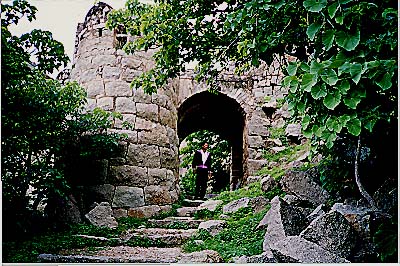 Now only a couple of microwave dishes adorn the top, next
to a ruined mansion. The massive stairways of stone are
still standing, as are the well made walls, bastions
and turrets. The earlier turrets are designed for spears and arrows
and the later ones for muzzle loading guns. Students climb
all the way up here to study because the breeze is very
refreshing. But from the flat plain, the rock of Bhongir
stands grey, menacing and silent, looming over the line of
trains and traffic snaking past, 300 feet below.
Now only a couple of microwave dishes adorn the top, next
to a ruined mansion. The massive stairways of stone are
still standing, as are the well made walls, bastions
and turrets. The earlier turrets are designed for spears and arrows
and the later ones for muzzle loading guns. Students climb
all the way up here to study because the breeze is very
refreshing. But from the flat plain, the rock of Bhongir
stands grey, menacing and silent, looming over the line of
trains and traffic snaking past, 300 feet below.
From the city of Hyderabad to Bhongir the soil and surroundings seem similar, but after Bhongir towards Warangal there is a slight change in the vegetation and soil. The area around Bhongir is rich in historical sights and interesting spots but is almost unknown.
by V Ramchandra Rao
last update: april 1998 e-mail