Sequoyah | ||||||||||||||||||
| The history of the Cherokee genius who created the talking leaves. | ||||||||||||||||||
|
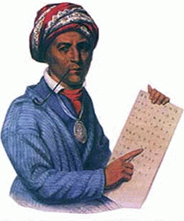
The accounts of the life of the Cherokee genius Sequoyah are numerous as they are varied. One thing is clear about Sequoyah's life. His enormous undertaking in creating a syllabary for his people was historic and provided them with a written language that made the Cherokee literate and resulted in the publication of the first Indian newspaper. Sequoyah was born around 1770 at Taskigi, Tenn., in the old Cherokee country. At an early age, he observed the whites reading from newspapers and books, communicating with what he called "talking leaves." Determined that his people should have their own written language, Sequoyah began working on putting his native tongue to paper around 1809. His manuscripts were pieces of bark, his pencil a piece of charcoal. He spent 12 years developing the syllabary, completing it in 1821. In less than six months, every Cherokee who could speak the language could read it. Illiteracy, following Sequoyah's invention, soon disappeared. Young and old Cherokee discovered that they could learn to read and write in a very short time by mastering the new invention. It was the only alphabet in the whole world to be finished by one man and was so complete that anyone understanding the Cherokee language could read and write it correctly upon learning the 86 characters of the syllabary. He devised a sound for each character. These sounds, when combined, would convey words. A testament to the syllabary's perfection may be seen in the fact that no change, either by addition or elimination has ever been found necessary. . His work on his "talking leaves" exposed him to some ridicule, mostly from his wife. Sequoyah was accused of being possessed by evil and was almost killed in accordance with old tribal customs. He replied to those who thought he was wasting his time, or worse going insane by saying: "It is not our people that have advised me to this and it is not therefore our people who can be blamed if I am wrong. What I have done I have done from myself. If our people think I am making a fool of myself, you may tell our people that what I am doing will not make fools of them. They did not cause me to begin and they shall not cause me to give up. If I am no longer respected, what I am doing will not make our people less respected, either by themselves or others; and so I shall go on and so you may tell our people." Upon completing the syllabary, Sequoyah established a school at his home, for scholars, grandparents, their children and grandchildren, missionaries, white and Cherokee traders, even medicine men, the same medicine who accused him of witchcraft. They finished their educations generally in four days and | |||||||||||||||||
|
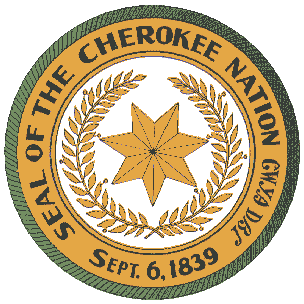
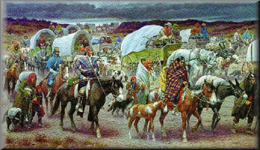
seldom more than a week. He afterwards visited other Cherokee towns on his mission of education. After about a year's work in the eastern Cherokee Nation, all of the Cherokee that cared to had mastered his syllabary, and Sequoyah visited the Cherokees who were then living on their reservation between the Arkansas and White Rivers, in Arkansas Territory. Shortly afterwards he removed his family to that locality, which was known as the western Cherokee Nation. After moving to the west, Sequoyah began using his English name George Guess. He signed the treaty of 1828 with the Western Cherokees using his English name. The year before five verses from the book of Genesis in the Old Testament were published in Cherokee in December 1827. It was the first time the syllabary was printed. The first volume of the Cherokee Phoenix was issued the following year on Feb. 21, 1828, at New Echota, Ga. It was the first ever Indian newspaper published in English and Cherokee Noting the gratifying consequences of Sequoyah's invention, the eastern Cherokee Legislative Council voted to give a silver medal to Sequoyah. It was made under the supervision of Chief John Ross. The medal bore on one side an inscription in English "Presented to George Gist by the General Council of the Cherokee Nation, for his ingenuity in the invention of the Cherokee alphabet." On the reverse side were two pipes with stems crossed and encircled by the same inscription in Cherokee. Sequoyah wore the medal for the rest of his life and it is said to be buried with him. Following the Trail of Tears in 1838-39, Sequoyah, who had never taken part in tribal affairs, was thrust into the role of patriot and worked tirelessly in an effort to merge the eastern and western Cherokee governments in Tahlequah, Okla. Sequoyah, and fellow Cherokee Jesse Bushyhead, were two of the most revered and trusted men by all factions, and their work eventually allowed the Cherokees to reach an "Act of Union," whereby all Cherokees would live under one government. Sequoyah was one of the signers of the Cherokee Constitution signed in Tahlequah on Sept. 6, 1839. A supporter of unification of all Cherokees in Indian Territory, Sequoyah led a party into Mexico in the spring of 1842 in search of those Cherokees | |||||||||||||||||
|
who migrated there in the early 1800s. Accompanied by eight other Cherokees, including his son Teesey Guess, he started to the southwest in an attempt to find a Cherokee settlement that was said to be located in the vicinity of the Rio Grande River in Mexico, now Texas. During the fall of 1843 reports reached the Cherokee Nation that Sequoyah had died, but this was not definitely confirmed for some time. There are many accounts as to where and how Sequoyah died. It was almost two years before the Cherokee Nation received news of Sequoyah's death. Cherokees in Mexico signed a statement certifying Sequoyah died in the town of San Fernando in August 1843. Several attempts to find his unmarked grave have failed, but the monuments to him soar as high as the giant Sequoia redwood trees in California, which were named in his honor, and in the hearts and intellects of the people who were given a written language by a genius who could not read or write English. | |||||||||||||||||
| ||||||||||||||||||

|
This page has been visited
|