XINGYIQUAN
General Overview
Xingyiquan, also known as Form and Will Fist, is a very
ancient Chinese martial art and has held a very high position in
the martial art history of China. During the Qian Long Period of
the Qing Dynasty, Xingyiquan became very popular and quite famous
in Henan, Shanxi, and Hebei Provinces. Over the past one hundred
years, Xingyiquan has had even greater advancements in that the
art has spread throughout the world. Xingyiquan is lesser known
than Taijiquan, but it too is one of the three major branches of
internal martial arts. Xingyiquan is a very effective
self-defense system as well as a way to generate internal energy
(Qi) to promote health and longevity. There are very few books,
in the western world, written on the Xingyiquan style. In
general, the most informative Xingyiquan book out on the market
has been written by Master Liang Shou Yu and Master Yang Jun
Ming. Besides this book, there are very few documents that
reference the philosophy and training methods of this internal
art. Most books discuss the five elements (metal, water, wood,
fire, and earth) and the twelve animals (dragon, tiger, monkey,
horse, alligator, chicken, hawk, sparrow, snake, Tai bird, eagle,
and bear) which are the basis of the style, but few describe
other routines and training techniques within the style. Many
people do not know that Xingyiquan includes many open-hand, two
person, and weapon routines. Some open-hand routines include the
Five Element Linking Fist, the Five Element Creation and
Destruction Fist routines, Za Shi Chui, Ba Shi Chui, the Chicken
Shape Fist, Si Ba Chui, Twelve Hong Fist, Enter/Exit Cave Fist,
Fighting Dragon and Tiger Fist, Eight Character Method, the
Upper, Middle, and Lower Eight Hands, the Great Continuous Fist,
etc.; some two person routines consist of Five Element Creation
and Destruction Fists, Three Hand Cannon, Five Flower Cannon,
Peaceful Body Cannon, Nine Cycle Fist, etc.; and some weapon
routines include the Five Element Linking Broadsword, Three
Harmony Broadsword, Six Harmony Broadsword, Five Element Linking
Straightsword, the San Cai Straightsword, Walking Six
Straightsword, Five Element Linking Staff, Five Element Linking
Spear, the Six Harmony Big Spear, etc.
Health
Benefits
Xingyiquan has many beneficial health promoting functions. It is
very helpful in the strengthening of the muscles within the body
and towards increasing the overall strength of the body. People
who practice Xingyiquan can develop very good muscle tone
throughout the entire body. Xingyiquan masters call this type of
training "the architectural foundation" of the style.
In the movements of Xingyiquan the arms expand and contract while
pressing against the sides of the rib cage causing a
massaging/rubbing action to occur in the various muscle groups.
When the arms rise and lower, there is first an outward spiraling
motion which drills upward and then an inward spiraling and
twisting motion which allows the muscles of the arms and
shoulders to be massaged, toned, and strengthened.
Xingyiquan has very strict requirements towards
stance-work. An example of this can be seen in the advancing
step. The advancing step must be conducted with a large step, the
pace must be very fast, and the landing must be very firm,
stable, and rooted. Under these various demands, the legs will
receive much exercise and conditioning. In the practice of the
Twelve Animal Forms, there are various jumping, sinking, and
quick paced movements which allow the muscles and tendons of the
body to obtain a complete workout.
Xingyiquan also has health promoting effects on the
nervous system. The movements of Xingyiquan stress that the eyes,
hands, feet, and body start and stop at the same time. The arms
and legs must be regulated with the concentration of the spirit
in which the form and mind are in harmony. By doing this, the
mind leads the movements of the external body. This will allow
the brain to be under a controlled state of stimulation during
practice and will have beneficial healing effects on the central
nervous system and the brain. For those who over use their mind
during work or other activities, Xingyiquan can be a way to give
the mind a needed rest.
Xingyiquan also has very beneficial effects on the
internal organs. Xingyiquan stresses that the chest be relaxed
and empty and the abdomen be filled. In this way, the internal
energy will sink down to the lower Dan Tian. This increases the
oxygen capacity of the lungs and strengthens the up and down
motion of the diaphragm. The diaphragm, in turn, will massage the
internal organs within the torso leading to rejuvenation of the
organs and cleansing of the body.
Self-defense
Application
In terms of self-defense, Xingyiquan has an abundant
array of fighting techniques. Within the practice of the
open-hand and weapon routines, there are numerous stance, hand,
and leg methods and weapon techniques which are practical for
developing self-defense skills. Some of these techniques can be
directly applied to fighting situations while other techniques
can be used to enhance training methods for self-defense. The
following uses Beng Quan as one example of Xingyiquan's ability
as a self-defense style.
Beng Quan, also known as the Smashing Fist, is one of the
five element fists found within the Xingyiquan system. Beng Quan
is associated with the wood element. The fist is a very good
example of the power that can be generated from Xingyiquan. Beng
Quan is a powerful fist technique that was used by many famous
masters throughout the history of the Xingyiquan system.
Xingyiquan masters used this fist to defeat numerous enemies.
Most martial artists know of Beng Quan's effectiveness,
but few know the power associated with its body posture, stance
work, and hand methods.
There are many variations of the stance and application
of Beng Quan in the Xingyiquan system, but the most basic
training method is called the Half-Step stance. All other Beng
Quan stances originate from this posture. The Half-Step Beng Quan
posture is called the "mother fist" of Xingyiquan. This
posture was created during the Qing Dynasty. The posture was
developed by a person who was imprisoned in jail where movement
was limited to a small area.
The movement of the Half-Step Beng Quan Posture is as
follows: Stand in the San Ti Posture (Three Body Posture) with
the left foot and fist forward. The right fist is placed at the
waist with the palm side facing upward. When advancing to the
front, the left foot takes a step forward and the right slides
forward. At the same time, the right fist punches to the front as
the arm turns inward. The palm of the fist will be facing to the
left upon full extension of the punch. The left fist is retracted
as the right fist is extended. The left foot should always be
forward while executing this technique. The movement can be
practiced continuously with the left and right fist in a forward
linear direction. The movement will begin to resemble an arrow
shooting out from a bow.
The stance of the Beng Quan uses the Half-Step to advance
forward without the legs ever crossing each other. When the front
leg (left) advances forward, the foot should rise up and then
move forward. The movement should be like an iron spade cutting
forward. The rear leg (right) should spring forward following
behind the front leg. The springing action must use elastic force
to push off the ground like a bow shooting an arrow. The combined
movement of both legs must be fierce and with speed.
Most people consider that Beng Quan is conducted along a
straight line; however, this way of looking at it is actually a
surficial characteristic. The analysis of the fighting motion of
Beng Quan shows that the motion is not along a straight line. The
process contains an arc-like motion. When the fist is prepared to
punch forward, the fist will move along the inside portion of the
front forearm. The inside portion of the arm being punched
forward contains a downward pressing force (Jin); the face of the
fist has a forward pressing Jin; and when the action produces
"Fa Jin", the forearm has both a forward and inward and
a upward rising force (jin), simultaneously. Therefore, in order
to produce these forces within the movement, a straight line
punch can not and should not be produced if properly executed.
Many famous Xingyiquan masters can attest to the motion of Beng
Quan. For example, in 1984 during a Japanese martial arts troupe
visit to Shanghai, there occurred a fight with a Chinese martial
artist. The Chinese martial artist used the chicken style Beng
Quan of Xingyiquan to knock the Japanese several feet into the
air. From this we can see that a simple straight line punch could
not have knocked the person that high.
Five Element
Creation Fist
This following describes the Five Element Creation Fist
routine. The author had the opportunity to study with Master Di
Guo Yong while in Beijing, China in 1992. Master Di is a disciple
of the late Ba Gua Zhang master, Li Zi Ming. He is the
vice-president and secretary general for the Xingyiquan Research
Society and Ba Gua Zhang Research Society which are a part of the
Beijing Martial Arts Association. Master Di is a national martial
arts judge and martial arts coach for the University of Beijing.
The Five Element Creation Fist follows the theory of the
creation cycle of the five elements. In other words, metal
creates water, water creates wood, wood creates fire, and fire
creates earth. The creation cycle has been described in many
articles and books, but few have described the practical training
method for this cycle. Prior to learning this routine, however,
one should become familiar with the Five Element Fists and how
each are independently performed. Following the study of the Five
Elements, one should either learn the Twelve Animal Forms or the
Five Element Linking Fist routine. Both of these routines, again,
have been described in various books and articles.
The following is a detailed explanation of the movements
in the Five Element Creation Fist routine:
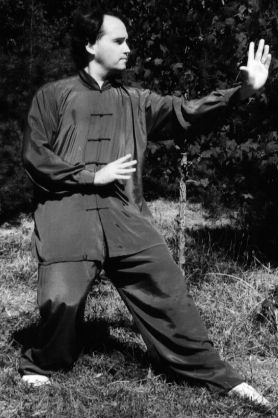
Posture One - Three
Body Posture (San Ti Shi):
The Five Element Creation Fist routine begins as with
most Xingyiquan routines in the Three Body Posture (San Ti Shi).
The San Ti Shi is the most important and most basic training
method in Xingyiquan. All movements in the style do not stray
away from the principles of the San Ti Shi. There is a saying
which states that "ten thousand methods originate from the
San Ti Shi". The San Ti Shi is formed by first placing the
feet together with body erect. The arms hang down beside the
body. The toes of the right foot turn out at a 45 degree angle.
The legs bend at the knees as the weight of the body shifts to
the right leg. The left arm rises up to the front of the chest
with the palm facing down and fingers pointing to the front. The
right hand rises up directly above the left hand (the right index
finger is in line with the left middle finger). Both elbows are
bent. The left foot steps to the front with the two heels in line
with each other. The distance between the two feet should conform
to the length of the lower leg. To check the width of one's
stance, place the knee of the right rear leg down to the ground.
The knee should fall directly next to the left front heel. Should
the distance be different, simply adjust the feet to fit this
width. The knees are bent with the weight distributed 60 percent
on the rear leg and 40 percent on the front leg. Consequently,
this stance is often referred to as the 60/40 stance. At the same
time, the left hand straightens to the front. The fingers point
up with the palm facing out at an angle. The wrist is at shoulder
level. The elbow is bent at an angle of approximately 135
degrees. The wrist of the left arm should be directly above the
ankle of the left leg; the elbow of the left arm should be
directly above the knee of the left leg; and the left shoulder
should be directly above the left hip (Photo 1).
Photo 1
The nose, the index
finger of the left hand, and the toes of the left foot should be
aligned in a straight line. The right hand lowers down to the
front of the lower abdomen. The base of the right thumb is
pressed against the navel. The eyes look in the direction of the
left hand. The head should be held upright with the chin slightly
tucked in. The tail bone should be slightly curled under to allow
the spine to become straight. The chest should be hollowed and
the abdomen should be filled. These requirements should be
maintained throughout the entire routine.
Posture Two -
Splitting Palm (Pi Quan):
The left palm grabs in a downward motion to the front of
the lower abdomen gradually forming a fist. As this occurs, the
waist turns slightly to the left helping the left hand grab
downward. The right palm changes to a fist without moving from
the abdomen. The palms of both fists should face the abdomen. The
shoulders and hips should be squarely aligned with upper body
held upright. The left fist spirals up and out towards the front
of the body. The palm of the fist faces up at an inward angle.
The fist moves up to shoulder level in front of the left
shoulder. At the same time, the toes of the left foot turn out at
a 45 degree angle. Draw the right foot up towards the inside of
the left foot. The right foot should not rise any higher than the
ankle of the left foot. While this is occurring, the right fist
moves up to the inside of the left elbow. The knuckle of the
small finger touches the side of the left elbow. Following, the
right foot makes a large step to the front as the rear foot
performs a follow step forming a 60/40 stance. The right hand
simultaneously spirals up and forward changing to a palm as the
two wrists pass each other. The right palm continues moving up
and then down in an arc to the front. The palm stops in front of
the right shoulder. The left hand forms a palm and moves down to
the front of the abdomen (Photo 2). The posture is identical to
the San Ti Shi as described in Posture One but is performed on
the opposite side.
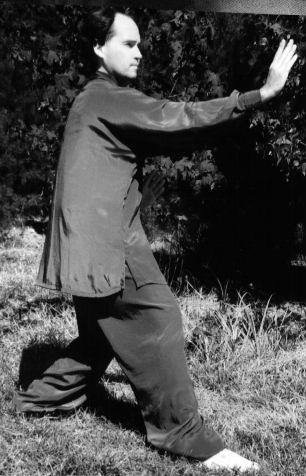
Photo 2
Posture Three -
Drilling Fist (Zhuan Quan):
The right palm turns down and forms a fist. At the same
time, the toes of the right foot turn out 45 degrees. Next,
advance the rear left foot next to the inside of the right foot.
The left palm, at the same time, changes to a fist and moves
directly above the back of the right fist. The palm of the left
fist faces up. Both fists should be at chest level. The next
motion will be to step the left foot forward to form a left 60/40
stance with a follow step from the rear foot. While this occurs,
the left fist will drill up and to the front similar to an upper
cut strike. However, the left fist will spiral and twist out as
it moves to the front. The final position of the fist is at nose
level with the joint of the little finger facing inward toward
the body. The elbow should be bent and sunk down. The
wrist/ankle, elbow/knee, and shoulder/hip joints should be
correctly aligned. As the left fist drills up and to the front,
the right fist draws down to the front of the lower abdomen with
palm side facing down to the ground (Photo 3).
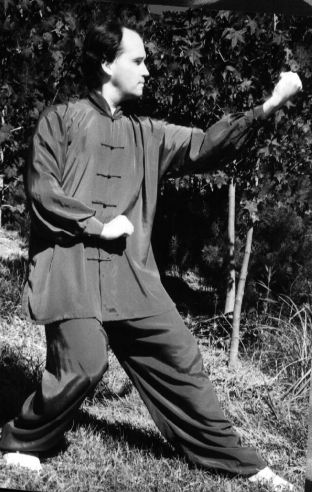
Photo 3
Posture Four -
Smashing Fist (Beng Quan):
The left foot takes a half step to the front as the left
fist lowers directly down to upper abdomen height. The left foot
remains pointing to the front. The palm of the right fist turns
to face up and moves near the side of the left elbow. The right
foot steps next to the inside of the left foot and then stomps
down directly beside the left foot. At the same time, the right
fist follows along the upper side of the left forearm with the
palm side of the right fist facing up. The palm side of the right
fist turns to face to the left as it passes over the left wrist.
The fist continues to move out at chest level until final
extenuation as shown in Photo 4. The left fist draws back and
down near the front of the lower abdomen. Palm side faces in
touching the body.
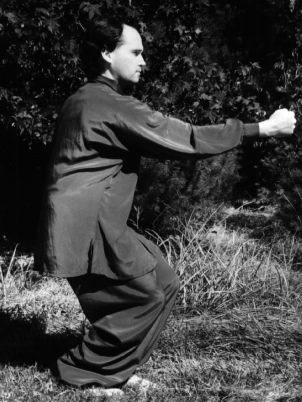
Photo 4
Posture Five -
Pounding Fist (Pao Quan):
The left foot steps out at a 45 degree angle to the left
as the right fist draws back towards the lower abdomen. Palm side
faces in towards the abdomen. At the same time, the right foot
steps next to the inside of the left foot. Following, the right
foot steps out to the right at a 45 degree angle as the left rear
foot conducts a follow step. This will form a 60/40 stance. While
this occurs, the right fist spirals out and moves up next to the
right side of the head (one fist away from the temple). The palm
side of the right fist faces out. The left fist punches out from
heart level along the center line of the body (Photo 5). The
motions of the right and left hand should be conducted together
in one motion.
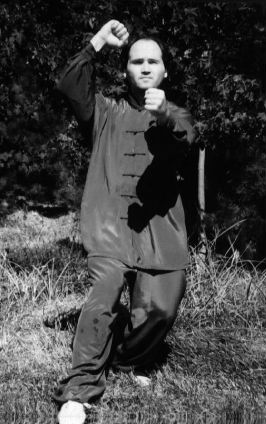
Photo 5
Posture Six -
Crossing Fist (Heng Quan):
The right foot takes an additional half step 45 degrees
off the center line. The left foot steps next to the inside of
the right foot. At the same time, the right fist circles to the
rear and then down to the side of the body. The palm side faces
up as it passes the waist. The right fist continues moving until
it is directly below the elbow of the left arm. The palm side of
the left fist turns to face down while the arm remains
stationary. Next, the left foot steps to the left at a 45 degree
angle from the center line as the rear right foot conducts a
follow step to form a 60/40 stance. While this occurs, the right
fist crosses underneath the left arm as it moves out to the front
at shoulder level. The left fist draws down towards the front of
the lower abdomen with palm side facing down (Photo 6).
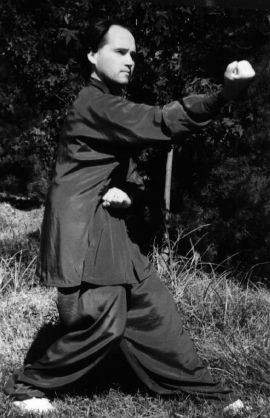
Photo 6
In order to turn around and return to the original
starting position, simply hook the left foot over to the right
corner to form a T-step with the right foot. The body will turn
to the right to face in the opposite direction. The right foot
turns out 180 degrees. The left foot steps next to the right foot
as the left hand moves next to the inside of the right elbow. The
right arm remains stationary in the Crossing Fist position. The
left foot steps forward as the left palm performs the Splitting
Palm on the left side as described in Posture One. Next, repeat
Postures Two to Six to return to the starting position. This
completes the Five Element Creation Fist routine.
Once one side has been mastered, begin to practice this
routine on the opposite side to balance out both sides of the
body. This routine can be performed in various manners based upon
one's physical condition. Younger, more energetic individuals can
practice the Five Elements with explosive force (Fa Jin) thereby
enhancing the strength of the body. Individuals who are
physically weak and/or those who are older can perform Xingyiquan
much slower and with more relaxed motions to enhance the flow of
internal energy. Individual stances can also be held for a set
period of time to help strengthen the legs and as a meditation
technique to circulate the internal energy throughout the body.
Return to Homepage