

 Carnations
Carnations originate primarily from the Mediterranean region and are a member of the Caryophyllaceae family. Many continue to refer to Carnations as "Pinks" because the petal edges are serrated like they were cut with pinking shears, scientifically the name comes from the Greek word Di (of Zeus & Jove) and Anthos (a flower). A single, large bloom is present on a sturdy stem. Available year-round in a wide array of solid and variegated colors that carry a fragrance reminiscent of cloves. A Carnation is representative of the month of January. According to the Victorian language of flowers, yellow represents disdain, purple antipathy, striped refusal and red means alas for my poor heart.
If present, remove the rubber band which holds the bunch together and re-cut the stem ends between the nodes, (thickened segment of the stem). Remove any foliage that will fall below the solution level of the container. Place in a clean vase that contains warm preservative solution which was mixed according to the manufacturer's recommendations.
Carnations are ethylene sensitive and are usually treated with Silver Thiosulfate STS at the grower level during hydration to help protect against this naturally occurring gas. If a more open flower is desired the opening may be enhanced by the immersion of the stem ends in a 7.0% sucrose solution that contains a biocide.
This all purpose flower can add height or width to any arrangement. With the wide assortment of varieties available, Carnations will work with any color scheme. This flower presses or dries well. In 1907 a Pink Carnation became a symbol of Mother's love and was chosen as the emblem of Mother's Day. The Carnation is believed to have medicinal value in the treatment of heart disease.
~My Language~
I think carnations are a beautiful flower, and I rather prefer them to the more expensive, rather blown out of proportion Rose. In fact, Miss KittyMouse used them in her bridal bouquet last May, and they did a much lovelier job at accentuation then any Rose would have. I think they have a Lovely aroma, and they do last quite a while. They are so soft and delicate, and MUCH MUCH more cost friendly then some stinky old Rose.

Not much can be found on the Iris. I can tell you it grows from a bulb, and that Irises are wonderful garden plants. You can certainly find some that will grow for you, if you just give them light. Some grow in deserts, some in swamps, some in the cold far north, and many in temperate climates. Iris means rainbow, and that's because irises come in so many colors: blues and purples, whites and yellows, pinks and oranges, browns and reds, and even blacks. They are beautiful beautiful plants, and there are a few good sites out there on them, such as [The Home Page for Irises!]
 Gerber Daisies

a.k.a. Gerbera Daisies, Gerbera jamesonii
~Technically Speaking~
In the gardens of mild-climate areas gerbera daisies offer a continuous display of blossoms from spring to late fall. Their long-lasting 4- to 5-inch blossoms are borne on leafless 12- to 18-inch stems, and their colors range from white through cream, yellow, orange, pink, salmon and rose to red. The flowers may be singles, with one ring of petal, or heavily petaled doubles. The 8- to 12-inch leaves are shallowly lobed, dark green above and woolly white beneath, and rise directly from the ground.
~HOW TO GROW~
Gerbera daisies can be grown in Zones 8-10. They need full sun, except in very hot areas, and a moist well drained soil liberally supplemented with peat moss or compost. Plant gerbera daisies 12 to 15 inches apart, setting the crown, or top of the root structure, level with the surface of the soil. Feed the plants every other month from early spring to late fall by scattering a handful of 5-10-10 fertilizer around each plant and scratching it into the soil. New plants may be started from divisions of clumps in spring. Clumps should be divided when they become overcrowded, usually after three or four years of flowering.
~My Language~
Gerber Daisies are BEAUTIFUL! They are the MUCH bigger, much more colorful version of a daisy. They are huge and look WONDERFUL in an arangement, adding a very nice twist to a classic arrangement.. All in all, they are just pretty to look at!
 Periwinkles
V. major (greater periwinkle); V. major 'Variegata' (variegated periwinkle); V. minor (common periwinkle, creeping myrtle)
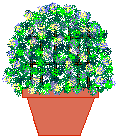
Flowering evergreen periwinkles have rooting stems that quickly spread to cover bare ground in sun or shade. Growing up to 5 feet long, periwinkles can also serve as trailing plants for window boxes, outdoor tubs and hanging containers. Greater periwinkle is hardy in Zones 8-10; its stems send out shoots up to 3 or 4 feet long and bear 1- to 3-inch oval leaves. Variegated periwinkle has green leaves with creamy white edges and markings. A perennial in Zones 9 and 10, it is grown as an annual in colder areas. Common periwinkle is hardy in Zones 4-10. Grown often as a ground cover, it has glossy oval leaves up to 2 inches long on shoots that form a mat 6 inches high. In early spring all three vines produce lavender-blue flowers 3/4 to 2 inches wide.
~HOW TO GROW~
Periwinkles grow best in deep moist soil enriched with organic matter but will tolerate poor soil. In Zones 8-10 they thrive in partial to deep shade; in Zones 4-7 they grow well in partial shade or full sun. Set out plants that will be grown as annuals after all danger of frost is past, spacing them 6 inches apart. Periwinkles to be grown as perennials may be planted in spring or fall; space them 6 to 12 inches apart. Mulch new plants to conserve moisture. Pinch back young shoots frequently to encourage bushiness. Large expanses of periwinkle may be sheared occasionally to induce new growth. Once established, periwinkles need little care and are seldom bothered by pests. Propagate by division in the spring or by cuttings at any time.
My Language~
Again, these are beautiful flowers to look at and they smell WONDERFUL!! They grow easily, if well taken care of. A wonderful garden plant.
 Dandelions
Suggested to gardeners with misgivings, this well-known weed, so often considered a troublesome pest in the garden and lawn, is actually a valuable salad herb, rich in vitamins A,B, C and D. In France, the young, tender leaves are especially popular and the root--like the root of its close relative chicory--is roasted as an additive for coffee. Dandelion is a perennial 2 to 12 inches tall whose deeply serrated, dark green leaves inspired the French name "dent de lion" or lion's tooth. Its golden yellow flowers, among the first to appear in the spring, bloom on solitary, hollow stems, and quickly turn to fluffy puffballs, scattering hundreds of seeds in the wind. Seeds germinate in only three days, which explains the plant's rapid proliferation.
~HOW TO GROW~
Dandelion is hardy throughout the
United States and adapts to any soil conditions including
very poor ones. However, to produce the most tender
leaves, plant dandelions in rich, moist soil. Seed catalogs
include selected, large-leaved types of dandelion. Sow
dandelion seeds in spring or fall in an isolated part of the
garden where they can be controlled. Cut flower heads
before they open to increase the plant's production of salad
greens. The tender leaves can be cut at anytime, but their
flavor is best in the spring when they first appear.
~My Language~
Ahhh, dandelions, the gardeners pest. I for one have always taken a liking to them, no matter how ugly they are. The delicate roundness of the white snow like pods, they always left a dusting on the front lawns in Texas, summertime snow my friends and I would call it. Well, weed or not, I like em, and they aren't hard to get going at all.
 Daisies

a.k.a.Chamomile, Anthemis
~Technically Speaking~
This aromatic, low-growing perennial makes a soft, lush ground cover long used as a grass substitute in the lawns of Europe. It can be mowed and tolerates light foot traffic. The whole plant has a pleasantly pungent fragrance. The stems lie flat and creep along the ground, rooting as they go, creating a feathery gray-green mat 3 to 10 inches high, depending upon the fertility of the soil. During midsummer, flower stems rise 12 to 14 inches high and bear 3/4-inch white daisy-like blossoms. The oil of chamomile blossoms has found many uses, from a rinse for lightening and softening the hair to a flavoring for sherry. Chamomile blossoms make a pleasant and soothing tea.
~HOW TO GROW
Chamomile grows in Zones 3-8 in almost any moist but well-drained soil. Though it will tolerate some shade, it does best in full sun. Plants are most easily propagated from root divisions, taken in the fall or early spring. To grow from seed, sow indoors in midwinter on a sunny window sill and transplant to individual pots when the first true leaves appear. Set the new plants outdoors in the spring, as close as 4 inches apart for ground cover, 8 and 10 inches apart for row planting. Keep the soil moist but not soggy until the plants are established.
~My Language~
Oh the Daisy, there are so many different kinds, just one search brought up 54 articles about that one "type" of plant. The ones I prefer, as does Miss KittyMouse, is the "Chamomile" kind....it has a very relaxing aroma and while it's not very pretty, it does have it's own unique characteristics.
 Bachelor's Buttons
a.k.a. Centaurea, or "Cornflower"
~Technically Speaking~
Within this large genus of plants is one of the world's most widely grown annuals--the cornflower. Its cheerful, ragged blossoms, about 2 inches across, are at home in temperate-zone gardens around the world. Besides the old favorite blue cornflower, there are newer varieties in pink, red, maroon, lavender and white. They bloom so prolifically with so little care that they often are the first plants that children grow on their own. Cornflower blossoms are borne on plants from 1 to 3 feet tall, contrasting with the gray-green foliage. The name "cornflower" comes from the fact that the plant grows wild in the grainfields of southern Europe. Two close cousins of the cornflower are the basket flower and sweet sultan. The basket flower gets its name from the fact that the flower buds appear to be encased in little baskets; the opened blossoms look like cornflowers but are much larger--4 to 5 inches across, on plants that become 5 or 6 feet tall. Basket flower blossoms may be pink, white or lavender. Sweet sultan, from the Near East, bears fuzzy 3- to 4-inch blossoms, delicately scented, in shades of yellow, pink or lavender as well as white; it grows 1 1/2 to 3 feet tall.
~USES~
The flowering kinds of Centaurea are effective when massed for color in beds and borders, in foregrounds or backgrounds, depending on the height specified on the seed packet.
~HOW TO GROW~
Sow cornflower seeds outdoors any time in the fall, so they will start to grow before the first frost is expected; fall seeding in any zone will produce plants that will start to bloom early in the spring. Or sow seeds in the garden in the spring as soon as the soil can be spaded and raked. Seeds may also be sown indoors about a month before the last frost is expected; transplant the seedlings into the garden when the ground can be spaded and raked. Plants should stand about 12 inches apart. Sow sweet sultan and basket flowers outdoors as soon as the soil can be cultivated, spacing them so plants will stand 6 to 10 inches apart.
~My Language~
There isn't much I can say about Bachelor's Buttons, I haven't worked with them much, but I do know what a beautiful filler they can be on arrangements and such, and they don't smell like anything to me. As a dried arrangement, they don't change very much. To dry a bunch of flowers, tie them tightly at the stem with a natural kind of string, you know the one, I just can't think of the name, not too tight, you don't want to break it, and just tie it up from the ceiling like, in a bathroom, in a dark area, a closet would be fine. Just tie it to the rack in your closet, and don't mush them all up with your clothes, they need room to dry out. Hang them up for about....oh......a month, and they will be pretty dried out. There is also a spray you can buy to ensure they don't become brittle, I can't remember where you get it, a craft store I think. My aunt is a florist, I'll have to ask her. Otherwise, you have to be VERY gentle with them. I'll get back to you on that.
I'll have to finish up later, it's late here, and I need my sleep.
Untill next time!
A good place to visit to get answers from everyday gardeners would be
the
[VegSource.Com Posting Board] where you can ask all kinds of
gardening and flower questions, and hopefully get a response from
someone who's had experience with that particular problem. But, don't
forget to bookmark it, so that you can check back in a couple of days and
see what's been said!