Animation showing the moon moving around the planet Neptune
Some very interesting facts and figures
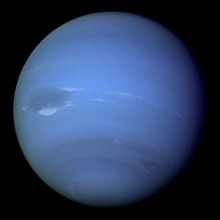
Neptune is the eighth planet from the sun and the fourth largest (although its mass
is slightly larger than Uranus'). Like the other gas giants, it has an atmosphere
rich in hydrogen and helium, but also contains about 1% methane which is responsible
for its blue colour. In 1846, French astronomer Urbain Jean Joseph Leverrier calculated
that Neptune must exist from perturbations in Uranus' orbit. Johann Gottfried Galle, a
German astronomer observed the planet the same year within 1� of its calculated
position.
It is not visible with the naked eye, but you may be able to spot it with binoculars
if you know where to look. Most of what we know today about Neptune comes from an
encounter that Voyager 2 had with the planet in 1989. In 1979, it was actually
the farthest planet from the sun, because Pluto's eccentric orbit cut inside that
of Neptune. In 1999 it once again placed rank as the eighth planet
when Pluto moved back outside of Neptune's orbit.
In many ways Neptune is similar to Uranus, but unlike Jupiter and Saturn its structure
is less layered. It likely has a very thick and roughly uniform composition of water,
ammonia and methane ice mixed together with hydrogen, rock and small amounts of helium
surrounding a small rocky core about the size of Earth. Since its surface temperature
is higher than expected for a body so far away from the sun, it must have an internal
heat source. Mysteriously, it also has a significant magnetic field, but it is tilted
considerably from the planet's rotational axis and is off center.
Typical of any gas giant, Neptune has bands of strong winds reaching 2000 km/hr (1250 mph),
the fastest in the solar system. Voyager photographed a Great Dark Spot of swirling gases
in its southern hemisphere that is similar to Jupiter's Great Red Spot. Observations from
the Hubble Space Telescope however, indicate that it has since disappeared. Late in 1994
Hubble discovered that another dark spot had appeared in its northern hemisphere.
The atmospheric composition is approximately 80% hydrogen, 19% helium and 1% methane. It
is the methane that is responsible for Neptune's deep blue colour.
Neptune has at least four rings which are far too faint to be seen from
earthly telescopes. The Voyager 2 spacecraft is credited with identifying
them. The outermost ring, called Adams, is narrow and thin and its material
tends to clump into "ring arcs".








 Neptune is the eighth planet from the sun and the fourth largest (although its mass
is slightly larger than Uranus'). Like the other gas giants, it has an atmosphere
rich in hydrogen and helium, but also contains about 1% methane which is responsible
for its blue colour. In 1846, French astronomer Urbain Jean Joseph Leverrier calculated
that Neptune must exist from perturbations in Uranus' orbit. Johann Gottfried Galle, a
German astronomer observed the planet the same year within 1� of its calculated
position.
Neptune is the eighth planet from the sun and the fourth largest (although its mass
is slightly larger than Uranus'). Like the other gas giants, it has an atmosphere
rich in hydrogen and helium, but also contains about 1% methane which is responsible
for its blue colour. In 1846, French astronomer Urbain Jean Joseph Leverrier calculated
that Neptune must exist from perturbations in Uranus' orbit. Johann Gottfried Galle, a
German astronomer observed the planet the same year within 1� of its calculated
position.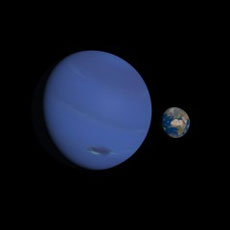 In many ways Neptune is similar to Uranus, but unlike Jupiter and Saturn its structure
is less layered. It likely has a very thick and roughly uniform composition of water,
ammonia and methane ice mixed together with hydrogen, rock and small amounts of helium
surrounding a small rocky core about the size of Earth. Since its surface temperature
is higher than expected for a body so far away from the sun, it must have an internal
heat source. Mysteriously, it also has a significant magnetic field, but it is tilted
considerably from the planet's rotational axis and is off center.
In many ways Neptune is similar to Uranus, but unlike Jupiter and Saturn its structure
is less layered. It likely has a very thick and roughly uniform composition of water,
ammonia and methane ice mixed together with hydrogen, rock and small amounts of helium
surrounding a small rocky core about the size of Earth. Since its surface temperature
is higher than expected for a body so far away from the sun, it must have an internal
heat source. Mysteriously, it also has a significant magnetic field, but it is tilted
considerably from the planet's rotational axis and is off center.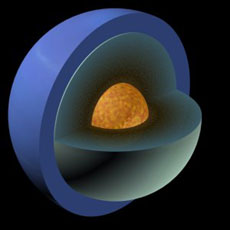 Typical of any gas giant, Neptune has bands of strong winds reaching 2000 km/hr (1250 mph),
the fastest in the solar system. Voyager photographed a Great Dark Spot of swirling gases
in its southern hemisphere that is similar to Jupiter's Great Red Spot. Observations from
the Hubble Space Telescope however, indicate that it has since disappeared. Late in 1994
Hubble discovered that another dark spot had appeared in its northern hemisphere.
Typical of any gas giant, Neptune has bands of strong winds reaching 2000 km/hr (1250 mph),
the fastest in the solar system. Voyager photographed a Great Dark Spot of swirling gases
in its southern hemisphere that is similar to Jupiter's Great Red Spot. Observations from
the Hubble Space Telescope however, indicate that it has since disappeared. Late in 1994
Hubble discovered that another dark spot had appeared in its northern hemisphere.