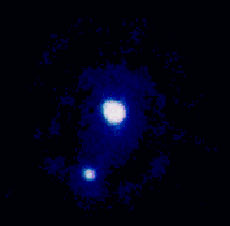
Animation showing the moon moving around the planet Pluto
Some very interesting facts and information
Since 1999, when Pluto moved outside of Neptune's' orbit, it has been the farthest planet
from the sun as it usually is. For a period of time (approximately 20 years) it is only
second farthest. Little is known about this tiny planet, and no Earthly
spaceships have yet visited it. Pluto is unusual for several reasons. Besides being
smaller than seven of our system's moons its orbit is highly eccentric and highly inclined
and its axis is tipped far from the perpendicular. It does not fit tidily into the
categories of terrestrial or jovian worlds. It could be that Pluto is an asteroid or
an object from the Kuiper Belt, but traditionally it is still recognized as a planet.
Because its moon Charon is quite large by comparison
(approximately one half the size of Pluto), the Pluto/Charon pair are often considered a
double planet.
Most of what we know about Pluto has been from observations in 1978 when Charon was
discovered. At that time the orbit of Charon and Pluto around each other was such that
they alternately passed in front of each other and measurements were taken from their
mutually occulting brightnesses. From this data, astronomers have been able to map
light and dark areas of both bodies.
In 1930 calculations were made that predicted the existence of a ninth planet. These
calculations were based on the orbits of Uranus and Neptune. Clyde W. Tombaugh is
credited with discovering the planet after surveying the sky from Lowell observatory
in Arizona. The calculations however, were later discovered to be erroneous and
Voyagers' measurements of Neptune's mass actually accounted for the perturbations that
Pluto's existence was to account for. Nevertheless, Pluto exists as the ninth and last
planet in our solar system.
Very little is known about the distant planet but estimates of its density
(2g/cm3) suggests that it is perhaps 70% rock and 30% water
ice. The bright areas, have been postulated to consist of frozen nitrogen,
solid methane and carbon dioxide. Its thin atmosphere is likely a
combination of nitrogen, carbon monoxide and methane. Its eccentric orbit though,
means that the atmosphere would only exist at perihelion and would freeze as it
moves away from the sun.
Charon's size is considerable when compared to Pluto and both bodies are incredibly close
to one another. Astronomers have been able to determine the combined mass of Pluto and
Charon, but neither one has been determined with sufficient accuracy by itself. Both
bodies orbit each other at a distance of about 19640 km (12275 mi) and each is synchronous
with the other; that is, each keeps the same face pointing towards its neighbour throughout
their mutual revolution. Charon is approximately one half the size of Pluto making it the
largest moon relative to its primary.








 Since 1999, when Pluto moved outside of Neptune's' orbit, it has been the farthest planet
from the sun as it usually is. For a period of time (approximately 20 years) it is only
second farthest. Little is known about this tiny planet, and no Earthly
spaceships have yet visited it. Pluto is unusual for several reasons. Besides being
smaller than seven of our system's moons its orbit is highly eccentric and highly inclined
and its axis is tipped far from the perpendicular. It does not fit tidily into the
categories of terrestrial or jovian worlds. It could be that Pluto is an asteroid or
an object from the Kuiper Belt, but traditionally it is still recognized as a planet.
Because its moon Charon is quite large by comparison
(approximately one half the size of Pluto), the Pluto/Charon pair are often considered a
double planet.
Since 1999, when Pluto moved outside of Neptune's' orbit, it has been the farthest planet
from the sun as it usually is. For a period of time (approximately 20 years) it is only
second farthest. Little is known about this tiny planet, and no Earthly
spaceships have yet visited it. Pluto is unusual for several reasons. Besides being
smaller than seven of our system's moons its orbit is highly eccentric and highly inclined
and its axis is tipped far from the perpendicular. It does not fit tidily into the
categories of terrestrial or jovian worlds. It could be that Pluto is an asteroid or
an object from the Kuiper Belt, but traditionally it is still recognized as a planet.
Because its moon Charon is quite large by comparison
(approximately one half the size of Pluto), the Pluto/Charon pair are often considered a
double planet.