 THE
JOE
E. BROWN PAGE
THE
JOE
E. BROWN PAGE
 GLIMPSES
OF A LIFE GLIMPSES
OF A LIFE
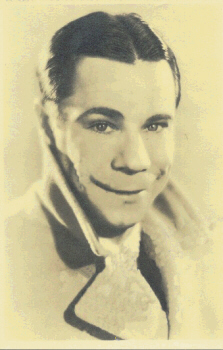
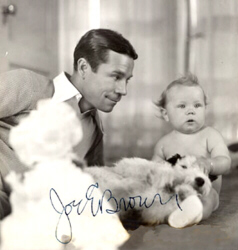
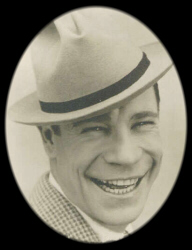
Taken from Laughter is a Wonderful Thing by Joe E. Brown as told to Ralph Hancock (1892-1973) Joseph Evan Brown was born to Mathias and Anna Brown on July 28, 1892. He was the third of five boys and two girls. At the age of ten, he joined the acrobatic team of the Marvelous Ashtons and performed in the circus for $1.50 a week. Perfecting his act he would later make a buck more. However, his time with Billy Ashe would end soon after their survival of the San Francisco earthquake and fire. He was fourteen years old when he returned to Toledo. Joe turned to what was the great love of his life, baseball. He was the youngest player on the Young Avondales, organized by Ollie Pecord, the bar tender at Colonel Bolen's Bar. Ollie later got him employment as a baseball player in the semi-pro Trolley League. Although small of stature, his athletic abilities came in handy. However, he soon returned to an acrobatics act, this time with Tommy Bell and Frank Prevost, calling themselves the Bell-Prevost Trio. He was making $7.50 a week and thought he was doing pretty well. Unfortunately, Bell turned out to be more physically harsh than Ashe, and faulted Joe for failed tricks, even though Bell missed practice sessions. Bell would prove himself as particularly untrustworthy. Finishing his somersault after Bell threw him into the air, Bell just walked and Joe saw himself, too late, falling toward the hard platform. Joe broke his leg and the act broke up as well. Frank Prevost, old enough to be his father, took Joe to his home in Jamaica, New York, to mend. Prevost would suggest that Joe try his hand with comedy in Burlesque. He slowly perfected his comedy, dressed up, but somewhat askew, and spoke in a high squeaky voice. He developed "an expression of super-idiocy" that amused the audience, an accentuated sneeze and the technique of double-talk. Playing baseball with the St. Paul team during the off summer season, he tried to comply with a signal not to slide into third base, but it was too late and he hit the ground awkwardly. Joe's leg was broken again. Joe tells us: "I was playing with a Toledo team, Needham's All-Stars, at Weston, Ohio, July 3, 1910, when I got one more broken leg." Joe loved baseball, and played on just about every Toledo team, but show business usually paid better. He became a good friend to the legendary John L. Sullivan who used his clout to get Joe released on bail for crossing traffic on a bicycle. While traveling on the Canadian National train, he became acquainted with Kathryn McGraw. He had never had a serious relationship with a girl, and this one after much correspondence on the road resulted in marriage. He received her answer while performing in Baltimore, MD. During the summer he made between three and twenty dollars a game playing baseball. While hanging out at a cottage on Lake Erie owned by a baseball pal, he yelled repeatedly for his friend Larry Gazzola to join him for an early swim. "I opened my mouth slowly and at the same time began a long, drawn out yell that ended with my mouth open. People's heads popped out of tents and cottages for blocks up and down the beach. And that's how the yell that was later 'heard around the world' got its start." Joe possessed decided values. He did not believe routines and jokes had to be obscene to be effective. He took care of his mother and Kathryn with immense devotion. Here is an extended passage: I knew she wanted a church wedding. With her family background it was almost a necessity. But with less than 100 dollars in my whole world, I couldn't afford to be married on such a grand scale. But on the subway that took us back to Times Square, I put my arms around my wife and said, "Kathryn, someday we'll have a real wedding. It'll be in a church, with organ music and flowers and all the rest." She said, simply, "Thank you, Joe."When his wife became pregnant with their first child he returned to Toledo and managed a bowling alley. Don was born on Christmas day, 1916, when Joe was 24. Joe got sick in the delivery room and passed out with news of the birth. He tried his hand at the Electric Auto Lite factory, but it did not work out. Returning to show business, he did one more season with Prevost and then decided to try and make it as a comedian in Burlesque. He would only accept jobs if there was no off-color stuff. Meanwhile, his wife was pregnant again and in 1918 gave birth to Joe Leroy. John Cort, the producer of Listen Lester, a broadway hit, was taking the show on the road, an impressed with Joe, offered him the part of Lester at $150 a week. He was to take over the role on August 7, 1919, but Equity called a strike. Going with the strikers, he lost the role and he was left impoverished. If that was not bad enough, his father died. Fortunately, when the strike ended he was again offered the part and played it to good reviews. He performed Jim Jam Jems that opened at the Cort Theatre on October 4, 1920. Joe received three raises-- from $200 to $250 to $400 to $500 a week. He was a star with his name in lights. He would be paid $1,000 to do Greenwich Village Follies, that opened in Atlantic City on August, 1921. He had a great run in the revived show, Captain Jinks, voted the best musical of 1925-26. 1926 saw the death of Joe's best friend, Frank Prevost. Joe would do one more show on Broadway, Twinkle Twinkle. After a long run, Joe moved to Los Angeles. Joe would be doing movies! Along with success, he enlarged his family. Moving into a house in Hollywood, they took in Mike Frankovich in 1930. He was just a few years older than his sons. Later they adopted a baby girl, Mary Elizabeth Ann. A year later they decided to adopt another child, Kathryn Frances. By now Joe was a top star at Warners, getting $100,000 a picture. During his career he made many films and took great personal risks. He filmed with a bear that he later discovered to be a proven man killer. He also made some films about which it is difficult to find information about today. For instance, his film SQUARE CROOKS made in 1932, what was it about? Are their any prints or videos available. Many of the old films are extremely hard to find. Joe loved children and they loved him. He relates the following: "One mother wrote that she and her young daughter had just seen one of my pictures. As they came out of the theatre after the show, the child-- just six-- said to her mother, 'Mommy, when Joe E. Brown dies, will he go to heaven?' 'Why of course darling,' replied the mother. 'Golly, Mommy,' the child said, 'won't God laugh!'" Joe was conscious of the goodness in innocence and never used the words "hell" or "damn" in any of his shows. He even inspired others, like Harry "Hennie" Cooper to clean up his Burlesque act. Joe often turned to plays and shows in the off season. Joe collected all sorts of important sports memorabilia, eventually donating much of it to U.C.L.A. Many do not know that he was once offered a contract himself to play with the New York Yankees. However, he turned it down because he was making headway on Broadway. His dear friend Lou Gehrig, suffering from multiple sclerosis, gave him the first baseman's glove with which he played his 2,130 consecutive games. It meant everything to Gehrig, but he wanted to make sure it would pass into hands that would truly cherish it. Joe kept these many trophies in his Room of Love. Joe's contract with Warner Brothers stipulated that Joe was to be supplied with a baseball team, a strange clause indeed. Joe E. Brown's All Stars was composed of professional athletes. He bought into the Kansas City Blues in 1933. Joe had also been the owner of a racing stable, although he attests that his horses were as slow as they come. When his boys attended U.C.L.A., he was on campus a great deal. His popularity was such that he was invited to join his son's fraternity, Zeta Psi. Although he lacked a high school diploma, he enrolled in the school to make this possible. He broke the Physics class up so, the professor promised him an 'A' if he would avoid class. Switching agents, he contracted to do six independent pictures for $100,000 each. However, none of the films were up to the standards set by Warners. Joe had suffered a double hernia on the set of THE GLADIATOR and was almost ready for work again when he had a devastating car accident. His brakes failed while surveying Joe E. Brown field at the university. He went off a steep 30 foot embankment on Sunset Boulevard and totaled the station wagon. Blood flowed from his face and he was barely conscious. He was virtually paralyzed. He had a severe septum and his back was broken in two places. Later they discovered one lung had collapsed. While being treated his heart stopped. He was clinically dead for 40 seconds. This was not the first time Joe had broken his back. Twelve years after a major fall from the trampoline, an X-ray discovered two separate breaks in the spine long healed over. The new break had inadvertently unfrozen certain vertebrae in Joe's back, giving him an additional half inch in height. Recuperation gave him time to take stock of his career. He thought some of his movies were poor. He went back to the stage and played the part of Aubrey Piper in the George Kelly farce, The Show-Off. It packed the houses. Then came the war. His sons graduated and entered the air corps. Mrs. Brown got involved with the Red Cross. Joe traveled over 200,000 miles in entertaining the troops during W.W.II. Then came the dire message, his son Don had been killed during what was supposed to be a routine flight. Meeting some of Don's fellow officers, they wept together and Joe came to a decisive understanding: "When you have lost your own boy, all other lads become your sons." Joe tells us of a spiritual awakening: I felt it that night, but I was too stunned to accept it then; acceptance came much later, and then it came through action.While entertaining the troops, a lone voice from somewhere shouted to Joe that he tell them some dirty stories. Joe told them, "I made a rule a long time ago that I'd never tell a story that I wouldn't want my mother to hear me telling." All of them, even the one that asked, applauded with a fury. "Cardinal (then Archbishop) Spellman said that within two weeks after that happened in Guinea, he heard about it in North Africa, halfway around the world." Parents of the boys would write him a whole carton of letters in appreciation. Ten chaplains wrote him as well. Many also promised to pray for him. (Having noted this, there is the unexplained GRAMP'S DIRTY LIL COMIC BOOK from the 1940's-- using his name and likeness-- that must be considered pornographic. How did this come about? I am told by a comic collector that it was WITHOUT Joe's consent? Such cheap works stealing the name and likeness of celebrities were once common in the sordid world of underground comics. He makes no mention of it in his autobiography.) While today, largely because of the movie, we associate the dramatic comedy, HARVEY, with Jimmy Stewart. It was Joe E. Brown that made it popular on the stage for quite some time. Joe would continue to do films, but often playing secondary characters. He would anchor baseball games on radio, too. His was a full life, and one that made ours richer, too. Joe passed away in 1973 but he is not forgotten. Thanks to video and DVD, there is real hope that his legacy of work will endure and entertain generations to come.
Joe was not a quitter. Remember these words from Joe, "As far as I'm concerned, no game is over until there are three men out in the ninth inning."
(As an
aside, back in 1907, Joe flew some thirty feet into the air attached to
a kite contraption. Although he crashed and broke a finger, he was
intrigued by flight. His friend, Glenn Martin (the airplane maker),
took Joe on his first airplane flight in 1911.)
|
 Joe
E. Brown LINKS
Joe
E. Brown LINKS