Civil
War Photographs Home Page
Time Line of The Civil War, 1861
1861 |
1862
|
1863 |
1864
|
1865 |
Other
Photographs
This time line was compiled by Joanne Freeman and owes
a special debt to the Encyclopedia of American History by Richard
B. Morris.
January 1861 -- The South Secedes.
When Abraham Lincoln, a known opponent of slavery, was elected president,
the South Carolina legislature perceived a threat. Calling a state convention,
the delegates voted to remove the state of South Carolina from the union
known as the United States of America. The secession of South Carolina
was followed by the secession of six more states -- Mississippi, Florida,
Alabama, Georgia, Louisiana, and Texas -- and the threat of secession by
four more -- Virginia, Arkansas, Tennessee, and North Carolina. These eleven
states eventually formed the Confederate States of America.
February 1861 -- The South Creates a Government.
At a convention in Montgomery, Alabama, the seven seceding states created
the Confederate Constitution, a document similar to the United States Constitution,
but with greater stress on the autonomy of each state. Jefferson Davis
was named provisional president of the Confederacy until elections could
be held.
February 1861 -- The South Seizes Federal Forts.
When President Buchanan -- Lincoln's predecessor -- refused to surrender
southern federal forts to the seceding states, southern state troops seized
them. At Fort Sumter, South Carolina troops repulsed a supply ship trying
to reach federal forces based in the fort. The ship was forced to return
to New York, its supplies undelivered.
March 1861 -- Lincoln's Inauguration.
At Lincoln's inauguration on March 4, the new president said he had no
plans to end slavery in those states where it already existed, but he also
said he would not accept secession. He hoped to resolve the national crisis
without warfare.
April 1861 -- Attack on Fort Sumter.
When President Lincoln planned to send supplies to Fort Sumter, he alerted
the state in advance, in an attempt to avoid hostilities. South Carolina,
however, feared a trick; the commander of the fort, Robert Anderson, was
asked to surrender immediately. Anderson offered to surrender, but only
after he had exhausted his supplies. His offer was rejected, and on April
12, the Civil War began with shots fired on the fort. Fort Sumter eventually
was surrendered to South Carolina.
April 1861 -- Four More States Join the Confederacy.
The attack on Fort Sumter prompted four more states to join the Confederacy.
With Virginia's secession, Richmond was named the Confederate capitol.
June 1861 -- West Virginia Is Born.
Residents of the western counties of Virginia did not wish to secede along
with the rest of the state. This section of Virginia was admitted into
the Union as the state of West Virginia on June 20, 1863.
June 1861 -- Four Slave States Stay in the Union.
Despite their acceptance of slavery, Delaware, Kentucky, Maryland, and
Missouri did not join the Confederacy. Although divided in their loyalties,
a combination of political maneuvering and Union military pressure kept
these states from seceding.
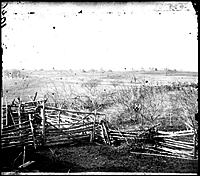 |
View of the battlefield,
First Bull Run,
Virginia, July 1861 |
Public demand pushed General-in-Chief Winfield Scott to advance on the
South before adequately training his untried troops. Scott ordered General
Irvin McDowell to advance on Confederate troops stationed at Manassas Junction,
Virginia. McDowell attacked on July 21, and was initially successful, but
the introduction of Confederate reinforcements resulted in a Southern victory
and a chaotic retreat toward Washington by federal troops.
None of the included photographs of First Bull Run were made at
the time of battle (July 21); the photographers had to wait until the Confederate
Army evacuated Centreville and Manassas in March 1862. Their views of various
landmarks of the previous summer are arranged according to the direction
of the federal advance, a long flanking movement by Sudley's Ford.
July 1861 -- General McDowell Is Replaced.
Suddenly aware of the threat of a protracted war and the army's need for
organization and training, Lincoln replaced McDowell with General George
B. McClellan.
July 1861 -- A Blockade of the South.
To blockade the coast of the Confederacy effectively, the federal navy
had to be improved. By July, the effort at improvement had made a difference
and an effective blockade had begun. The South responded by building small,
fast ships that could outmaneuver Union vessels.
On November 7, 1861, Captain Samuel F. Dupont's warships silenced Confederate
guns in Fort Walker and Fort Beauregard. This victory enabled General Thomas
W. Sherman's troops to occupy first Port Royal and then all the famous
Sea Islands of South Carolina, where Timothy H. O'Sullivan recorded them
making themselves at home.
These photographs show Confederate winter quarters at Manassas, Centreville,
Fairfax Court House, and Falls Church, Virginia.
1861 |
1862 |
1863
|
1864 |
1865
|
Other Photographs
Civil War Photographs
Home Page
Back To the Main Page
