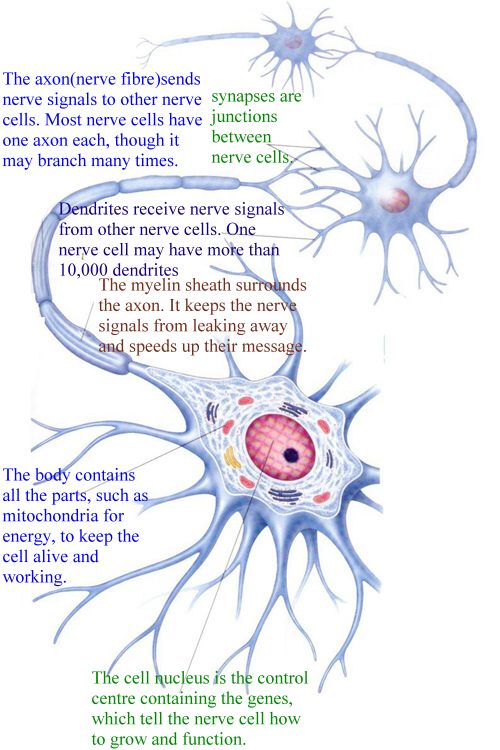
The nerve cell
The body is made up of billions of microscopic cells of many different shapes and sizes. Bone cells made bones, muscle cellsform bones and the liver cells made liver. Nerve cells make the brain and the nerves.
Nerve cells are also called the neurons. The main part of the nerve cell, the cell body, is very similar to other cells, when seen under the microscope. It has tiny parts inside it, such as the nucleus, or control centre, and the mitochondria to provide energy. But nerve cells are unusual cells, in that they have very specialized and complex shapes. Around the cell body are lots of long, thin, spidery-looking parts. These are called dendrites. There is also a longer, slightly thicker part, which is the axon, or nerve fibre.
The nerve cell's long, thin axon and dendrites resemble microscopic wires used to carry electrical signals inside computer circuits. In a way, they are. The brain and nerves work using tiny pulses of electricity, called the nerve signals or impulses. These are passed among the billions of nerve cells in codes and patterns that represent information, like the bleeps of electronic codes inside a computer. The dendrites of a nerve cell receive nerve signals from the other cells. They pass them to the axon, which carries them a long distance, to the dendrites of other nerve cells in the system.
For nerve cells to pass nerve signals among themselves, they must be linked together. This happen at junctions called synapses. The dendrites and axons do not actually touch in synapses. There is a tiny gap between them. But the nerve signal can jump the gap from one nerve cell to the next. It all happens incredibly fast, as billions of nerve signals flash around the brain and along the nerves every second.
The nerve cell's axons and dendrites are so thin and fine that, for many years, they could not been seen even with the most powerful microscope. However, in 1873, the Italian neurologist Camillo Golgi discovered that a sliver-containing stain added to nerve cells, showed up their dendrites and axons clearly. This lead to the discovery of synapses and many other important findings about the brain and the nerves.
The brain and nerves are made of billions of nerve cells, or neurons. These have spidery-looking extinsions. The smallest ones are dendrites, and the large one is the axon. These link together at junctions called synapses. Tiny pulses of electricity, known as nerve signals, pass through the network of nerves, carrying information around the brain and the body.