
|
|
|
|
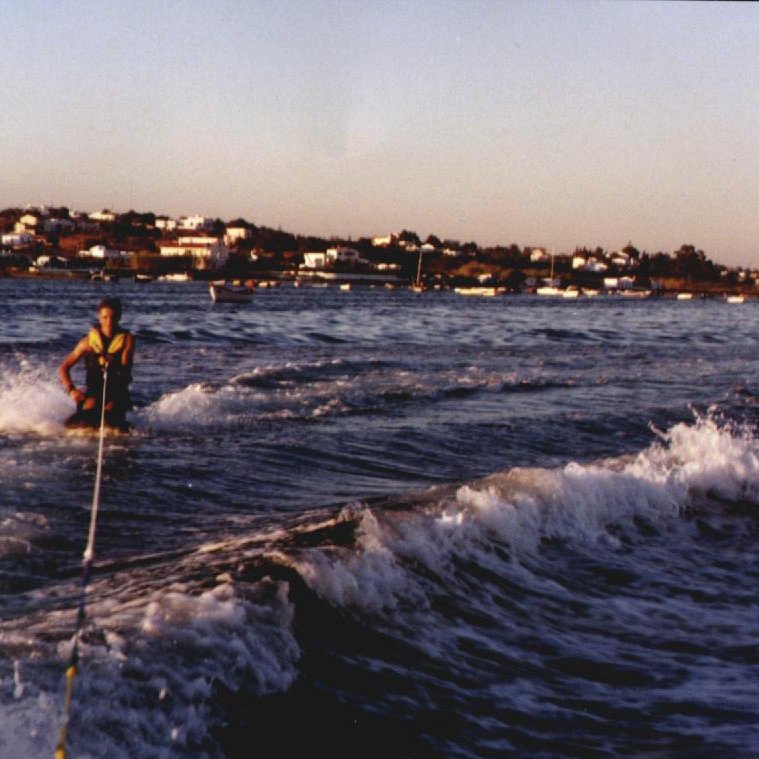
Description: Stand on the board for 5 seconds Tip on performing this trick: This is a great trick for beginners who are just starting out and learning to balance themselves on the board. Helpful hints would be to keep your arms straight (or slightly bent) but NOT all the way in to your chest. Spread your hands out to use the whole handle with both palms down. Keep you knees bent like shock absorbers to ride out any waves. Focus on twisting your hips so that your upper body is facing the boat and your lower body is keeping the board pointed in the direction of the pull.
Ride w/ one hand on handle (5 seconds)Description: Ride one handed for 5 secondsTip on performing this trick: Now that you're getting more confident, take a hand off the handle and wave to the boat or to those watching from the shore. Doesn't matter which hand but make sure you are at least smiling!!
Cross one wakeDescription: Cross one wakeTip on performing this trick: After you've gotten used to your board we're sure you will want to cross the wakes. Remember that a key element when learning is how you position your hips. Focus on twisting your hips so that your upper body is facing the boat and your lower body is keeping the board pointed in the direction of the pull. In order to turn the board to head in either direction, it's just a matter of moving your hips in the direction you want to cross the wake- turn the hips to the left and your body positions the board to turn left. Same thing when you turn your hips to the right.
Cross both wakesDescription: Cross both wakesTip on performing this trick: Crossing one wake or two, it's all the same- use your hips! In order to turn the board to cross in either direction, move your hips in the direction you want to go. Rotate the hips to the left and your body positions the board to turn left. Same thing when you rotate the hips to the right.
Wave to boat judgeDescription: Wave to the boat judgeTip on performing this trick: Just like Riding one handed for 5 seconds, take a hand off the handle and wave to the boat. Doesn't matter which hand but make sure you're at least smiling and having fun!
Crouch down and touch waterDescription: Crouch down and touch the waterTip on performing this trick: Another one to test your balance as you learn to ride. Keep your upper body upright and bend at the knees. You don't want to have your legs straight and band over to touch the water- you could end up head over heels and flat ou your face.
Surf the wakeDescription: Turns up and down on boat wake (min. 3 turns)Tip on performing this trick: Cut up and down the wake as if you were really wanting to tear it up. The shorter and harder you make the cuts, the cooler it looks!
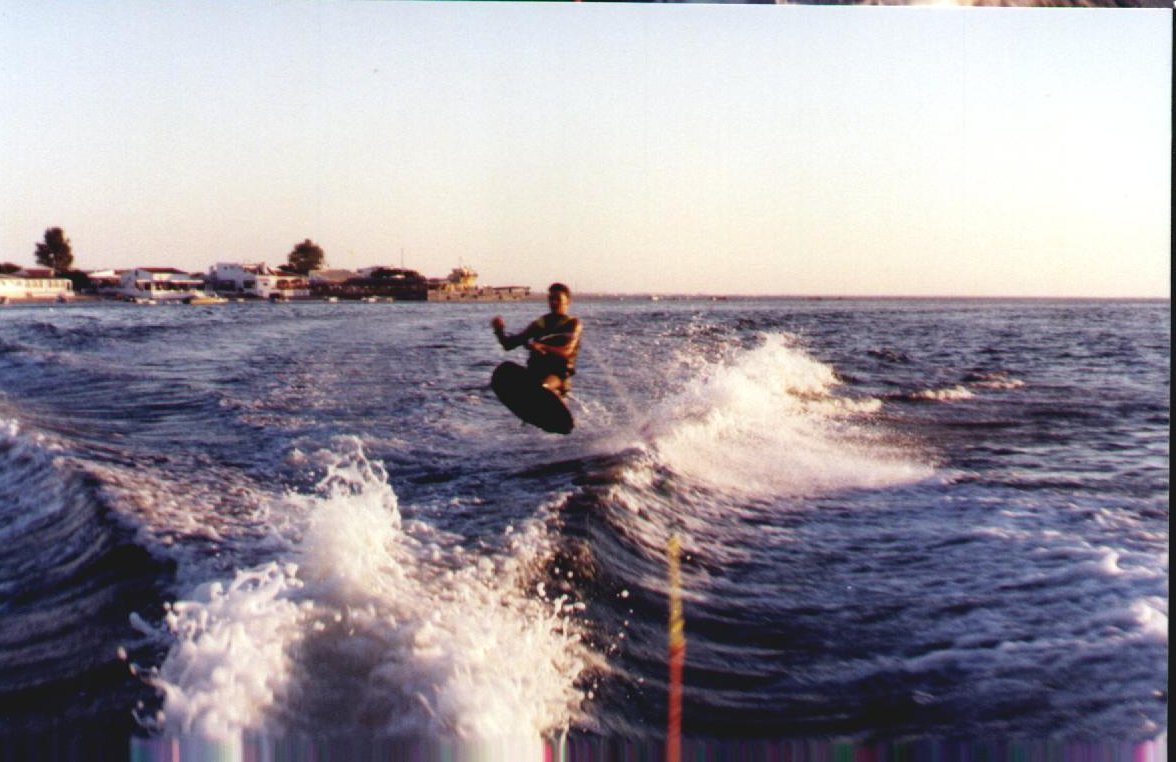
Air (1 wake)Description: Rider uses wake to get board in the air, off waterTip on performing this trick: Approach the wake at a moderate speed hitting it square and head on. Keep you knees slightly bent. As you go up the wake, straighten them out a little to get some spring and try not to flatten out the board until after you have taken off and are about ready to land. This is called "edging through the wake" and it very critical to your jumping as you improve and begin to crave more air. Especially if you're just starting out, it's a good habit to form! (see also Backside/Frontside Air, 2 wakes)
Bunny HopDescription: Getting air without using a wakeTip on performing this trick: With this trick it is important load the line with a little resistence from the handle and a downward push on the tail of the board. This combined force generates the pop known as a Bunny Hop.
Surface 180Description: Board changes direction (back-front/front-back)Tip on performing this trick: Surface 180's are a fun trick to learn as you become familiar with riding your board- left foot forward rotate to the left, righties rotate to the right. Try to place your weight over the center of the board. In one smooth motion, swing the board around leading with your rear foot. Once you are in the 180 position, place more weight on the tip to allow the board to track for stability. To get back around, do the same thing from back to front.
SideslideDescription: Board slides sideways on the water (1 sec. min.)Tip on performing this trick: A Sideslide can be done either ourside or inside the wake. Usually it's an accident while learning the Surface 180- consider it turning the board 90 degrees on the surface. The thing you need to be careful of is not to catch an edge - can you say face plant?? To aviod such pain, put more weight on your heels and dig that back edge into the water. This might produce some spray... but isn't that what looks most cool!? (See also Reverse Sideslide)
Surface 360Description: Board rotates 360 degrees on the surface of the waterTip on performing this trick: Surface 360's are next in line after you've mastered the Surface 180. In fact, you could even do a Surface 180, hold that position for a minuite and then continue the rotation- left foot forward rotate left, righties rotate right. At this point, you will want to pull the handle in towards you and turn in the same motion. Let go with your trailing hand, bend the elbow to make the handle pass in the small of your back, grab it with your trailing hand and keep turning until you've made it all the way around.
LipslideDescription: Rider slides sideways on the crest of wake (1 sec. min.)Tip on performing this trick: The Lipslide looks really cool and isn't really hard to do. If you can do tricks like a Sideslide or a Surface 180 you should be able to do this one. Position yourself on or very near the crest of the wake. Do a Sideslide while the board cuts the very top of the wake. Doing this forward and backward is good practice and also a good trick to learn balance.
Off the wake 180Description: Rider uses boat wake (no air) to change directionTip on performing this trick: This trick reminds us a lot like surfing (of course the wave is a LOT smaller). Ride up the wake, at the very top do your 180 and ride revert back down. This trick can be seen as a combination of Surf the Wake, Surface 180, and a Lipslide.
Reverse Sideslide (touch water)Description: Sideslide w/ back towards boat, hand touching waterTip on performing this trick: We know you've seen one of these before- usually done through a bunch of lilly pads?? Spraying leaves and water all over the place?? Makes great video footage! So the Reverse Sideslide is basically the opposite of a regular Sideslide- but instead you will be digging in your toes and trying not to catch your heelside edge. It works better if you keep you head up looking back and not down at the water. By choice or by reaction, try reaching down and touch the water. What do you call a Reverse Face Plant - a HeadSlam?? or how about a NumbSkull!!
Air 180 (1 wake)Description: Rider uses wake to get into air and then changes directionTip on performing this trick: Approach the wake at a comfortable speed. Generate some pop to you can level out in the air and make your 180 turn. Make sure you are in the air when you turn otherwise the landing is more difficult and will feel off-balance.
Backside Air (2 wakes)Description: Heelside air, rider uses wake and must clear both wakesTip on performing this trick: Getting air enough to cross both wakes and then some has a lot to do with your edging all the way through the wake... right as you approach the crest of the wake, most people ease up the pull and flatten out- not good. By easing up, you take away most of that tension the rope has built up and significantly lessens that force that pops you into the air. Keep in mind, your maximum speed should be at the TOP of the wake- not as you first make the cut or anytime during the cut. Best approach is to make a gradual turn into your carve, dig that edge in as you build up speed toward the wake, spring with your legs when you reach the wake and hold on until you're in the air.
Bunny Hop 180Description: Change direction outside wake by hopping into the airTip on performing this trick: Similar to other Bunny Hop maneuvers, it is important load the line with a little resistence from the handle and a downward push on the tail of the board. When you get enough air to free the rear fin, rotate around to a revert position and transition your weight very similar to a Surface 180.
Half Cab (1 wake)Description: Rider uses wake to get into air and then changes directionTip on performing this trick: Starting from the fakie position (switchstance), the rider uses the wake to get into air and then changes direction.
LaybackDescription: Rider lays back onto water, back touching water required (1 sec. min.)Tip on performing this trick: Gene Kornacki describes this as: "The best way to do a Layback is to edge out strong into the flats, slowly bend backwards and allow your board to come out of the water. Once you feel you're beginning to sink or you begin to lose speed, simply catch the edge of your board and pull yourself up with the handle. Don't pull too hard to get up you could end up with a head full of water and peeled back eyelids. This trick is a great stepping stone for those of us who want to master the Tumble Turn. I keep trying to stay down longer and get my board higher out of the water."
Frontside Air (2 wakes)Description: Toeside air, rider uses wake and must clear both wakesTip on performing this trick: Just like the Backside Air over 2 wakes, it is very important to edge all the way through the wake... right as you approach the crest of the wake, most people ease up the pull and flatten out- not good. By easing up, you take away most of that tension the rope has built up and significantly lessens that force that pops you into the air. Keep in mind, your maximum speed should be at the TOP of the wake- not as you first make the cut or anytime during the cut. Best approach is to make a gradual turn into your carve, dig that edge in as you build up speed toward the wake, spring with your legs when you reach the wake and hold on until you're in the air.
Off the wake 360Description: Rider uses wake (no air) to rotate board 360 degreesTip on performing this trick: This trick can be one in progression from the Off-the-Wake 180. Ride up the wake, at the very top do a 360 without leaving the surface of the water and ride back down.
OleDescription: Board rotates 360 degrees on the surface of the water with a handle rotation over the headTip on performing this trick: This is just like a Surface 360 with some added style! It works like this- instead of doing a behind-the-back handle pass through your 360 rotation, keep the handle in your trailing hand and hold it over your head as you rotate the trick. It's best to do this after cutting outside the wake about 10 feet. Remember, the handle never leaves your hand as the rope goes right over you making for a stylin' move. OLE!
Backside Air w/ grab (2 wakes)Description: He elside air with any grab on board, either handTip on performing this trick: Here's a trick to get you comfortable grabbing the board. Just go for big air and grab the board in whatever way you feel coomfortable with. Key thing- bring the board to you not you down to the board!
Frontside Air w/ grab (2 wakes)Description: Toeside air with any grab on board, either handTip on performing this trick: Approach the wake in the frontside position (toeside) with enough speed and lift for enought time to make a decent grab across both wakes. The secret here is to pull the BOARD up closer to you instead of YOU reaching down for it.
TailboneDescription: Straighten (bone) out back legTip on performing this trick: This is a skateboard trick that looks great on a wakeboard- Just go for some big air and poke out your back leg.
BackscratcherDescription: Riders gets air and outs board 90 degrees to water behind riderTip on performing this trick: This one is very much like a Fashion Air- As you jump the wake, all you need to do is bend your knees to a 90 degree angle so the board reaches back toward your rear.
NoseboneDescription: Straighten (bone) out front legTip on performing this trick: Another trick from the skateboarders list- similar to the Tailbone, get some air and do a poke with your front leg.
Tip on performing this trick: A 1 wake 360 Heli is like every other heli - keep you position vertical, lead with you head and let the rest of your body follow.
Air 180 (2 wakes)Description: Rider uses wake to get air and change directions, clearing 2 wakesTip on performing this trick: An Air 180 initailly seems easier to do frontside than it is backside. Starting this trick from the toeside approach allows you rotate open towards the boat and land facing that same direction. With a heelside approach, your rotation isn't too diffcult but the landing is almost with your back to the boat. So on this side, focus on keeping the rope near your hip and bend your knees to maintain the direction of the board.
Bunny Hop HeliDescription: Outside of wake, rider must hop and twist 360 degreesTip on performing this trick: This one is a little tricky only because you're not using the wake for lift. To do a Bunny Hop 360, it is important load the line with a little resistence from the handle with a push on the tail of the board. Once you release to start the rotation keep you position vertical, lead with you head and let the rest of your body follow.
Fashion AirDescription: Backscratcher with any hand held high and backTip on performing this trick: Very similar to a Backscratcher, the Fashion Air is the same 90 degree knee-bend getting the board closer to your rear. What makes it different is that you must also swing your arm up and out behind you too- some riders placing their hand behind their head and tilting it back like a pose to add a bit of style might have given the Fashion Air it's name.
MethodDescription: Backscratcher with heelside grabTip on performing this trick: As mentioned with the Backscratcher, bend your knees to a 90 degree angle so the board reaches back toward your rear. Now with your leading hand, reach back and grab the top-middle part of the board.
Nosebone w/ tail grabDescription: Nosebone and grab tail of boardTip on performing this trick: If you can do a regular Nosebone, it shouldn't be hard at all to add a tail grab. When you bone out your front leg, bring your back leg closer to your bottom by bending that knee. This will allow you to very easily reach down and grab the tail.
TwistDescription: Board rotates 90 degrees and backTip on performing this trick: Think of this as a half-180 rotation - or better yet, like stalling an Air 180... Something like this- go off the wake, start your 180, hesitate like you changed your mind in mid-air, and bring the board back down as if you didn't complete a full 180- there you have it, the Twist!
NuclearDescription: rear hand heelside grab, bone out back legTip on performing this trick: The Nuclear (and others in its class) are slightly more difficult grabs. These require a fair amount of air and good balance mainly because these tricks force you to grab the board in ways that seem awkward and difficult at first.
PalmerDescription: Front hand heelside grab with twistTip on performing this trick: The Palmer (and others in its class) are slightly more difficult grabs. These require a fair amount of air and good balance mainly because these tricks force you to grab the board in ways that seem awkward and difficult at first.
StiffyDescription: Bone out both legs in front of riderTip on performing this trick: The Stiffy is pretty much the opposite of a Backscratcher. As you go off the wake, straighten out your legs and bring the board completely forward. It's almost like you are showing the bottom of the board to everyone in the boat.
Grab 180Description: Rider gets into air, grabs, and lands opposite direction from take offTip on performing this trick: Even if you can do regular 180's and grabs consistently, combining these two can often be tricky. Just remember NOT to bend down and reach for the board, but instead pull the board up to you make the grab. Experiment around a bit to get comfortable grabing any part of the board with either hand. As you get better, you can try the more complicated combinations.
Half Cab (2 wakes)Description: Air 180, back to front, clearing 2 wakesTip on performing this trick: Air 180, back to front, clearing 2 wakes - just like the 1 wake Half Cab, the rider starts from the fakie position (switchstance) and changes direction in mid air.
Roast BeefDescription: Rear hand heelside grab, between feet through the legsTip on performing this trick: This one shouldn't be a hard one to learn. If you're getting good air and landing pretty consistently, the Roast Beef is a great trick to start progressing into board grabs. As you jump the wake, bring your knees to you chest, reach through your legs with your trailing hand and grab the middle of the board.
Tip on performing this trick: Again with a 2 wake 360 Heli, keep you position vertical, lead with you head and let the rest of your body follow.
Switchstance 360 Heli (2 wakes)Description: Starting from the fakie position, the rider must use the wake to get air, rotate 360 degrees (clear 2 wakes)Tip on performing this trick: Very much like a regular 360 Heli (2 wakes), keep you position vertical, lead with you head and let the rest of your body follow. The only difference here is that you need to start in the fakie position like you would for a Half Cab.
Backside 360 Heli Hand Pass (2 wakes)Description: Heelside approach, rider must use wake to get air, rotate 360 degrees, passing the handle behind the back from one hand to the other (clear 2 wakes)
Frontside 360 Heli Hand Pass (2 wakes)Description: Toeside approach, rider must use wake to get air, rotate 360 degrees, passing the handle behind the back from one hand to the other (clear 2 wakes)
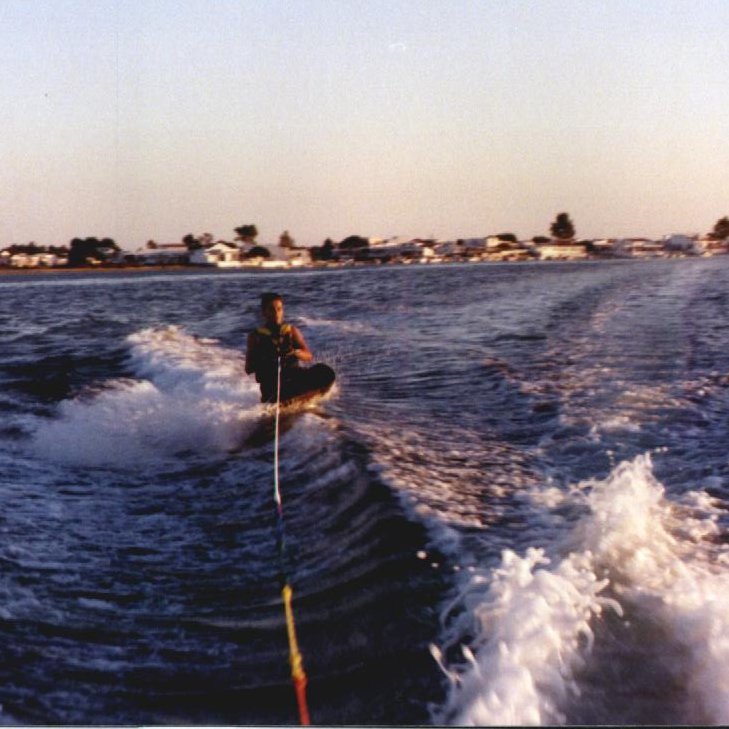
The deep water start is an essential element of Kneeboarding. You can't begin to have any fun if you can't get up on the board. This article will explain how to perform a deep water start. Loosen your strap so that it will reach the front of the pad. Lie on your stomach with your elbows in the Knee pockets of the pad. Grab the strap and handle and place them just in front of the pad. Your shoulders should be even with the front of the pad. As the boat takes off, remain on your stomach until the board begins to plane off. Use your elbows for leverage and to gain control of the board. Once you have planed off, slide your Knees underneath you. The handle should remain just in front of the pad. Slide your knees all the way to the front of the pad. Move slowly and keep your weight evenly distributed over the board. Once your Knees reach the front of the pad, sit up straight on the board.Release the handle with one hand and bring the strap over your legs. Pull on the loose end of the strap to get it tight and fasten it. Remember to keep the handle close to your body. Smile and you are now on your way to enjoy the thrills of Kneeboarding. The easiest trick that you can learn on your Kneeboard it's called the sideslide. This trick is a pre-requisite for other tricks that you will learn later. Start directly behind the boat, inside the wake. Keep your arms bent at about 90 degrees. In one fluid motion, rotate your head and upper body to the right, while shifting your weight onto your right leg and leaning away from the boat. Once you reach the 90 degree position, hold it for a second. Keep the handle into your left hip and keep on leaning away from the boat slightly. Rotate your head and shoulders back toward the boat. Keep the handle in close to your body. You have now completed the Sideslide When you have learned the sideslide, let's take it one step farther and learn the 180 Front to Back. Start directly behind the boat, inside the wake. Keep your arms bent at about 90 degrees. In one fluid motion, pull on the handle toward your right hip. let go of the handle with your left hand. Rotate your head and shoulders to the left. Pull the handle toward your lower back, turning it, so your palm are facing up. Once you have reached the 180 position, Grab the handle with your left hand and shift your weight toward the nose of the board slightly. You have completed the 180 Front to Back. And one more time the big dilema of size does or does not matter comes again. Well let me tell you something, it all depends on the person and the experience. Because it is not the size but also the speed and the way you use it. In the begining it doesn't matter if it is Big or Small but the Speed. You should star slowly, get your confidence, lose your fear and try different aproches. As time goes by and you are more confident and you know the basics, how to start and manouver yourself them let your imagination take control, try new techniques, speeds, positions and sizes, but always take care and protect yourself, because safety is above all. And remenber...size only matter for the different levels and techniques of the wakeboarder or kneeboarder...and ride your wake as you ride life!
|