
How to build a vibration meter

How to Build a Vibration Meter
By James Goss
If you have read my previous article entitled Vibrations, then you will understand why I feel we need a vibration meter for our hobby. A vibration meter is technically known as an accelerometer, I am going to call my version a vibrometer. At this time we have absolutely no reference to go by for checking the vibrations in our models. How do you know if the prop-balancing job that you just performed have actually reduced the vibrations, maybe it increased the vibrations that your plane is being subjected to? All we have is our senses to go by. We might here someone say, “well that certainly sounds better” or “it doesn't seem to vibrate as much” or “the tail is not shaking as bad, maybe it will stay on this time”. In troubleshooting our electronic circuits we don't guess if the voltage or current is there or not, we take a meter and measure it. So why not have a meter to measure the vibrations coming from the engine. I know that I could find a lot of uses for a device of this type. I would probably wonder how I ever got alone without it, just like the hinge machine for installing ca hinges. Even if I can't get my design to work, I know somebody out there can design us a reliable vibrations meter at a low cost. So this article will describe how I approached the design and whether or not it will work.
I first determined that the device had to be portable so I could take it with me to the field or any other location needed. The power supply would be batteries, 9 volt transistor type, and would need two in order to get + 9volts and also - 9 volts. The biggest problem at first was trying to decide on which sensor to use for picking up the vibrations. They were several transducers to select from, so I started with the piezo crystal first. I first thought about using a piezo pad, like the ones used in the medical field. You know the ones I am talking about, they are on a round pad and the technician sticks them all over your chest to monitor your vital signs. When the technician removes them they take hair and all with it! Have you ever wondered how these little devices work? In the very center of these pads there is a tiny little crystal that picks up any pressure change on the surface of your skin. They are not measuring electrical impulses like most would think, but instead they are creating an electrical impulse. Each time the blood pulsates through your body, the crystal receives a tiny vibration that excites it by piezo action. Piezo action is defined as applying physical pressure to a crystal and having the crystal generate a voltage across itself. This seemed like an ideal sensor so I went to the hospital and borrowed a few piezo pads. After checking these pads I could see that it would take a great deal of sensitive amplifiers to get the signal up to the level that would allow us to use them. Also, only one side of the crystal has an electrical connection. In using them to monitor our vital signs, they connect many of them and use only one of them as what I would call a ground reference. So even though it looked really convenient to use these pads by just sticking them on our planes, they were not practical.
Now I was looking for a much larger crystal that could deliver more punch for its size when I happen to think about the piezo igniter used in grills and fireplaces. These little guys are used to light the flames in a lot of devices we have around our homes. The piezo igniter works by you pressing a button that cocks a striker hammer. The hammer is then automatically released to hit the crystal with a great deal of force. The crystal then generates a voltage pulse that is very high in amplitude. Can you guess how much voltage one of these little powerhouses will generate? With voltage it takes about 80 volts to arc one mill (.001 inch). This translates to about 10,000 volts needed to arc 1/8 inch. As an example, the 120 volts you have at home will arc about .0015 inch, in other words the hot and neutral conductor must almost touch each other before an arc can develop. Now once the arc develops it can be drawn out or stretched about an inch in length. If you have ever looked at the arc from the igniter you have seen that it is about ¼ inch in length. This little guy is generating about 10,000 volts of pulsed ac. The actual crystal measures about ¼ inch in diameter and ¾ inch long. I placed the crystal in an in-line fuse holder that provided an ideal housing for it. The holder also keeps spring tension on the crystal. Boy, I thought this was the ideal way to go for this project.
I started testing the unit and found out that it was indeed a very sensitive little fellow, but was it sensitive enough to pick up low level vibrations in wood. Testing it with an oscilloscope showed that a light touch to the surface on the crystal did indeed produce an ac voltage in the milivolt range. If struck with just a little more force the crystal would generate up to 20 volts in a nice clean crisp pulse. So I thought this would be the sensor transducer for this project. With the crystal in contact with my wood workbench, I could not get it to respond to tiny taps on the table. A hard tap would drive it but it was just not sensitive enough to pick up small vibrations in the wood. At this time I was still using my scope as an indicator for the output. I now knew that I needed several stages of amplification for the signal to obtain enough amplitude to drive an indicating device such as an analog meter or led bar graph. I first tried an instrumentation amplifier, which uses three op-amps and is one of the most sensitive amplifiers around. The amp worked fine, but there was still not enough sensitivity on the front end to pick up the smallest vibrations.
I decided to now try another type of sensor, a magnetic sensing head. I wound a small coil with 5,000 turns of 56 awg copper wire. Number 56 awg is about the size of a hair on your head, and will brake if you look at it hard, so you have to really be gentle with it. The coil has a core that is moveable and it consists of one-inch ring magnets. The ring magnets will fit inside a 35-mm film canister. Place the first magnet in the bottom of the canister so it will be in reverse polarity to the main magnets. This will allow the main magnets to float in the canister. Any vibrations at all will allow the magnets to respond by moving. The canister holds them in place with just enough room so they can also move laterally as well as vertical. When the magnets vibrate, a voltage is induced into the 5000 turn coil. Ceramic magnets from Radio Shack will work, but for maximum sensitivity I used two one inch neodymium rare earth magnets. These are some of the strongest magnets on earth with a very high flux density. Some have a flux rating of 27 to 35 million gauss.
Remember that it takes three things to have a voltage generated by magnetic action. The process requires conductors, magnetic flux lines, and relative motion. Relative motion means that either the coil can move past the magnet, while the magnet is stationary or the magnet can move past the coil with the coil stationary. Either will produce the same amount of voltage. The amount of voltage will depend on the number of turns the coil is wound of and the strength of the magnetic field. In this case it is easier to let the magnets move and keep the coil stationary. If you remember the old generators on automobiles back before 1964, they used stationary fields and the armature, which housed the conductors, rotated with the load current being taken from it by the brushes. This is why the brushes didn't last very long; they had high current flowing through them. Then someone came up with the idea of the alternator. It uses a rotating field and the conductors are stationary with no brushes. These conductors are referred to as the stator winding. Load current is taken directly from the stator without using any brushes. The rotor has brushes that pass only three or four amps to the rotating field, which is why the brushes last so long. The alternator is also three-phase in its operation, this accounts for its high current output at a low rpm. So having a stationary coil assembly and a moving magnetic field is the best combination for this project. It's like having a single-phase alternator, except the field is not rotating around in a 360-degree circle, it just vibrates up and down inside the coil.
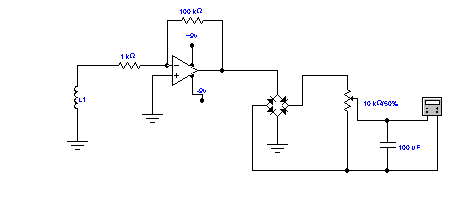
The diagram below shows the schematic for this circuit. The coil, L1 is directly coupled to the input of the amplifier. The amplifier has a gain of 100 and will provide enough amplitude to drive the bridge diodes and still have nice amplitude remaining to drive an indicating device. By using two batteries we can get twice the peak amplitude on the output. The bridge diodes are 1N4149 switching diodes, but with this amplitude almost any diodes will work. The indicator is any device you would like to use. I am using an old meter movement from some military surplus equipment I had around my shop. As you can see the circuit is simple in operation. As stated above I started out with a much more elaborate amplifier system, but found that this little op-amp is all that is needed, keep it simple and inexpensive is always the best approach. The system has been removed from my breadboard and will be tested on real models soon. I will post an update at that time.
Almost the End
 The End
|