
Redundant Systems

Redundant Systems
By James Goss
This article will describe some of the methods you can use to improve your radio systems safety or reliability. Reliability in this case is referring to redundant backup systems (superfluous backup). Redundant simply means having more than is really needed to do a specific job. Backup systems are normally used only on the large expensive planes such as giant scale, but can be used on any size plane. If you have a really nice small plane that you love to fly, then why not use some added protection. For example, if you use two servos to control a surface instead of one, you have a redundant system. If you use two batteries instead of one, you have a redundant system. Of course weight and available space inside the plane is the main concerns we have with small planes. With large planes, like 60 sizes up to giant scale, there is no reason not to have some type of backup onboard. Cost may be a concern for some, but if your model costs $1000.00, surely you can afford and extra battery. The battery is not required to be as large as your main battery, just so it has the same number of cells in it. This is a decision that one has to make, do I want a plane that weights a few ounces lighter and cost just a little less, or do I want to feel safer while flying the model?
If your flight pack battery fails during flight, your plane will probably do one of three things. Depending on the type of battery failure you have will determine how your plane responds. One possibility is that your plane ceases all functions and comes down to earth with no control at all. The receiver has lost all of its input voltage from the battery, and is receiving 0 volts instead of the 4.8 volts it normally operates on. For this situation to occur, an open has developed between the battery and the receiver. It could be a broken wire, a bad solder joint, or a defective switch. In some cases I have known of the switch being turned off in flight due to extreme vibrations from the engine. I have found that anything mechanical in nature can, and will fail more often than a component that has no moving parts. So this makes the switch the number one component to suspect in a failure of this type.
The next possibility is that the receiver is receiving voltage from the battery, but the voltage is lower than normal. This may give you many different flight responses, but here is one. The symptoms for low voltage would be that the plane is flying ok when near the field, but as it moves away from the field it starts to have a mind of its own. The problem will come and go, you will think you are getting some hits from other radios in the area, so you shout out “does anyone have channel ** turned on”? Then you notice that as the plane comes back toward the field you have full control again. Of course there could be a lot more symptoms for this type of fault, but you can get an idea of what I am talking about here. The problem could be a defective cell in the battery, or a high resistance connection along the current's path from the battery to the receiver. A plug is making contact but not good contact, it has some resistance at that point which creates a voltage drop. This voltage drop will be subtracted from the battery's voltage and the receiver will have less voltage to operate on. During this time the solid-state devices inside the servo will be functioning, but with less amplitude. The servos will move slower and have less power output to the control surfaces. Remember that power varies with the square of the voltage. If you half the voltage, the power in watts will be reduced four times, not two as you might think. Any voltage loss at all will reduce your power output a great amount. So again, any problem with the receiver's voltage supply can be put into three groups: no voltage at all, low voltage, or an intermittent voltage. An intermittent voltage means that the supply voltage is coming and going at random. We hope that it is off and on at a high rate so we only get a glitch in our controls, but it could be at any time interval.
There are several ways to achieve battery backup, but I feel the one with the least number of components would be the best choice. Fewer components mean fewer things to go bad. The easiest way to add on a second battery would be to plug it into any unused channel on the receiver. It would be important to also have a second switch for this backup battery. What you are trying to establish is two complete paths for the current to flow from the battery to the receiver. If either path is broken, the other path will provide the receiver with its needed current. The backup battery can plug into any unused channel because all channels have a common voltage bus and are connected in parallel to the battery when the switch is on. If all channels are in use, you can use a wye harness, but you would be adding a connection that is common to both batteries, so if the common wye connector goes bad, it would still shut current to the receiver off. This is what you are trying to do away with in the system, any component that can stop current flow to the receiver.
We call it a backup battery, but it will be used at the same time as the main battery. It is not switched on and off like the name would imply; it is in parallel with the main battery during all of your flight time. Some elaborate systems will switch a second battery on if the main one fails, but here again you are using a lot more components, and components do go bad. Keep it simple! Jomar (EMS) has an electronic switch that monitors the main battery for a fault condition. If a fault occurs in the primary battery, the primary battery will be disconnected and the backup battery will come on line to keep you in the air. The unit sells for about $50.00.
The backup battery's current rating can be smaller or larger than your main battery, but it must have the same number of cells as your main battery pack. For example, you would not want to use a 4-cell and a 6-cell (4.8 volt and 6 volt) in parallel. This would produce internal current flow between the batteries, even if there were no load connected at that time. So if we were using two 4.8-volt batteries, and one is rated at 600-mah, and the other is rated at 1200-mah, the system will work fine. With a fresh charge on both batteries, they will share in providing equal currents to the receiver. As they both discharge, the 600-mah battery will try to reach its discharge state first. At this time it starts to act as a load to the 1200-mah battery and the 1200-mah battery is now furnishing all the load current plus maintaining the charge on the 600-mah pack so its voltage will not drop off. As long as the 1200-mah can supply the load current, the terminal voltage on both batteries will be maintained at 4.8-volts. When it can no longer supply the demand, the terminal voltage will drop and the receiver now receives less than needed voltage to operate. Time to recharge both batteries, but it's better to charge them separately. If you charge both batteries in parallel from the same charger and they are a little different in mah ratings, the one with the lowest mah rating will become charged first. It may now become over charged while the other battery, which has a larger mah rating, is still being charged. If you use switch harnesses that have charging ports built in, then it is easy to charge each battery by using two wall chargers at the same time.
Some modelers will not use this method of backup because they feel that if one of the batteries has a cell to short while in flight, it will load down the other battery and the overall voltage will drop. I agree that this is possible, but the likelihood of this happening is very slim, especially it you check your battery pack before each flight with your loaded voltmeter. When a cell is going bad, it will probably do it over a period of time and this will show up on your meter as reduced voltage when a 250-ma load is placed across it. This is exactly what your expanded scale voltmeter does, it connects a load of about 250 ma across the battery each time you measure the batteries voltage. So I would feel safe by using this method because I always load check the batteries on my giant scale plane before each flight. It is far more likely that you will develop a fault in the switch or associated wiring, rather than in the battery while the plane is in the air. So even though one of the batteries can affect the other if a fault occurs, I feel that we are increasing the reliability of the system overall by at least 30% to the good.
The next method for paralleling the two batteries is to place a diode in series with each battery lead. The diode can be placed in either the negative or positive lead of the battery. These diodes will act as blocking diodes and will not allow battery A to load down battery B if a cell becomes shorted in battery A. Likewise, battery B will not load down battery A if a cell in battery B becomes shorted. By placing a diode in series with the battery there will be a .6-volt drop across the diode. The diode requires .6 volts for its forward bias needed to turn it on. This voltage will be subtracted from the battery voltage and the receiver will receive .6 volts less. Using Schottky diodes will create less voltage drop and have less power loss. Here again, placing more components in line with the current path may be asking for more trouble. Diodes do go bad, they can short or they can open. If one of them shorts, we are back where we started from, if one opens we loose that battery. So if I were going to use two batteries in parallel, I would just use two switches and two batteries, with one battery plugged into the receiver battery jack, and the other plugged into any unused servo port on the receiver.
What is really getting popular today with the giant scale planes is a redundant system that uses two switches, two batteries, and two receivers. I feel that using twin receivers is going to give us the ultimate backup system for R/C. Again I am calling it a backup system, but they are used simultaneously, one is not in reserve waiting to be used if the other one fails. Most pilots will place one aileron and one elevator half on receiver A. The other aileron and elevator half will be placed on receiver B. The rudder and throttle can go on receiver A or B. With this setup, if either switch, battery or receiver goes bad, we still have half control of the main control surfaces.
I noticed at the Tournament of Champions this year (2001) twin receivers were very popular. Out of 21 contestants for the title, all but four used twin receivers. The ones that didn't use two receivers said that two receivers created more components and a higher chance for a fault to occur. My logic is a little different from this. When using one receiver, if it goes bad, your plane is coming down for sure. When using two receivers, if that same receiver develops a fault, we still have half control of the most vital surfaces, the elevator and ailerons. Still having some control of the plane should allow us to land with minimum damage. So there is more chance of a fault to occur when using two receivers, but your probability of landing the plane in one piece has increased by 100%. I would feel better about the reliability of my radio system if I knew there was a twin receiver system in operation.
How many of you have actually had a crash that was due to your radio equipment? The thing is, a lot of times when we crash we can't determine if the radio was at fault or not. I am sure that most of the time it is simply pilot error in my case, but they are those times that I was left wondering. Could it have been an intermittent bad connection in the battery line or in the switch assembly? I will never know for sure. On planes that we invest a great deal of money into, why not go ahead and use some type of added protection. Like I stated above, if you have hundreds, or in some cases, thousands of dollars in your plane, investing a few more dollars may be a very wise decision. Just think about how long it takes to rebuild that plane, if it can be rebuilt. It's funny, but rebuilding is not as fun as the first build of the project. Same thing when you build two identical planes in a row. With the first go around there is some unknown aspect involved and some mystery as to what the outcome will be. On the next one it is just all work because we already know the outcome.
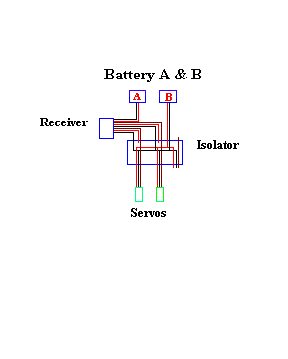
Another system that is sometimes used with two batteries is known as an isolator. The isolator allows you to use two batteries, one for the receiver and one for the servos. The theory here is that if a servo goes bad and loads the servo battery down; the receiver will still have its regular voltage to function normal. Also, low voltage on a servo means that it might move slower and have less power output, but low voltage on the receiver might mean that you have no control of your plane. I can see the advantages of an isolator when using this logic. These systems are totally mechanical in that they have no electronics involved. I think they should be called an octopus instead of an isolator because they have so many connectors involved. I would not think of using this system because of the increased probability of having a faulty connection at one to these many plugs.
Using multiple servos on one control surface is also getting popular with the large planes. Some pilots are using as many as four of five servos on the rudder and two or three for the elevators and ailerons on the 40% and up planes. Keep in mind that I am not talking about using two push rods connected to one servo like a lot of the sport planes are doing now. This only prevents flexing of the push rods. I am talking about having two or more servos with their push rods connected to the same control surface so the total output power from the servos will be added together. This arrangement will work fine unless one of the servos develops a problem. If one of the multiple servos stops working, it will immediately become a load for the other servo that is working with it. Now, not only does the surviving servo have to operate the control surface, it also must operate the faulty servo as well. This can really place a heavy load on the flight pack and drain it in a hurry. I guess this is why some of the Tournament of Champion guys will use two 3600 mah battery packs. At any rate, using multiple servos does have its advantages and disadvantages.
Using two servos on split surfaces such as the elevators does not present this problem of loading. Here, each side of the elevators operates independent of each other. If one of the servos go bad, you still have the other elevator half to fly the plane and without extra load from the bad servo.
Here is a diagram of a simple isolator. You can see that the positive lead coming from battery A is not used by the servos. The servos pick up their power from battery B on the voltage bus in the isolator.
 |