ABOUT ME | MY PROM PICTURES | TEENAGE POEMS | BRITNEY SPEAR PICTURES | JENNIFER LOPEZ PICTURES | MY LINKS PAGE | WHAT'S NEW WITH MY HOMEPAGE? | MY EAGLES PAGE | MY NAVY PAGE | MY AWARDS PAGE | THE PICKET FENCE GUIDE PAGE
Best Viewed at 1024 px by 768 px
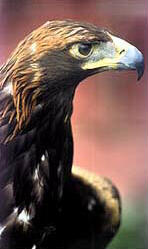
The Golden Eagle (Aquila Chrysaetos) is distributed through most of the northern hemisphere. This is the eagle that has been regarded from ancient times as a symbol of courage and power because of its large size, superb aerial skills, and the inaccessibility of many of its nest sites, in wild and mountainous country. In Roman myths this eagle is associated with the principal deity, Jupiter. It was the emblem of certain Roman legions, of France under the Bonapartes, of Germany, and of the Russian and Austro-Hungarian empires. In North America the Golden Eagle occurs as far south as Mexico, but it is most common in the mountainous areas of the western United States and Canada; east of the Mississippi it is relatively rare. Females attain a length of about 1 m (about 3 ft) from the tip of the beak to the tip of the tail, and have a wingspread of about 2 m (about 7 ft). Males are smaller, as is true for most of the birds of prey. A characteristic of the genus is the feathering of the legs down to the toes; in other eagles the lower part of the leg is bare and scaled, as in most birds. The body plumage is dark brown, with a distinct golden wash over the back of the head and neck, giving the species its name. The tail of adults is brown with several indistinct pale bands; that of immature birds is white with a dark brown terminal band. Most Golden Eagle nests are placed on cliff ledges, but in some areas large trees are preferred. The nest is large and coarse, built of sticks and twigs. The same nest is used from year to year, and the birds add more sticks, so that the nest may eventually be as much as 1.8 m (6 ft) in diameter and 1.5 m (5 ft) high. The usual number of eggs is two, often only one, and occasionally three. They are heavily marked with blotches and spots of various shades of brown. The diet of this species consists mainly of mammals, ranging in size from mice to deer. Birds are taken most often in the breeding season to provide tender food for the young. If live food is in short supply, golden eagles will eat carrion. There are eight other species in the Golden Eagle's genus, all in Eurasia. The smallest is the lesser spotted eagle, with a wingspan of about 1.5 m (about 5 ft); it migrates from central Europe to as far south as South Africa. The largest is the wedge-tailed