
From Our Heart To Yours | home
Christmas | Death Of Christ | Easter | End Times | Gambling | Godly Living | Hell | Memorials | Spiritual Slumber | The Cross

HOW WILL YOUR WALK WITH GOD
BE REMEMBERED?
(Sermon: March 18, 2001)
If you could please turn with me in your Bibles to the book of Exodus and chapter 17 this morning. I want to look beginning at v. 8 in Exodus 17. ******* Notice now, my friends, v. 8 of Exodus 17 reads...
Then Amalek came and fought against Israel at Rephidim. So Moses (v. 9) said to Joshua, "Choose men for us, and go out, fight against Amalek. Tomorrow I will station myself on the top of the hill with the staff of God in my hand." And Joshua did as Moses told him (the first part of v. 10 says), and fought against Amalek . . . . (And jumping down now to v. 13--I want you to notice--it says in v. 13) So Joshua overwhelmed Amalek and his people with the edge of the sword. Then the Lord said to Moses (v. 14), "Write this in a book as a memorial, and recite it to Joshua, that I will utterly blot out the memory of Amalek from under heaven" (Ex. 17:8-10a, 13-14).
My brothers and sisters, shall we pray?
I brought a bag with me to the service today so that I could bring a couple of items that are very important to me. They're items from my past. They happen to be a couple of trophies I received. I think I may have told you another time about my Little League baseball exploits and how I was fortunate to play on a championship team, back-to-back, in my early teens. These trophies remind me of that wonderful time in my life where I was on "top of the baseball world," as it were (at least my little part of the world!). I want to pass these trophies around this morning so that you can take a look at 'em yourself as I'm wanting to talk about, not so much trophies today, beloved, but about memorials. Memorials. *******
"[T]he Lord said to Moses, 'Write this in a book as a memorial, and recite it to Joshua'" in referring to His decision to blot out the Amalekites from the face of the earth for their wickedness. "'Write this in a book as a memorial,'" the Lord said to Moses. I want to talk about memorials this morning. A memorial is "[something that is] established [or instituted (or, as is the case in Exodus 17, written down] to commemorate an event or truth [or person]" (OB 215). In the case of my trophies, they are a type of memorial for me in that they do this very thing. They remind me of past glory. And in the case of the Lord speaking to Moses regarding Amalek--of which I plan to come back to this verse at the end of my message today--in that case what Moses was to write down would be a reminder to Joshua of what God had decided must happen.
I'm talking about memorials this morning. *******
And what I want to do now is share with you various memorials in Scripture and what they were established for to be reminders of. They're not only memorials for the descendants of those who established them, but they're meant to be memorials for us as well--these memorials we'll be looking at today.
I. Memorial #1: Jacob's Stone.
And the first memorial I want you to see is the memorial of Jacob's stone. If you could please turn with me to the book of Genesis and chapter 28. ******* In Genesis 28:18-22 we find a memorial being established by Isaac's son, Jacob. And let's just read about it now--v. 18 of Genesis 28 says--notice...
So Jacob rose early in the morning, and took the stone that he had put under his head and set it up as a pillar (a memorial!), and poured oil on its top. 28:19 And he called the name of that place Bethel; however, previously the name of the city had been Luz. 28:20 Then Jacob made a vow, saying, "If God will be with me and will keep me on this journey that I take, and will give me food to eat and garments to wear, and I return to my father's house in safety, then the Lord will be my God. And this stone (v. 22), which I have set up as a pillar (a memorial!), will be God's house; and of all that Thou dost give me I will surely give a tenth to Thee" (Gen. 28:18-22). *******
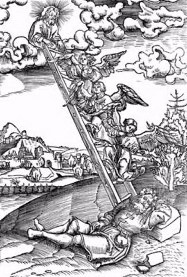 And so Jacob establishes a memorial. And it happens to be that he establishes it to commemorate a dream he had. You remember the dream, I'll bet. Jacob's dream--it was about "a ladder set on the earth with its top reaching to heaven; and . . . the angels of God were ascending and descending on [the ladder]" (Gen. 28:12). And right above the ladder, the Lord was standing and He spoke to Jacob from there--some awesome words the Lord spoke to him. He said, "I am the Lord, the God of your father Abraham and the God of Isaac; the land on which you lie, I will give it to you and to your descendants" (Gen. 28: 13). God continued, "[And y]our descendants shall also be like the dust of the earth," (Gen. 28:14a). And God went even further, "And behold, I am with you and will keep you wherever you go" (Gen. 28:15a). The Lord said all these things and more to Jacob. It was a very significant conversation God had with him, not only in what was said, but in that it was the first time God had spoken to Jacob personally. My friends, this wasn't just any ol' pizza dream Jacob was having here. The Lord of heaven and earth was really speaking to him. And God was saying the promise of his forefathers was now to be Jacob's promise. It was a most significant moment.
And so that's why Jacob establishes a memorial. To commemorate what is a significant time when God spoke to him.
Can you remember a time like that, my friends--when the Lord spoke to you--when you heard God's voice and it was a significant moment? *******
Which brings me to the point I want to make here. And that point is this: when the Lord speaks to us in a significant way, we ought to remember it. We ought not forget it. It goes without saying that we ought to cherish these times and also chronicle them as well, I believe. We ought to both cherish and chronicle the significant moments God speaks to us. Jacob chronicled his moment with God. Jacob remembered it. He did so by setting up a stone. It's memorial #1 from the Scripture I wanted to point out to you this morning.
II. Memorial #2: The Wilderness Manna Jar.
******* And memorial #2 now--if you could please turn with me in your Bibles--we were in Exodus once already today--I want you to turn to Exodus again and chapter 16 this time. ******* I want to read v. 15 and then v. 31-34 of Exodus 16. ******* Notice now, v. 15 of Exodus 16 reads...
When the sons of Israel saw it, they said to one another, "What is it?" For they did not know what it was. And Moses said to them, "It is the bread which the Lord has given you to eat. (Jumping ahead now to v. 31, it continues) And the house of Israel named it manna, and it was like coriander seed, white; and its taste was like wafers with honey. Then Moses said (v. 32), "This is what the Lord has commanded, 'Let an omerful of it be kept throughout your generations, that they may see the bread that I fed you in the wilderness, when I brought you out of the land of Egypt.'" 16:33 And Moses said to Aaron, "Take a jar and put an omerful of manna in it, and place it before the Lord, to be kept throughout your generations." As the Lord commanded Moses, so Aaron placed it before the Testimony, to be kept (v. 34 goes on to say) (Ex. 16:15, 31-34).
Memorial #2 I want to point out to you this morning is the wilderness jar of manna. The wilderness manna jar. It was to be a memorial to the children of Israel of God's provision in the wilderness. *******
And something interesting about this manna God provided Israel with, my brothers and sisters. You might miss it in the Scriptures if you blink. We didn't read it--but the next verse in Exodus 16--v. 35 says--let me just read it to you (you can look at it as well if you want)--v. 35...
And the sons of Israel ate the manna forty years, until they came to an inhabited land; they ate the manna until they came to the border of the land of Canaan (Ex. 16:35).
And so for forty years God provided manna in the wilderness for Israel. Not once in those entire forty years did they go without manna. Not once. All the way up until the day they entered the Promised Land. Let me just read you the verses in Joshua 5. You might want to turn to it so you can see it for yourself. It's just such an awesome truth
for us to lay hold of this morning. Joshua 5:11-12. ******* It says regarding manna in v. 11 of Joshua 5...
And on the day after the Passover, on that very day, [Israel] ate some of the produce of the land (the Promised Land that is!), unleavened cakes and parched grain. (Verse 12 goes on) And the manna ceased on the day after [Israel] had eaten some of the produce of the land--And the manna ceased on the day after [Israel] had eaten some of the produce of the land, so that the sons of Israel no longer had manna, but they ate some of the yield of the land of Canaan during that year (Josh. 5:11-12).
I said it once. I'll say it again. For forty years God provided manna in the wilderness for Israel. Not once in those entire forty years did they go without manna. Not once. All the way up until the day they entered the Promised Land. We just read the record of it.
And so the truth for us this morning, my friends, to lay hold of--we're in the wilderness
--this sojourn called life. We're in the wilderness as believers--you and I--on our way to the Promised Land--that's heaven! And the fact remains that God's going to provide for our needs while we're in this wilderness. Is somebody hearing me this morning? God's going to provide for our needs while we're in this wilderness. All the way up until we walk through those precious Pearly Gates. God's going to provide for our needs. In the same way God didn't fail His people of old, He will not--He will not--He will not fail us today. Is this a good word for someone here?
And my God shall supply all your needs according to His riches in glory in Christ Jesus (Php. 4:19). *******
Memorial #2 again this morning is the wilderness manna jar. It was to be a memorial to the children of Israel of God's provision in the wilderness.
And like I've already said about significant moments God speaks to us--I believe we ought to both cherish and chronicle the times that God miraculously provides for us as well like we do those moments God speaks.
III. Memorial #3: The Twelve Stones At Gilgal.
We're turning our attention to memorial #3 now. If you could please go with me just a chapter back in Joshua--to chapter 4. ******* I want to read a number of verses in Joshua 4 that explain what I've chosen as memorial #3 this morning. I want you to notice, first of all, at v. 1--it says...
Now it came about when all the nation (that's Israel!) had finished crossing the Jordan, that the Lord spoke to Joshua, saying, 4:2 "Take for yourselves twelve men from the people, one man from each tribe, and command (v. 3) them saying, 'Take up for yourselves twelve stones from here out of the middle of the Jordan, from the place where the priests' feet are standing firm, and carry them over with you, and lay them down in the lodging place where you will lodge tonight'" (Josh. 4:1-3).
And so we have God counseling Joshua to set up a memorial here.
(This is the beginning of the campaign to take the Promised Land. Israel crosses the Jordan in Joshua 3 in similar fashion to what happened in the Exodus with Moses and the Red Sea. And so this is the moment that God is telling Joshua to memorialize. The priests are still on the dry waterbed standing with the ark as the Jordan waters are standing up in a heap--Josh. 3:16--the people have passed through, and twelve men are now to go in to retrieve twelve stones from before the priests' feet for the memorial.)
We're at v. 8 now. I want you to notice, it goes on in v. 8...
And thus the sons of Israel did, as Joshua commanded, and took up twelve stones from the middle of the Jordan, just as the Lord spoke to Joshua (Josh. 4:8a).
And now if you could please look at v. 19--a little bit further in the story--v. 19 says...
Now the people came up from the Jordan on the tenth of the first month and camped at Gilgal on the eastern edge of Jericho. And those twelve stones (v. 20)--And those twelve stones which they had taken from the Jordan, Joshua set up at Gilgal. 4:21 And he (Joshua) said to the sons of Israel, "When your children ask their fathers in time to come, saying, 'What are these stones?' then you shall inform your children, saying, 'Israel crossed this Jordan on dry ground.' For the Lord your God (v. 23) dried up the waters of the Jordan before you until you had crossed, just as the Lord your God had done to the Red Sea, which He dried up before us until we had crossed; 4:24 that all the peoples of the earth may know that the hand of the Lord is mighty, so that you may fear the Lord your God forever" (Josh. 4:19-24).
This is memorial #3 this morning, my friends. It's the memorial of the twelve stones at Gilgal. The twelve stones memorialized Israel's crossing the Jordan on dry ground. My brothers and sisters, listen close. This memorial is a memorial of a way made where there was no way. *******
And I'd assume we all might be able to remember a time like that in our life--where, except by a miracle, we wouldn't be standing here today. Do you remember a time like that, anybody here? Maybe it was in the area of finances or health or a job or something else. But God made a way for you where there was no way. *******
And isn't it the case that oftentimes our Lord does it--He makes a way--in a way that we we least expect Him to do it? Amen? *******
"A British submarine lay disabled on the ocean floor. [A true story.] After two days, hope of raising her was abandoned. The crew on orders of the commanding officer began singing: 'Abide with me! Fast falls the eventide, The darkness deepens--Lord, with me abide! When other helpers Fail and comforts flee, Help of the helpless, Oh, abide with me!' The officer explained to the men that they did not have long to live. There was no hope of outside aid, he [went on], because the surface searchers did not know the vessel's position. [It was at this point that God's deliverance arrived.] Sedative pills were distributed to the men to quiet their nerves. One sailor was affected more quickly than the others [by the sedative], and he swooned. He fell against a piece of equipment and set in motion the submarine's jammed surfacing mechanism. [In turn,] the submarine went to the surface and made port safely" (Tan #4573). *******
Oftentimes our Lord makes a way where there is no way in a way we least expect Him to do it. ******* And I just feel like I ought to stress this point a little longer this morning especially since it might be that one of you here--you are right now or you're going to be real soon--one of you here--you're going to be in a situation and you're going to need God to make a way and you're going to have to keep your faith that He'll make the way you need Him to make. How many of you know that we need to believe God to make a way if we expect Him to do it--we need to have faith that He will? *******
There's a French tale entitled "The Clever Old Woman of Carcassonne." Carcassone was a town under enemy siege. Many there had died due to hunger and sickness. Finally, the Mayor called for the people to surrender as provisions were exhausted. And that's when a little shabby, old woman stood up. She said, "'No, no! . . . Don't give up yet. I am sure the enemy will leave soon. If you will do as I tell you, I promise that the town will be saved.'" She went on, "'First of all, bring me a cow.'" This was a crazy request. All the cows had been eaten up. At least that's what they thought. But the woman insisted they bring her a cow. And it was finally in the house of a miser that one was found. Upon receiving the cow the old woman asked that a bushel of meal be brought as well. This was a second crazy request. All the meal had been eaten up. At least that's what they thought. But the woman insisted as before. And so they went from house to house collecting grain by grain until they gathered a basketful. They brought it to the woman. She watered it down and then fed it to the cow. "The Mayor declared . . . it was wicked to give good grain to an animal while women and children were starving, but the old woman only shook her head and smiled knowingly." Finally, as night had fallen and the cow had finished eating, the woman ordered the city gate be opened and the cow let go. This was a third crazy request except that the enemy heard the creaking gate, came running and found the cow. Bringing it to their camp, they showed their King who inquired where it came from. "'[From j]ust outside the gates of the town,'" the soldiers answered. "'[The people] must have let it out to graze.' 'Oh,' exclaimed the King, 'I thought they were starving in there! But I must be mistaken, for if they were hungry they would certainly have eaten this cow--even though it is not very plump.' 'Yes, they must have more provisions than we thought they had,' [his soldiers answered him]. 'It's been a long time since [we've] eaten fresh meat,' they [cont! inued]. 'Well,' suggested [the] King, 'kill the cow and we shall have steak for dinner.' To their amazement, when the cow was cut open, they found its stomach filled with grain. When the king heard of this, he said, 'If the people of Carcassonne still have enough grain to feed it to their animals, we shall have to wait here too long a time before they surrender. And we ourselves shall probably starve before they do.' So he gave orders to break camp, and [he] left with his army that very night. And that was how Carcassonne became free again. The people carried the old woman in triumph through the streets, and gave her money to live in comfort for the rest of her life" (Childcraft Vol. 3, pg. 122-124). *******
Now I know that was a little bit longer of a story. But it just goes to furthering this point of God making a way where there is no way in a way we least expect Him to do it. Sometimes the Lord asks us to do something that seems crazy to do. Like the woman in the story with the cow and the meal. But we need to do it anyway. Like paying our tithe when we really could use the money in another fashion. Sometimes God asks us to do something that seems crazy to do. But, beloved--listen--in the end, it'll prove to be our deliverance that crazy something God asks us to do--whatever it might be. Just like the story of Carcassonne. *******
I've been talking about memorial #3 here--the twelve stones at Gilgal. Again, they memorialized Israel's crossing the Jordan on dry ground--a time when a way was made where there was no way.
And like I've already said today once about significant moments God speaks to us and miraculous times when God provides--we ought to both cherish and chronicle these events, also--when God makes a way where there wasn't one in our lives.
IV. Memorial #4: The Lord's Supper.
We're coming to memorial #4 this morning. It's the last memorial I want to consider. If you could please turn with me to Luke's Gospel and chapter 22. I want to read beginning at v. 19 of Luke 22. We find memorial #4 in Luke 22:19. ******* Notice now, it reads...
And when He (Jesus) had taken some bread and given thanks, He broke it and gave it to them (the disciples), saying, "This is My body which is given for you; do this in remembrance of Me." 22:20 And in the same way He took the cup after they had eaten, saying, "This cup which is poured out for you is the new covenant in My blood" (Lk. 22:19-20).
Memorial #4 this morning, my friends, it's one we ought never forget. It's the Lord's Supper. It was established by Jesus to memorialize (/proclaim) His death until He comes (1 Cor. 11:26). ******* And doesn't it also remind us of what it took for us to be saved--the Lord's Supper? Sure it does. *******
And so it has to do with our salvation, this memorial. And that's the last thing I wanted to make mention of that we ought to both cherish and chronicle--that day--some of you may even be able to remember the exact date--January 7, 1943 or something else--when you accepted the Lord. We ought to both cherish and chronicle that time, my brothers and sisters, and the experiences leading up to the day we got saved. *******
I've been saying alot about cherishing this morning. And I'd expect you all do cherish your interactions with God over your lifetime. But what I want to stress, in closing, is what I'm convinced is the importance of chronicling these interactions, too--when God spoke to you like He did Jacob, when God provided for you like He did Israel in the wilderness with manna, when God made a way for you where there was no way like He did the Jordan crossing for the Jews, when God saved you, also--when God saved you. You ought to be chronicling these things. I want to challenge you in this area.
I said I'd come back to it again. We read earlier: "[T]he Lord said to Moses, 'Write this in a book as a memorial, and recite it to Joshua'" in referring to His decision to blot out the Amalekites from the face of the earth for their wickedness. "'Write this in a book as a memorial,'" God said to Moses. It was so that Joshua would have it. It was so that Joshua would remember.
You need to do the same thing. I challenge you. You need to do the same thing so your kids, grandkids, great grandkids, great, great grandkids will have it--your personal interactions and moments with God--a record of it. ******* What I wouldn't do to be able to look at it on paper (or maybe you'll be able to save yours on computer disk--I don't know)--what I wouldn't do to be able to read about my ancestor's faith--about their relationship with the Lord and what went on. What I wouldn't do to read about it today!
Are you hearing me this morning, my friends? I've been talking about memorials. And as you're standing and we're just about to close in prayer, let me just ask you, "What'll they remember--your descendants--about your walk with God?"