|
Quark
|
|
Electron
|
|
Proton
|
|
Atom
|
|
Molecule
|
|
Strand of DNA
|
| Reaction Time |
Human Synapse (nerve ending) Take the reaction-time test.
|
(52K)
|
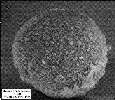
Human Ovum (egg) - (The animated sperm are not drawn to scale, but they are somewhat helpful in picturing what takes place, not to mention cute. In the lower-middle front of the ovum, you can see an actual-size sperm.)
(Picture credit: NanoWorld)
|
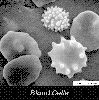 |
Human Blood Cells
(Picture Credit: NanoWorld)
|
|
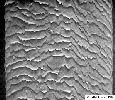
Human Hair (1000x magnification)
(Picture Credit: NanoWorld)
|
|
Grain of Sand
|
|
Drop of Water
|
|
A Breadbox
|

(15K)
|
Some Guy (About 6' 2", 1.88 meters). Normal walking speed for a person is 3-4 miles/hour. Athletes who can run a 4 minute mile are averaging 15 miles/hour.
|
|
A House
|
|
A Giant Redwood
|
|
A City
|
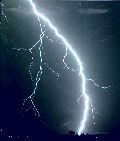 |
Lightning, a mile away, reaches your eyes almost instantly (about 0.000005 seconds), the thunder would take roughly 5 (actually 4.76) seconds to reach your ears (sound travels at 755 miles/hour, depending on the density of the air).
The next time you see some lightning, count: "1 elephant, 2 elephant, 3 elephant..." until you hear the thunder; then divide the total elephants by 5. This will tell you roughly how many miles away the lightning struck. Measuring distance using elephants time, is also handy when estimating distances to celestial objects.
|
|
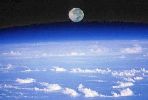
The Earth's atmosphere.
(Picture Credit: STS-35 Crew, NASA)
|
|
North America (A continent)
|
(29K)
|
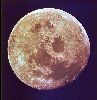
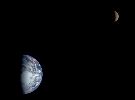
The Moon (The closest celestial object. The shadows in the animated moon pic are not the least bit astronomically accurate, just rather fun.)
(Earth-Moon Picture credit: NEAR Spacecraft Team, JHUAPL, NASA)
|
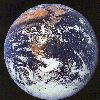 |
The Earth
|
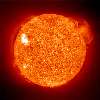 |
The Sun (The closest star, about 92,752,000 miles; 149,600,000 kilometers away). Light travels at about 186,000 miles/second. It takes 8 min. 20 sec. for light from the sun to reach the earth.
(Picture credit: SOHO- EIT Consortium, ESA, NASA)
|
|
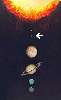
The Solar System. Planet sizes are relative, distances aren't. The white arrow points at the Earth (if you squint, you can almost see it).
|
|
Proxima Centauri |
Proxima Centauri, the closest star to the sun, is in the star system Alpha Centauri; 4.22 light-years away. A light-year is the distance light can travel (at 186,000 miles/second) in one year, that rounds out to almost 6 trillion (6,000,000,000,000) miles. So Proxima Centauri is about 25 trillion miles away. (Just for comparison: the Sun is about 0.000016 light-years away from the earth.)
|
|
The Milky Way
|
A spiral galaxy, is a grouping of billions (1,000,000,000's) of stars, one of which is a rather small star, named The Sun.
|
|
Sagitarius Dwarf
|
The closest galaxy; less than 60 thousand light-years away.
|
(8K)
|
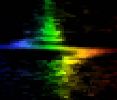
A Black Hole? This digital signature of a black hole, in the center of galaxy M84 in the Virgo Cluster is about 50 million light-years away.
(Picture credit: B. Woodgate (GSFC), G. Bower(NOAO), STIS Instrument Definition Team, NASA)
|
|
Virgo Cluster of Galaxies is the physical center of our local Supercluster (that means The Milky Way, our galaxy, is just one of about 2,000 galaxies that are grouped together to form the Virgo Cluster). Think on this for just a minute: "A cluster of galaxies." We're talking HUGE. So this bohemoth is a monster-grouping of thousands of galaxies, some of which are smaller, lots are bigger, than our own.
|
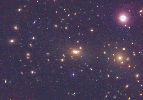 |
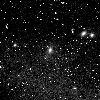
The Coma Cluster of Galaxies is millions of light-years across, and hundreds of millions of light-years away from our own Cluster! Even though it looks like just another picture of a bunch of stars, almost every object shown in the picture is a galaxy!
(Picture credit: O. Lopez-Cruz and I. K. Shelton (U. Toronto), Kitt Peak National Obs.)
|
(177K) |
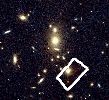
The Farthest Known Galaxy, the 13 billion light-years away reddish-orange streak (outlined in the white rectangle) in the galaxy cluster CL1358+62. The universe is currently calculated as being around 14 billion years old. What you are looking at is what that galaxy looked like 13 billion years ago. What does it look like right now? We won't know for another 13 billion years.
|
| What? No Pic?
|
The Universe (which curves back in on itself?) Ever wonder what all that huge space between stars/galaxies/clusters consists of? It's hard to picture "emptiness," but it may be filled with tiny little wave-particles (wavicles?) called gravitrons; something on the scale of quarks.
|