Previous Contents Next

Chapter 11   Metals, Semiconductors and Insulators

11.1   Introduction

In the last lecture we showed that the electrons fill the available levels up to the Fermi Energy level EF . This lecture adds the effects of band structure to the model.

11.2   The Facts

Metals Non-Metals
shiny and opaque rarely reflects, sometimes transparent
all conduct electricity resistivity varies up to a factor of 109 from sample to sample
conductivity falls as temperature rises conductivity rises as temperature rises
obeys Ohm's Law Sometimes obeys Ohm's Law
ductile brittle

11.3   EF Position


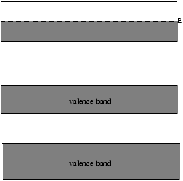
Figure 11.1 - A Metal

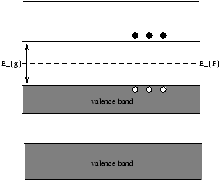
Figure 11.2 - A Semiconductor

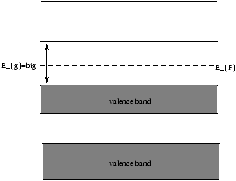
Figure 11.3 - An Insulator

11.4   Full Bands Carry No Current


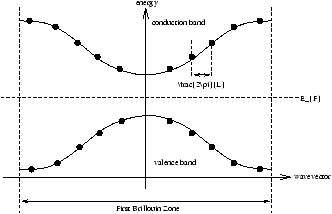
Figure 11.4 - Full Bands Do Not Carry Current
In a full band equal numbers of electrons with positive and negative K exist. This creates a net charge motion of zero, so it cannot conduct electricity.


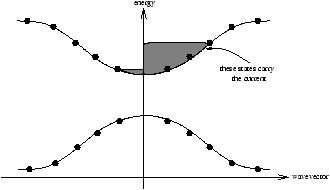
Figure 11.5 - Applying an Electric Field to a Partially Filled Band
If we apply an electric field to the bands we get figure 11.5. The carriers of current scatter into states that are further to the right in K space, the unpairer carriers carry the net current.

11.5   Mobile Carrier Concentrations in Pure Non-Metals


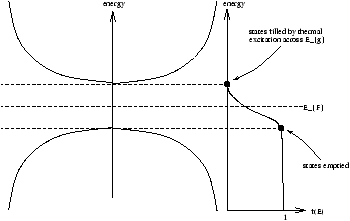
Figure 11.6 - A Pure Non-Metal
the density of mobile carriers in the conduction band is
niµ e
-
Eq
2kT
 
Ge Si GaA Diamond
Eg (eV) 0.66 1.12 1.42 ~ 4
ni (cm-3 ) 2e13 1.4e10 1.7e6 almost zero

11.6   When Does EF Fall in the Gap

Each band spans 2p/d in K space, the allowed states are determined by the crystals size which is spaced by 2p/L . In the one dimensional case there are L/d K states/bands. However in three dimensions the band contains (L/d)3 K states. This will hold N=2(L/d)3 electrons, so in terms of density
n=
N
L3
=
2
d3
ie. when n=2 it represents the density of the unit cells.

A band, in a pure material, will be exactly full when the unit cell contains an even number of electrons.


Previous Contents Next