|
|
|
GEDCOM-Families |
White City--North Central Morris CountyIn Chicago, in 1870, a group of Englishmen, headed by a Mr. Pierce, organized themselves into a colony. Their eagerness to secure homes in the far west led them to send three representatives to seek a good location for the Colony, which numbered about thirty-six. McKenzie, the main street of White City, was on the old Mormon Trail. Water on the north side of McKenzie drains north but the flow of the opposite side drains south toward Council Grove. The first and only jail still exists untouched by progress. Good water, sewer, an elementary school and original brick pavement are but a few of White City's attributes. An authentic collection of nearly 700 pieces of intimate apparel is owned by Phyllis and Bob Taylor, and is housed in an old railroad flop house (Missouri, Kansas and Texas Railway). Pierce, Chas Lewis and E. Rietenour were sent to select a good townsite and a good farming community. They selected the land in and around what is now known as White City. The Colonists drew lots for their land numbers. The colony came in the spring of 71 and settled on their land, later going back to Chicago to bring their families. Mr. McKenzie entered the land on which the town is laid out and for which the principal street is named. Mr. Pierce tried to have the land located about a mile east of the town and to call it New Chicago. The land platted belonged to Mr. McKenzie. He neglected to file his plat and during that fall, a colony of Swedes headed by Erick Johnson, came to this place and laid out a town site on the other side of the MK&T, filed their plat and called it New Swedenland. Mr. Dunbar and James Thornley built the first building in White City using it for a grocery store and post office. A hotel was built by a Mr. Eldredge, this the first victory of White City over New Chicago. The following year, Sept. 17, 1872, a charter was granted to White City by the state. The incorporates were: P.C. Johnson, Thos Eldredge, Amos Calwell, James Thornley, WH Mulnix, C. Crawford, W. A. Staley, E. R. Pierce and C.H. Eldredge.This did away with White City and New Chicago, except the Post Office which still bore the name of White City. This continued for some time when the citizens of the town agreed to change the name back to White City, in honor of Mr. White, a popular MK&T official. In February 1872 the now Katy RR was completed to Burlington and mail service was put on the road. The next store was by Larson & Co. when Mr. Case opened a grocery store. In the spring of 1872 a school house was built. In 1873 the Congregational Church was organized as well as a Sunday school. The first 4th of July celebration was held in 1873. In 1874 the grasshoppers, known as Rocky Mountain Locusts, came and ate all growing crops. They departed only to return the following year. The Methodist Episcopal Church was organized in 1878. The Baptist Church in 1882, the Presbyterian Church in 1884 and the Christian Church in 1886. In 1885 the first Newspaper was the White City WHIG. The first bank organized in 1886 through the efforts of John Taggart, who helped lay out the town of Nortonville. The first track of the Rock Island Rail Road was laid through in 1886-87. In 1886 a grade school was erected. |
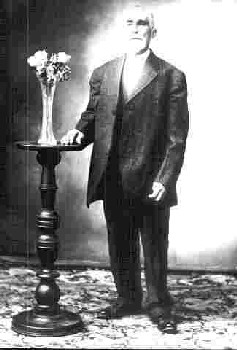 William Henry Mulnix --Source: Lester
Mulnix/Juanita Mulnix (EDITOR NOTE; Juanita originally recorded this story in connection
with Levin, however an interview with Lester by Jerry Mulnix Jr. corrected this to be
William Mulnix) Lester remembers his Father (Sidney) telling a story of William driving
his wagon through Woodland Park and someone yelled, "Hey monkey Mulnix,"
(because of his beard). William stopped the wagon and very quietly tied the horses to the
post, proceeded to hit whoever yelled at him and got back in the wagon without saying a
word. He must have been a very cool and spunky man.- -------- ref: Rebecca Watson Walker
4/98 A great majority of the information I'll be relating on was sent to my brother by
another Mulnix who was doing genealogy. My brother turned the paperwork over to me.
Included was a copy of a news article titled: " W.H. Mulnix, Old Resident, Buried
Today " It further states the following: "Last member of First Set of Twins born
in Chicago Passes Away. Wife and Seven children Survive. William H. Mulnix, who would have
been 87 years old December 22, and for many years a resident of Colorado Springs, died
Wednesday at his home, 2203 West Pikes Peak Avenue. Last July 14 Mr and Mrs Mulnix
celebrated their 64th wedding anniversary. Mrs. Mulnix survives. Funeral Services for Mr.
Mulnix were held this afternoon at 2 o;clock from the Trinity Methodist Church with Rev
Joseph Antle, pastor, officiating. Burial was in Fairview cemetery. Mr Mulnix was born in
Chicago, Ill December 22,1841. He spent his early years and resolved his eduction in
Chicago and was for many years in business there. He moved with a colony to White City,
Kansas in 1871 and farmed in that district until 1887 when he moved to Colorado Springs. A
few years later he moved to Denver where he was for a number of years engaged in the
mercantile business. About four years ago he returned to Colorado Springs to be near his
twin sister, Mrs. Henrietta Young, who died about two years ago. Mrs. young and Mr. Mulnix
were the first twins born in the city of Chicago. Besides his wife Mr Mulnix is survived
by seven children all past 40 years of age. Nearly all the members of the family were
present when he died. The children are: \William H Mulnix, Jr. Canon City Colo; A L
Mulnix, Gypsum, Gypsum, Colo; S E Mulnix, Colorado Springs; F W Mulnix New Paris, O; Mrs.
F A Lewis, Avon , Colo; Mrs. O W Johnson, Latimer, Kan; and Mrs. W E Bailey, Denver,
Co." * Note this article also contains a picture of Mr. Mulnix and, I'm assuming,
Mrs. Mulnix................might possibly be his twiin sister?
William Henry Mulnix --Source: Lester
Mulnix/Juanita Mulnix (EDITOR NOTE; Juanita originally recorded this story in connection
with Levin, however an interview with Lester by Jerry Mulnix Jr. corrected this to be
William Mulnix) Lester remembers his Father (Sidney) telling a story of William driving
his wagon through Woodland Park and someone yelled, "Hey monkey Mulnix,"
(because of his beard). William stopped the wagon and very quietly tied the horses to the
post, proceeded to hit whoever yelled at him and got back in the wagon without saying a
word. He must have been a very cool and spunky man.- -------- ref: Rebecca Watson Walker
4/98 A great majority of the information I'll be relating on was sent to my brother by
another Mulnix who was doing genealogy. My brother turned the paperwork over to me.
Included was a copy of a news article titled: " W.H. Mulnix, Old Resident, Buried
Today " It further states the following: "Last member of First Set of Twins born
in Chicago Passes Away. Wife and Seven children Survive. William H. Mulnix, who would have
been 87 years old December 22, and for many years a resident of Colorado Springs, died
Wednesday at his home, 2203 West Pikes Peak Avenue. Last July 14 Mr and Mrs Mulnix
celebrated their 64th wedding anniversary. Mrs. Mulnix survives. Funeral Services for Mr.
Mulnix were held this afternoon at 2 o;clock from the Trinity Methodist Church with Rev
Joseph Antle, pastor, officiating. Burial was in Fairview cemetery. Mr Mulnix was born in
Chicago, Ill December 22,1841. He spent his early years and resolved his eduction in
Chicago and was for many years in business there. He moved with a colony to White City,
Kansas in 1871 and farmed in that district until 1887 when he moved to Colorado Springs. A
few years later he moved to Denver where he was for a number of years engaged in the
mercantile business. About four years ago he returned to Colorado Springs to be near his
twin sister, Mrs. Henrietta Young, who died about two years ago. Mrs. young and Mr. Mulnix
were the first twins born in the city of Chicago. Besides his wife Mr Mulnix is survived
by seven children all past 40 years of age. Nearly all the members of the family were
present when he died. The children are: \William H Mulnix, Jr. Canon City Colo; A L
Mulnix, Gypsum, Gypsum, Colo; S E Mulnix, Colorado Springs; F W Mulnix New Paris, O; Mrs.
F A Lewis, Avon , Colo; Mrs. O W Johnson, Latimer, Kan; and Mrs. W E Bailey, Denver,
Co." * Note this article also contains a picture of Mr. Mulnix and, I'm assuming,
Mrs. Mulnix................might possibly be his twiin sister?