Go back to The Bible and the Book of Mormon
Another classical charge against the book of Mormon is that there is not any
archeological evidence regarding the places mentioned in the Book of Mormon.
I am not an archeologist and I have no intention to pretend to be it.
What is the archeology? The archeology is the study of the
past trough the study of old finds and of the ground. Is it possible to do archeology if
you don't have the history like base? It is possible but it will be very hard, specially
if you are looking for a city. We have to keep in mind that many of the cities described
in the Bible had a location in an environment well known and possibly the same history
contained some clues. In the old world, I mean:Europe, Asia and high Africa, it is easier
to do this kind of search because many of those people have maintained their history
written, but for America it is different we don't have those text and the book of Mormon
it is not a historical text but a religious text. So even though we have many finds it is
very hard to tract them. Even in the old world we have many mysteries to solve. The Book
of Mormon being a religious text had no interest to give indications on places, cities and
stuff like that, its main purpose is to declare that Jesus is the Christ, therefore there
is not an interest to describe places and give indications where they were. Also in the
third Nephi, at the time of the Christ's resurrection, great cataclysms provoked a great
environmental disaster that changed literally the face of that continent, therefore only
after that time it could be possible do some searches, but not having no book of history
it is very hard to do it. Specially in south Americas we have many places that could
fit in its account. Also in the old world the cities changed its name many times,
specially in the Bible's time:Jerusalem was Salem at the beginning, Jebus later and after
Jerusalem. Anyway there are many artifacts that are showing something interesting. The
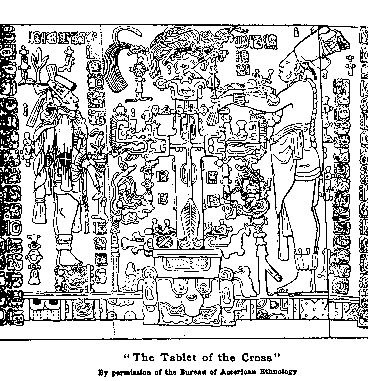
cross of Palenque, baptismal founts at Chiceniza. What about Pyramids like the Egyptians?
Those people had several oral traditions, speaking about the flood and other stuff Bible's
related, but the most interesting was the idea of a white God with a beard that had
promised to be back in the last days. This story is well documented by the history, before
Cortez and after Pizarro had easy ground to conquer and destroy the Incas, Maya and so on.
The story of Montezuma welcoming Cortes like this God is something that nobody can avoid.
The truth of the Book of Mormon can't be found in archeological evidence, the faith is the
requirement for the spiritual things, not earthly evidence, think about this, could you
prove any evidence of the resurrection? No you have to trust in the scriptures where
sacred witnesses maintain that Jesus arose from the death. Many important happenings in
the scriptures can't be proved by any evidence, only by faith: the story of Jonah, the
falling of the walls of Jericho, the opening of the red sea and so on: without faith it is
impossible to please HIM.
When a person is looking for archeological evidence is taking the same place that the Jews
took asking to Jesus a sign, a proof. I am not condemning archeology I am just saying that
this science is not the base for religious stuff. If the real purpose of the Gospel is,
according to Paul:"Preach Jesus and Him crucified" it is easy to say that
archeology is an interesting thing but nothing more.
God asks faith, science asks for proofs and when you are asking for evidence you are
killing your faith.
This a wonderful talk about this topic by Hugh Nibley
Archaeology and Our Religion
Hugh Nibley
Nothing illustrates better than archaeology the inadequacy of human knowledge at any given
time. It is not that archaeology is less reliable than other disciplines, but simply that
its unreliability is more demonstrable. Meteorology (to show what we mean) is quite as
"scientific" as geology and far more so than archaeology--it actually makes more
use of scientific instruments, computers, and higher mathematics than those disciplines
need to. Yet we laugh at the weatherman every other day; we are not overawed by his
impressive paraphernalia, because we can check up on him any time we feel like it: he
makes his learned pronouncements--and then it rains or it doesn't rain. If we could check
up on the geologist or archaeologist as easily when he tells us with perfect confidence
what has happened and what will happen in the remotest ages, what would the result be?
Actually, in the one field in which the wisdom of geology can be controlled, the finding
of oil, it is calculated that the experts are proven right only about 10 percent of the
time. Now if a man is wrong 90 percent of the time when he is glorying in the complete
mastery of his specialty, how far should we trust the same man when he takes to
pontificating on the mysteries? No scientific conclusion is to be trusted without
testing--to the extent to which exact sciences are exact they are also experimental
sciences; it is in the laboratory that the oracle must be consulted. But the archaeologist
is denied access to the oracle. For him there is no neat and definitive demonstration; he
is doomed to plod along, everlastingly protesting and fumbling, through a laborious, often
rancorous running debate that never ends.
To make a significant discovery in physics or mathematics or philology, one must first
know a good deal about the subject; but the greatest archaeological discoveries of recent
years were made by ignorant peasants and illiterate shepherd boys. From that it follows,
as the handbooks on archaeology never tire of pointing out, that the proper business of
the archaeologist is not so much the finding of stuff as being able to recognize what one
has found. Yet even there the specialist enjoys no monopoly. Dr. Joseph Saad, who directed
the excavations at Khirbet Qumran, tells of many instances in which the local Arabs were
able to explain findings that completely baffled the experts from the West, to the rage
and chagrin of the latter. Hence Sir Mortimer Wheeler warns the archaeologist: "Do
not ignore the opinion of the uninstructed. `Everyone knows as much as the savant. . . . '
Emerson said so and he was right. "
With everybody getting into the act, it is not surprising that the history of archaeology
is largely the story of bitter jealousies and frightful feuds. Archaeology mercilessly
accentuates certain qualities characteristic of all research but often glosses over the
exact sciences. The elements of uncertainty, surprise, and disappointment, and the
pervasive role of speculation and imagination, with all the unconscious conditioning and
prejudice that implies, are not merely regrettable defects in archaeology--they are the
very stuff of which the picturesque discipline is composed. "What in fact is
Archaeology?" asks Sir Mortimer, and answers, "I do not myself really know. . .
. I do not even know whether Archaeology is to be described as an art or a science."
Even on the purely technical side, he points out, "There is no right way of digging,
but there are many wrong ways."
Duel in the Dark
The idea of archaeology as the key to a man's origin and destiny was introduced as a
weapon of anti-clerical polemic in the revolutionary movements of the eighteenth and
nineteenth centuries. Reimar's "hate-filled pamphlet" on history and the New
Testament launched the "scientific" attack on the Bible, and when Boucher de
Perthes, a child of the French Revolution, found stone "hand-axes" among the
flints of Abbeville he published them in five stately volumes entitled, with pontifical
finality, "On the Creation." These objects, whose use and origin are still
disputed, were to be nothing less than the key to the creation. Such fantastic leaps of
the mind reveal the fierce determination of the first modern archaeologists to "get
something" on the Bible. It was inevitable that biblical archaeology should become
little more than "an offshoot of Darwinism. " The great Lamarck, before he even
came up with his explanation of the creation, was animated "by a severe . . .
philosophical hostility, amounting to hatred, for the tradition of the Deluge and the
Biblical creation story, indeed for everything which recalled the Christian theory of
nature." And Darwin writes of himself in his twenties: "I had gradually come, by
this time, to see that the Old Testament from its manifestly false history of the world
and from its attributing to God the feelings of a revengeful tyrant, was no more to be
trusted than the sacred books of the Hindoos [sic], or the beliefs of any barbarian. . . .
By further reflecting. . . that the more we know of the fixed laws of nature the more
incredible do miracles become--that the men at that time were ignorant and credulous to a
degree almost incomprehensible to us. . . . This disbelief crept over me at a very slow
rate, but was at last complete. The rate was so slow that I felt no distress, and have
never since doubted for a single second that my conclusion was correct."
This is a very revealing statement, a rich compound of cliches, a testament of Victorian
smugness: "manifestly false . . . revengeful tyrant. . . any barbarian. . . fixed
laws of nature . . . never doubted for a single second." Those are the words of a man
who knows all the answers and is proud rather than ashamed of his unflinching loyalty to
his adolescent prejudices. Just how much would a young English theology student in the
1820s know about the real history of the world, books of the Hindus, or "the beliefs
of any barbarian"? Next to nothing, is putting it mildly, but it was enough to put
the stamp of "complete disbelief" on Darwin's thinking forever after. Students
commonly assume that it was the gradual amassing of evidence that in time constrained such
men to part company with the Bible. Exactly the opposite is the case: long before they had
the evidence, they brought to their researches such an unshakable determination to
discredit the book of Genesis that the discovery of the evidence was a foregone
conclusion. It was Darwin's bosom friend and spokesman who blurted out the real issue with
characteristic bluntness: "Darwin himself avoided attacking the Bible, but for
Huxley, his doughty champion against all comers," writes J. C. Greene, "the
battle against the doctrine of inspiration, whether plenary or otherwise, was the crucial
engagement in the fight for evolution and for freedom of scientific enquiry." The
battle was against revelation, and evolution was the weapon forged for the conflict. We
must not be misled by that inevitable tag about "freedom of scientific enquiry."
When a Tennessee high-school teacher was fired for teaching evolution in 1925, the whole
civilized world was shocked and revolted at such barbaric restriction on freedom of
thought; yet at the same time there was not an important college or even high school in
the country that would hire a man who dared to preach against evolution. Freedom of
thought indeed.
The great debate between "science" and "religion" has been a duel in
the dark. How do things stand between the picture that "archaeology" gives us of
the past and the picture that the scriptures give us? Take the biblical image first: the
best efforts of the best artists back through the years to represent a clear picture of
things described in the Bible look to us simply comical. Even the conscientious Flemish
artists, using the best Oriental knowledge of their time, paint Solomon or Holofernes as
boozy Landgraves at a fancy dress ball, while the masters of the Italian Renaissance show
their prophets and apostles affecting the prescribed dress and stock gestures of traveling
Sophists of the antique world. We are no better today, with our handsome "Bible
Lands" books, based on diligent research, showing Jesus or Elijah in the garb of
modern Bedouins or Ramallah peasants moving through the eroded terrain of modern Palestine
or discoursing beneath arches and gates of Norman and Turkish design. The moral of this is
that no matter where we get our information, our picture of the Bible is bound to be out
of focus, for it will always be based on inadequate data, and it will always be of our own
construction. And at no time did the Christian world have a more distorted picture of the
Bible than in the nineteenth century. To the Victorians, creaking with culture and
refinement, it was easy and pleasant to assign all other creatures their proper place and
station in the world-for that is what evolution does. Their outspoken objection to
Mormonism was that it was utterly barbaric, an intolerable affront to an enlightened and
scientific age. Huxley declared with true scientific humility that the difference between
a cultivated man of his own day and a native of the forest was as great as that between
the native and a blade of grass. What possible understanding could these people have of
the real Bible world? Taken at face value the Bible was a disgustingly primitive piece of
goods--"poor stuff," John Stuart Mill pronounced it; the work of people
"ignorant and credulous to a degree almost incomprehensible to us," as Darwin
said, for this, of course, was the Bible that Darwin rejected: in it he was attacking an
image that was the product of his own culture and nothing else.
The Mind's Eye
Archaeology today "in our universities and schools," according to Wheeler,
"forms innocuous pools of somewhat colorless knowledge--mostly a refined
Darwinism--in which our kindergartens are encouraged to paddle." Again, everybody
gets into the act. My own children, long before they could read, write, or count, could
tell you exactly how things were upon the earth millions and millions of years ago. But
did the little scholars really know? "What is our knowledge of the past and how do we
obtain it?" asks the eminent archaeologist Stuart Piggott, and answers: "The
past no longer exists for us, even the past of yesterday. . . . This means that we can
never have direct knowledge of the past. We have only information or evidence from which
we can construct a picture." The fossil or potsherd or photograph that I hold in my
hand may be called a fact--it is direct evidence, an immediate experience; but my
interpretation of it is not a fact, it is entirely a picture of my own construction. I
cannot experience ten thousand or forty million years--I can only imagine, and the fact
that my picture is based on facts does not make it a fact, even when I think the evidence
is so clear and unequivocal as to allow no other interpretation. Archaeology brings home
this lesson every day, as Sir Flinders Petrie pointed out, for in no other field does
interpretation count for so much. "The excavator," writes Sir Leonard Woolley,
"is constantly subject to impressions too subjective and too intangible to be
communicated, and out of these, by no exact logical process, there arise theories which he
can state, can perhaps support, but cannot prove. . . . They have their value as summing
up experiences which no student of his objects and notes can ever share." Yet what
makes scientific knowledge scientific is that it can be shared. "There are
fires," writes a leading student of American archaeology, "which man may, or may
not, have lit--animals he may, or may not, have killed--and crudely flaked stone objects,
which those most qualified to judge think he did not make. By weight of numbers these
finds have been built into an impression of probability, but the idol has feet of
clay." This is the normal state of things when we are dealing with the past: "If
one certainty does emerge from this accumulation of uncertainties," writes an eminent
geologist, "it is the deep impression of the vastness of geologic time." An
"accumulation of uncertain- ties" leaves the student ("by weight of
numbers") with an "impression" which he thereupon labels a
"certainty."
Yet with examples gross as earth to exhort him, the archaeologist is constantly slipping
into the normal occupational hazard of letting the theory rather than the facts call the
tune. For years archaeologists always assumed that pieces could be chipped from the
surface of stones merely by exposure to the burning sun--they never bothered to put their
theory to the test, though no one ever was present when the sun did its chipping. From
Breasted's Ancient Times, millions of high-school students have learned how primitive man
woke one morning in his camp in the Sinai Peninsula to find that bright copper beads had
issued from the greenish rocks with which he banked his fire that night. It was not until
1939 that a scientist at Cambridge actually went to the trouble to see if copper could be
smelted from an open fire, and discovered that it was absolutely impossible. Nobody had
bothered to check up on these simple things like the Aristotelians who opposed the
experimenting of Galileo, the men of science felt no need to question the obvious. If man
had been on the earth for, say, 100,000 years, scattered everywhere in tiny groups
subsisting on a near-animal level, could we possibly find the cultural and linguistic
patterns we do in the world today? After fifty thousand years of local isolation, is it
conceivable that languages at opposite ends of the earth should be recognizably related?
Only in our day are such elementary questions beginning to be asked--often with surprising
and disturbing results. But however vast the accumulation of facts may become, our picture
of the past and the future will always be, not partly but wholly, the child of our own
trained and conditioned imaginations. "The world will always be different from any
statement that science can give of it," a philosopher of science writes, and he
explains: "that is, we are looking for an opportunity to restate any statement which
we can give of the world. . . . We are always restating our statement of the world."
Scholarship is also an age-old, open-ended discussion in which the important thing is not
to be right at a given moment but to be able to enter seriously into the discussion. That
I cannot do if I must depend on the opinion of others, standing helplessly by until
someone else pronounces a verdict, and then cheering loudly to show that I too am a
scholar.
Because interpretation plays an all-important role in it, archaeology has been carried on
against a background of ceaseless and acrimonious controversy, with theory and authority
usually leading fact around by the nose. If the great Sir Arthur Evans decided eighty
years ago that the Minoans and Mycenaeans were not Greeks, then evidence discovered today
must be discounted if it shows they were Greeks; if it was concluded long ago that the
Jews did not write in Hebrew at the time of Christ, then Hebrew documents from that time
if they are discovered today must be forgeries. "Does our time scale, then, partake
of natural law?" a geologist wonders. "No. . . . I wonder how many of us realize
that the time scale was frozen in essentially its present form by 1840. . . ? The
followers of the founding fathers went forth across the earth and in Procrustean fashion
made it fit the sections they found even in places where the actual evidence literally
proclaimed denial. So flexible and accommodating are the `facts' of geology."
"Science," said Whitehead, "is our modern-day dogmatism." There is
something cozy and old-fashioned, almost nostalgic, in the archaeology of forty years ago
with its invincible meliorism and romantic faith in man's slow, steady, inevitable onward
and upward march. But archaeology is the science of surprises, and the most desperate
efforts of accommodation have not been able to discredit the sensational changes of our
day.
"One of the most exciting results of the radio-carbon dating," writes
Piggott," . . . has been to emphasize how rapidly and severely the environment was
modified." Extreme and rapid changes of environment have long been anathema to
science. "Darwin's secret, learned from Lyell," according to H. F. Osborn, was
(in Lyell's own words) that "all theories are rejecting that which involves the
assumption of sudden and violent catastrophes." In a world of nuclear explosions this
seems downright funny, but it "was a perfect expression," as Egon Friedell has
written, "of the English temperament and comfortable middle- class view of the world
that refused to believe in sudden and violent metamorphoses, world uprising, and world
calamities." One of the most militant evolutionists of our day says that "it
remains true, as every paleontologist knows, that most new species, genera, and families,
and nearly all categories above the level of families, appear in `the record suddenly, and
are not led up to by known, gradual, completely continuous transitional sequences. "
One wonders why if most species appear on the scene suddenly without millions of years of
evolutionary preparation leading up to them, the human race cannot have done the same.
"Because it didn't," we are told. For a hundred years, thousands of scientists
have devoted their lives to proving that it didn't; yet all they have to offer us as proof
to date is a large and cluttered science fair of bizarre and competing models, interesting
but mutually damaging.
Through the years the writer, who is no archaeologist, has had to keep pretty well abreast
of the journals and consult occasionally with archaeologists in order to carry on his own
varied projects. Anyone who has any contact at all with what is going on is aware that the
significant trend since World War II has been the steady drawing together of far-flung
peoples and cultures of antiquity into a single surprisingly close-knit fabric. Early in
the present century an "Egyptologist" could make fun of the "amusing
ignorance" of the Pearl of Great Price, in which "Chaldeans and Egyptians are
hopelessly mixed together, although as dissimilar and remote in language, religion, and
locality as are today's American Indians and Chinese." Today a ten-year-old would be
reprimanded for such a statement, since now we know that Chaldeans and Egyptians were
"hopelessly mixed together" from the very beginning of history. Even as late as
the 1930s so eminent a scholar as T. E. Peet had to exercise extreme caution--suggesting
that there might be any resemblance between the literatures of Babylonia, Palestine,
Egypt, and Greece. Today we know better, as every month establishes more widely and more
firmly the common ties that knit all the civilizations of the ancient world together.
A hundred years ago, investigators of prehistory already sensed "the essential unity
of the earlier Stone Age cultures throughout the Old World." From the very beginning
of the race "at a given period in the Pleistocene," writes Piggott, "one
can take, almost without selection, tools from South India, Africa and South England which
show identical techniques of manufacture and form. . . .What happened at one end of the
area seems to be happening more or less simultaneously at the other." I have never
seen any attempt to account for this astounding worldwide coordination in the industries
of primitive beings who supposedly could communicate to their nearest neighbors only by
squeals and grunts. In the mid-nineteenth century the folklorists were beginning to notice
that the same myths and legends turned up everywhere in the Old and New Worlds, and
philologists were discovering the same thing about languages; today Hockett and Asher are
bemused by the "striking lack of diversity in certain features of language" and
make the astounding announcement that "phonological systems [of all the languages of
the world] show much less variety than could easily be invented by any linguist working
with pencil and paper." The same authorities note that "man shows an amazingly
small amount of racial diversity," and pardonably wonder "why human racial
diversity is so slight, and. . . why the languages and cultures of all communities, no
matter how diverse, are elaborations of a single inherited `common denominator.'"
With a million years of savagery and hostility, ignorance, isolation, and bestial
suspicion to keep them divided, it seems that men should have had plenty of time to
develop a vast number of separate "denominators" of language, legend, race, and
culture. But that is not the picture we get at all.
In religion it is the same. It was not until 1930 that a group of researchers at Cambridge
cautiously presented evidence for the prevalence through the ancient world of a single
pattern of kingship, an elaborate religious-economic-political structure that could not
possibly have been invented independently in many places. We do not find, as we have every
right to expect, an infinite variety of exotic religious rites and concepts; instead we
find a single overall pattern, but one so peculiar and elaborate that it cannot have been
the spontaneous production of primitive minds operating in isolation from each other.
When history begins, "let us say c. 5000 B.C.," to follow J. Mellaart, "we
find throughout the greater part of the Near East . . . villages, market towns . . . and
castles of local rulers" widely in touch with each other as "goods and raw
materials were traded over great distances." It is essentially the same picture we
find right down to the present; and we find it everywhere--if we go to distant China
"the life of the Shang [the oldest known] population can have differed little in
essentials from that of the populous city-states of the Bronze Age Mesopotamia," or
from that of the peasants of the Danube or of "the earliest English farming culture.
" This is what has come out since World War II. Before that, archaeology had made us
progressively aware of the oneness of our world with successive discoveries of Amarna,
Ugarit, Boghazkeui, Nuzi, and so on, each one tying all the great Near Eastern
civilizations closer and closer together while revealing the heretofore unsuspected
presence of great nations and empires as active and intimate participants in a single
drama. And the Bible is right in the center of it: the patriarchs who had been reduced to
solar myths by the higher critics suddenly turned out to be flesh-and-blood people; odd
words, concepts and expressions, and institutions of the Bible started turning up in
records of great antiquity; the Hittites, believed to be a myth by Bible scholars until
1926, suddenly emerged as one of the greatest civilizations the world has ever seen. Since
then a dozen almost equally great empires have been discovered, and the preliminary
studies of each of them have shown in every case that they had more or less intimate ties
with the great Classical and Middle Eastern civilizations. The picture of ancient
civilization as a whole has become steadily broader and at the same time more uniform, so
that the growing impression is one of monotony bordering on drabness. Seton Lloyd is
depressed by "the drab impersonality of the `archaeological ages.'" Archaeology
gives us, as M. P. Nilsson puts it, "a picture-book without a text"; or, in the
words of Sir Mortimer, "the archaeologist may find the tub but altogether miss
Diogenes." The eager visitor to a hundred recent diggings is fated to discover that
people once lived in stone or brick or wooden houses, cooked their food (for they ate
food) in pots of clay or metal over fires, hunted, farmed, fished, had children, died, and
were buried. Wherever we go, it is just more of the same-all of which we could have
assumed in the first place. The romance of archaeology has always resided not in the known
but in the unknown, and enough is known today to suggest the terrifying verdict that a
great Cambridge scientist pronounced on the physical sciences a generation ago: "The
end is in sight."
And now we come to the crux of the matter. As the tub without Diogenes has nothing to do
with philosophy, so archaeology without the prophets has nothing to do with religion.
"You cannot," says Piggott, "from archaeological evidence, inform yourself
on man's ideas, beliefs, fears or aspirations. You cannot understand what his works of art
or craftsmanship signified to him." The ancient patriarchs and prophets ate out of
ordinary dishes, sat on ordinary chairs, wore ordinary clothes, spoke the vernacular,
wrote on ordinary paper and skins, and were buried in ordinary graves. The illusion of the
pilgrims to the holy land, Christian, Moslem and Jewish, that this is not so--that is,
that contact with such objects by holy men rendered them holy-gave rise to Biblical
archaeology at an early time. The Palestine pilgrims from Origen and Gregory to Robinson
and Schaff had all been looking for extra-special things, for miraculous or at least
wonderful objects. Men who viewed the idea of living prophets as a base superstition
turned to the dead stones of the "Holy Land" for heavenly consolation, and
enlisted archaeology in the cause of faith. But though archaeology may conceivably confirm
the existence of a prophet (though it has never yet done so), it can never prove or
disprove the visions that make the prophet a significant figure. Former attempts to
explain the scriptures in terms of nature-myths, animism, and psychology had nothing to do
with reality. What can archaeology tell me about the council in heaven? Nothing, of
course--that all happened in another world. The same holds for the creation, taking place
as it did at a time and place and in a manner that we cannot even imagine. Then comes the
garden of Eden--a paradise and another world beyond our ken. It is only when Adam and Eve
enter this world that they come down to our level. Strangely enough, the biblical image is
not that of our first parents entering a wonderful new world, but leaving such to find
themselves in a decidedly dreary place of toil and tears. Before long the children of Adam
are building cities and are completely launched on the familiar and drab routines of
civilized living: "dreary" suggests old and tired, and there is nothing fresh or
new about the Adamic Age.
On the archaeological side we have Jericho, by general consensus (as of the moment) the
oldest city in the world. It emerges abruptly full-blown, with a sophisticated and
stereotyped architecture that remains unchanged for twenty-one successive town-levels, and
from the first it displays a way of life substantially the same as that carried on by the
inhabitants of the nearby towns right down to the present day. This has come as a great
surprise; it is not at all consistent with the official model of the onward and upward
march of civilization that we all learned about at school. When the civilization of China
was rediscovered by European missionaries in the seventeenth century, skeptics and
atheists saw in it a crushing refutation of the Bible--here was a great civilization
thousands of years older and far richer, wiser, and more splendid than anything Western
man had imagined, thriving in complete unawareness of God's plan of salvation. It was the
discovery of such other worlds, such island universes, that was once the concern of
archaeology, ever seeking the strange, the marvelous, and the exotic. But now archaeology
has found too much; the worlds are there, but they are not isolated--not even China; they
are all members of a single community, and by far the best handbook guide to the nature
and identity of that community remains the Bible.
If you like this site send it to a friend. Click here

Go back to The Bible and the Book of Mormon
www.massimo.bigsm
