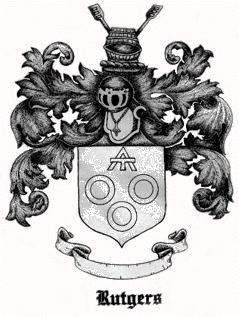

The helmet represents an Esquire because it is made of steel and shown in profile with the visor in a closed position. The title Esquire has its origins in the day of chivalry and is one rank higher than a �Gentleman� and two above �Yeoman.� It is an apprenticeship through which every aspirant must pass before becoming a Knight and was, in Medieval Times, an armor bearer or attendant upon a knight. More recently it was given to judges, magistrates and justices of the peace, while they were serving, as well as many others.
In this case a garland or chaplet of ivy leaves is placed over the helmet. It is symbolic of �Strong and Lasting Friendships.�
The diaper is an ornamental accessory used relieve the monotony of flat surfaces such as the breastplate in this case. It is effected by placing a small lozenge on the surface. The lozenge represents honesty and constancy, and it was also held to be a token of noble birth.
Beneath the breast plate is the shield. This is an important part of any coat of arms, because it is upon the shield that the charges are placed. The charges are those devices which make the coat of arms distinctive to an individual or family. The surface of the shield is called the field. The upper one third of the field is called the chief, which may or may not be defined by a line. The chief is considered to be a place of honor, and in this case, contains the cross and the chevron.
The cross, known as Saint Anthony�s cross, is one of the earliest and noblest of the honorable ordinaries. It is also known as a Tau cross because of it resemblance to the Greek letter �T.� A cross of this shape was an implement of deadly torture used by the Romans in Palestine during the 1st century. As such, it is usually used on a coat of arms to represent Christian faith, Christian experience, or some Christian sentiment.
In this coat of arms, the cross is combined with the chevron (up-side-down �V�). The chevron represents the roof tree of a building and is granted to those who build churches or fortresses. It signifies having achieved some notable enterprise.
The lower two thirds of the field contains the annulets. The annulets are rings which are symbolic of nobility and jurisdiction. They are a gauge or royal favor and protection, and when used in the difference, annulets represent the cadency of the fifth son. They are an emblem of fidelity.
The mantle is the decorative leafy structure which encircles the upper part of the escutcheon. The mantling was intended to protect the helmet. The colors represented in the mantle of this coat of arms are: Red--Military valor and courage. Red is the warrior's color and symbolizes a desire to serve one's King and Country to the utmost of his ability. And Gold--The emblem of generosity, elevation of mind and untarnished honor.
Crowning this coat of arms is the crest. The crest was a distinguishing mark for leaders in battle long before heraldry was evolved. It was not until later, after the science of heraldry had been established, that incorporating a crest became an integral part of a coat of arms. In this case the crest is two half tuns (casks) with stirring paddles projecting from behind. I can only guess that this crest was used because it represented the family�s trade, at least in the New World. Rutger and his descendants were involved in the brewery business and Teunis worked for his brother. It may be a skill the brothers brought over from the Netherlands.