Economic Development Results of Metro Rail Implementation
By Gordon Thompson
Overall:
The Buffalo Common Council adopted the Transit-Area zoning category which en-courages transit-oriented land uses and discourages automobile-oriented land-uses along Main Street in the vicinity of Metro Rail stations. [Unfortunately, this was a later ac-tion, after Metro Rail had been completed and running for eight years.
Station-by-Station:
south of AUDITORIUM
Marine Midland Arena built.
Marine Midland Atrium Annex built.
AUDITORIUM to SENECA
[This area is occupied by Marine Midland Center Tower which spans Main Street and was conceived and built before the rapid transit project
SENECA to CHURCH
older Marine Midland Bank building converted to office building
Marine Midland Annex building (bank offices) converted to office building
iron-facade office building restored next to 241 Main Street
Pilot Field (now North Americare Park) AAA baseball stadium built at Seneca and Washington Streets
Ellicott Square Building rehabilitated
CHURCH to LAFAYETTE SQUARE
Manufacturers and Traders Trust Company (M&T) instituted seasonal weekday noontime entertainment on its broad plaza alongside the Church station.
The tradition of Farmers? Market along both sides of Main Street between Eagle Street and Clinton Street every seasonal Thursday was instituted.
restoration of Lafayette Square nearly to its 1890s configuration, and institution of Thursday evening outdoor entertainment in the resulting park. (Previously, the park had been predominantly paved for traffic connecting Broadway directly to Court Street.)
LAFAYETTE SQUARE to FOUNTAIN PLAZA (formerly HURON station)
restoration of building fronts and rehabilitation of the east side of Main Street be-tween Mohawk Street and Huron Street (including removal of unsightly unused overhead billboard frames.
Hyatt-Regency built by renovating the former Genesee Building and adding to it as part of the North Block project, and encompassing one block of Genesee Street as its atrium.
vacated YMCA renovated as Olympic Tower apartments on Pearl Street.
Empty Sibleys department store (nee Hengerer's) was converted to office building.
FOUNTAIN PLAZA to THEATER
North Block developed by the City and NFTA as the only federal Urban Initiatives project to be implemented and completed: Fleet Bank, CitiBank twin towers, and outdoor skating rink and plaza (Fountain Plaza)
Buffalo Savings Bank office building (now M&T) built on east side
Chippewa Street red-light district west from Main Street to Delaware Avenue up-graded to respectable and popular nightclub district.
The entire block north from Chippewa Street to the station was rehabilitated through both private and public projects, including some remarkable restorations of stylish building fronts.
Raddison Hotel (and T.G.I.Fridays restaurant) built on northeast corner of Main and Chippewa Streets replacing dirty-book stores in derelict buildings.
Vacant multi-storey furniture warehouse at northwest corner of Main and Chippewa Streets rehabilitated, heightened, and converted to City Centre condominiums.
restoration of empty Market Arcade
current: Irish Theater being built behind facades of long-vacant storefronts.
Shea's Theater thoroughly renovated; current project is to expand both the stage and the theater to better accommodate Broadway shows.
multi-screen Cinema built on site of burned-out Swiss Chalet (and old building face preserved)
Clarkson Center installed in burned out restaurant next to Theater station
THEATER to ALLEN-HOSPITAL
McDonald's fast food restaurant opened at Theater station. (This was laughable at the time because this was regarded as the first transit-enhanced development.)
abandoned Greyhound terminal converted to Police Station.
former Palace Theater (burlesque) converted to Studio Arena Theater.
former theater restored as SUNYaB arts performing threater.
Vacant second-storey space in 700 block business buildings converted to apart-ments.
vacant Courier-Express offices and newspaper plant converted to Catholic Diocese offices.
ALLEN HOSPITAL to SUMMER-BEST
Roswell Park Memorial Institute considerably enlarged
Buffalo General Hospital expanded
City has plans to formalize the medical center and increase activity around Allen-Hospital station, including air-rights over the station.
Bryan & Stratton, a nationally-renown technical school expanded.
downtrodden Roosevelt Apartments rehabilitated as Roosevelt Arms and a commu-nity center.
some vacant and derelict buildings rehabilitated as housing for disabled veterans.
SUMMER-BEST to UTICA
northwest of Main Street and Summer Street a vacant building was rehabilitated as quality apartments; the corner lot (temporarily a parking lot) is slated for a new apartment building, but has been deferred because of the Recession.
UTICA to DELAVAN-COLLEGE
burned-out corner store at northwest corner of Main and Utica Streets replaced by a chain drug store
new apartment building built on Utica Street vacant lot between corner drugstore and afore-mentioned apartment building.
abandoned multi-storey apartment building on Utica Street between Main Street and Linwood Street rehabilitated.
multi-storey apartment building at Utica and Linwood upgraded.
Uniland development at southwest corner of Main Street and Delavan Avenue
DELAVAN-COLLEGE to HUMBOLDT-HOSPITAL
Re-use (restoration) of vacant Sears Roebuck store at Main Street and Michigan Avenue by Blue Cross/Blue Shield
expansion of Canisius College administrative and educational space
Canisius College's Castiglia House and Village Townhouses (west of Main Street)
LBJ Apartments immediately south of Humboldt Parkway (a HUD project that re-quired public transit links to necessary services for senior citizens) right behind Humboldt-Hospital west station entrance.
Canisius College's Main Humboldt Town House (east of Main Street) right next to Humboldt-Hospital east station entrance.
HUMBOLDT-HOSPITAL to AMHERST STREET
Medical office building built at northeast corner of Main Street and Humboldt Parkway.
Sisters Hospital expanded.
current: City of Buffalo's Main and LaSalle development project for a mixed-use in-city neighborhood on fallow abandoned railroad land surrounding LaSalle station.
AMHERST STREET to LaSALLE
two business schools opened in then-vacant commercial buildings, but one lost its accreditation and closed
the empty post office building was concerted to commercial use
Lafayette Hospital converted to long-term care center.
Munro Muffler opened on site of burned out Bobbie-Pin factory [not transit-related]
LaSALLE to SOUTH CAMPUS
large new complex of senior housing (Jill-Joseph Towers) built off Custer Street be-hind Main Street businesses; now leasing; has direct access to station area.
on southeast side of Main Street, a large quality-housing complex is being developed.
north of SOUTH CAMPUS
Campus expansion and development has continued, focusing medical and graduate programs on this campus (while other SUNYaB activities have been transferred to the newer North Campus). [This unheralded expansion has necessitated City in-vestment in new water-supply pipes and Niagara Mohawk investment in electrical services and a new transmission line which reach this location via NFTA?s former railroad rights-of-way ? Erie International Branch and DL&W Black Rock Branch.]
A Walgreen super-drugstore replaced the Basil Ford dealership at Main Street and Kenmore Avenue.
University Plaza has been improved and front-face landscaping added.
Other Results:
Buffalo Common Council adopted a new zoning code for station areas encouraging transit-related land uses and discouraging automobile-related uses.
Along residential sections of Main Street (Humboldt Parkway to Oakwood Street, and Amherst Street to Hertel Avenue) some large homes have become professional of-fices.
The existence of Metro Rail has stabilized the neighborhoods within walking dis-tance of stations. Real-estate values have gone up, and vacancy rates are lower than in other parts of Buffalo. However, where the project bypassed areas, there has been no positive impact
METRO RAIL SIGNIFICANT DATES(info from Gordon Thompson)
December 6th, 1973-Mini Ground-breaking(on UB front lawn during a heavy snow storm; it launched the core-bore drilling activity)
November 3rd, 1978-Official Ground-breaking(start of tunnel work)
September 1984-ground breaking for transit/pedestrian mall
November 1984-first day of rail service on downtown mall
May 18th 1985-"mini" opening, downtown to South Campus, but not stopping at LaSalle station
December 29th 1986-Grand Opening(full line including LaSalle Station)
Return to CRTC Main Page
Advocating Mobility for All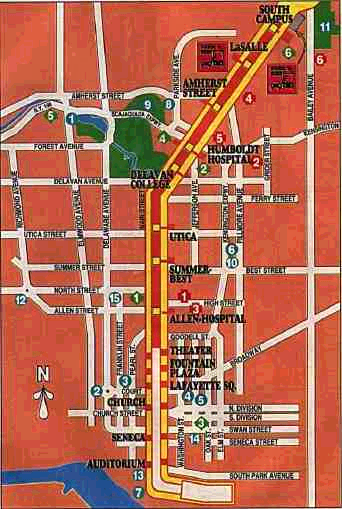 Map of Present Metro Rail Line