
 "Oh muse, the causes and the crimes relate,
So begins the second verse of book one of Virgil's epic poem, The Aeneid. He has invoked the muse of epic poetry, Calliope; he has called upon her to tell the tale of the Trojan prince, Aeneas, son of Priam, King of Troy. Virgil was only a conduit for the voice of an immortal goddess, one of nine known to the Greeks as Muses.
"Sing in me, O Muse, and through me tell the story,
Of that man skilled in all ways of contending,
The wanderer, harried for years on end
After he plundered the stronghold
On the proud height of Troy." (Robert Fitzgerald)
In perhaps
the eighth century before the Christian era, Homer, that greatest of epic
poets, sung those words, sung of the Odyssey, no doubt at the court of
an Argive prince. But perhaps not. Perhaps he sung for the common man;
perhaps his immortal words were first heard by nothing more than a group
of boys in a village gathered round a fire, somewhere along the coast of
Greece. I would like to believe so, but in fact, we shall never know. Scholars
can debate the issue and they shall, but all that matters is that he spoke
them, those words, and somehow, we have been blessed enough to have them
passed down to us. The Muse, Calliope, saw fit to ensure that her finest
works were preserved.
The Greeks
believed there were nine muses, each providing over some form of literature,
art, or science. There was Calliope, of course, as well as Clio the muse
of history, Euterpe of lyric poetry, Melpomene of tragedy, Terpsichore
of choral dance and song, Erato of love poetry, Polyhymnia of sacred poetry,
Urania of astronomy, and Thalia of comedy. It was believed that each would
help mortals in the furtherment of her art. Hesiod wrote of them in his
tale of the birth of the gods, Theogony, and dedicated his work
to them.
Those were
simpler times, and modern man has no use for such foolishness, or so he
believes. Undoubtedly, the ancients believed that a mere mortal man could
not compose a work of such intricacy and depth as The Iliad, or
of such breadth and splendor as The Odyssey. And perhaps they were
right. The works of the ancients do not have their rivals in modern man.
Perhaps only when a man believes that the Muse of epic poetry is speaking
through him, that Calliope whispers in his hear and wraps her arms about
him, perhaps only then can he write with such spirit and accomplishment.
But perhaps not . . .
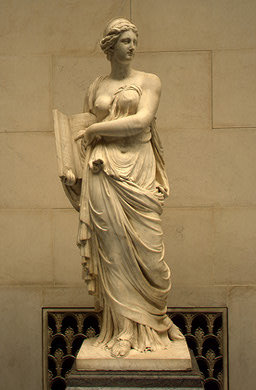
(The sculpture is one by Augustin Pajou, and is from the
Samuel H. Kress Collection 1952.5.107. It is on display at The National
Gallery of Art. For further information, follow this
link.)