Hanukkah
Hanukkah
There are four different ways to spell Hanukkah. They're
Hanukkah, Chanukah, Kanukkah, and Hannukah.Hanukkah is the eight-day religious holiday celebrated by people of Jewish faith. The holiday honors a historical event in which a small band of Jews triumphed in a struggle to preserve their heritage. Hanukkah means rededication and the symbols and rituals of the holiday demonstrate an annual renewal of Jewish faith and practices. The story can be found in the Second Book of Macabees, the last historical book of the Old Testament.
Hanukkah always occurs in the late fall or early winter, but varies from late November to late December in the secular calendar. The Jewish calendar is based on both the solar and lunar calendars, and the dates of the holidays do not change in the Jewish calendar, but vary in the secular calendar.
In 1998, Hanukkah starts at sundown on Sunday, December 13th, and lasts for eight days and nights.
In the year 167 B.C.E., Israel was under Greek rule, and many Jewish practices had been outlawed. The Temple in Jerusalem, the center of Jewish observance, had been taken over for the worship of Greek gods. The Greeks destroyed the holy scrolls, books, and the inside of the Temple.
Soon, fighting broke out. The Jews were lead by Mattathias and his five sons. Mattathias was succeeded by his son Judah Maccabee, and Judah's army was known as the Maccabees, which means strong as a hammer.
Judah was an excellent leader, and after many battles with the enormous army of the Greek king, he and his men took back the Temple on Mount Moriah in Jeruslaem. On the
There they rekindled the eternal flame, which was supposed to be kept burning constantly within the Temple. They had only one day's worth of oil for the flame, but miraculously, the flame last for eight days and nights until more oil could be brought!
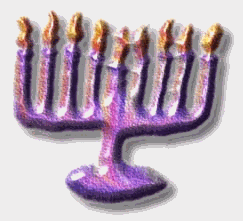
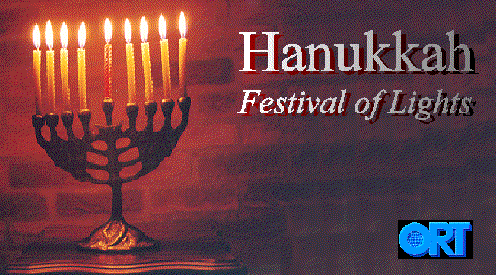
During the festival of Hanukkah, menorahs are lit for eight days to commemorate the miracle. There are nine candles on the menorah, one for each night and one for the shamash, or servant, the candle used to light the others.Families gather at nightfall to rekindle menorah flames, rededicate themselves to their faith, and to share in festive meals. Blessings are sung or recited as the candles are lit. First, a special blessing for the Hanukkah lights, then a blessing for the miracles that happened long ago, and then the blessing that is said on the first night of every Jewish holiday. It is called Shehehayanu.
During dinner, there are special potato pancakes called latkes fried in oil as a reminder of the miraculous oil.
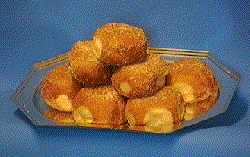
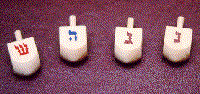 Each night the celebration continues with songs or readings, games, and small gifts. Children play the dreidel game with spinning tops; on each of the four sides of the dreidel, there is one of the four Hebrew letters that stand for a "Great Miracle Happened There."
Hanukkah is celebrated in the synagogue as well as in homes, and there are prayers and readings fom the Torah that accompany the lighting of the menorah.
The most important observance associated with Hanukkah is the kindling of the Hanukkah lights on the Menorah or Hanukkiya, a seven- or nine-branch candelabrum. On each night more more light is kindled, beginning with one candle on the first night of Hanukkah and ending with eight on the final evening. The lighting is accompanied by the chanting of appropriate blessings and the singing of songs. The ninth branch is reserved for the shamash, the servant light, which is lit first and used to kindle the other lights of the Menorah.
In a broader sense, however, the Hanukka light symbolizes the light of religious, national and cultural freedom won by the Maccabees for their people. It gave new force to the faith that had waned under the influence of Hellenism and Jewish culture began to flourish again. Also the Hebrew language, which had been largely supplanted by Greek, came into its own once more.
Menorah Comes from the Aramaic noor meaning "fire", and now means "candelabrum". It has become the symbol of the State of Israel Hanukkah Means "dedication", but also shares the same root in Hebrew as the word "educate". Hasmoneans Descendants from a family of priests from Modiinwho ruled the Hasmonean realm from 165 B.C. to 67 B.C. Maccabees The Hasmoneans are also called Maccabees. Their deeds are chronicled in the four Books of the Maccabees in the Apocrypha. Dreidel A spinning top with four facets so that, when it falls, only one side is uppermost like a die. The root is the Middle German verb meaning "to spin". Shamash. From the Hebrew verb meaning "to use", the shamash is the "servant" light, and is used to light the other eight candles. It can be used for other purposes as well, unlike the other candles which are only to be seen and not used. Eretz Israel The Land of Israel. Diaspora The global community of Jews not living in Israel. Talmud The body of Jewish law consisting of the Mishnah and the Gemara, also known as the Oral Law.
Hanukkah Recipe
Latkes
Latkes are potato pancakes fried in oil. The oil is a reminder of the miraculous oil that lasted for eight days when the Temple of Jerusalem was rededicated.
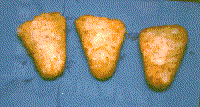 (Warning: Always cook with a grown up for help and safety; fried foods can get very hot and can burn!)
You will need:
4 cups peeled, grated potatoes
1 large onion, chopped
1 1/2 teaspoons salt
2 tablespoons flour
2 eggs
pepper to taste
2 teaspoons chopped chives (optional)
Wash, peel, and grate the potatoes. Squeeze out liquid. Combine with onion, salt, flour, and pepper (and chives). Lightly beat the egg, and stir into the mixture.
Heat the oil in a skillet, and spoon in tablespoons of the mixture to make medium sized patties. Brown on one side, turn and brown lightly on the other. Repeat with the rest of the mixture.
 Serve with applesauce, cottage cheese, yogurt, or sour cream.
