HOUSE DESIGN CONSIDERATIONS


 Introduction: philosophy, homework
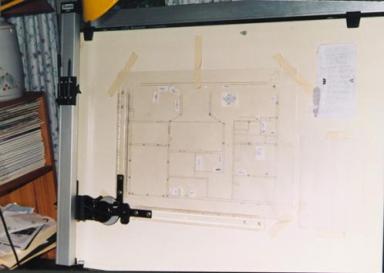
The house was to have the following
general design parameters:
BUILDING THE HOUSE
· most or all of the design and construction work would be done as an owner/builder and so save on labour costs, and also get more satisfaction from the job
· the design would incorporate passive thermal principles so as to minimise heating and cooling requirements, and so have low impact on greenhouse emissions
· construction activity and materials used to have low impact on the environment
· use low cost materials, but good quality
· realistic view of length of time to undertake construction. This had 2 large effects on the project:
o the house construction to be divided into separate sub-projects or modules each of which could be finished and used to live in while the next module is being built
o the floor to be constructed first, then roof, then walls. This would help provide shelter for building materials and walls as they were being built
LIVING IN THE HOUSE
· design and location of rooms will relate strongly to what activities go on in them, proximity to other rooms and the time of day it occurs
· efficient thermal design
· fit in with the bush environment, and low impact on the environment in general
· low maintenance
· long lasting
·
bushfire
resistant
· termite resistant
· it could be sold fairly easily in the future
Why mudbricks?
·
Mudbricks have been used for thousands of years in
many parts of the world (especially E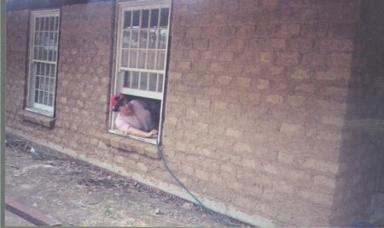 gypt). There are now significant numbers of
mudbrick buildings in such diverse places as USA (especially around Santa Fe),
China, North Africa, Middle East, South America and Australia (especially
Eltham in Melbourne)
gypt). There are now significant numbers of
mudbrick buildings in such diverse places as USA (especially around Santa Fe),
China, North Africa, Middle East, South America and Australia (especially
Eltham in Melbourne)
·
There are a number of different types of
Mudbricks – the original being mud, water and straw, but the most common now
(in western countries at least) being a sand and cement mix. All types are dried in the sun
·
Despite what you may think mudbricks do not wash away
in the first shower of rain. There are
a few mudbrick buildings, which have been made without cement, that are
hundreds of years old. The building
should be designed so that rain or water do not fall directly onto the bricks
(eg the eves should be fairly wide).
They can be made to last longer by painting with a waterproof
finish. On our house we used a mixture
of Mineral Turps and Linseed Oil.
·
Mudbricks have only fair thermal insulation properties,
but they do have good thermal mass.
This means that they are not great at keeping heat outside (in Summer)
or cold outside (in Winter).
Insulation can be improved by making the walls quite thick – 300 mms (12
ins) is common. However, with 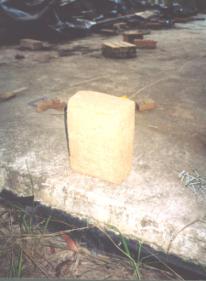 appropriate
house design you can make the mudbrick walls to help control the temperature
throughout the whole house. In other
words the mudbricks can maintain a steady cool temperature (in Summer), and in
winter they can soak up heat from the sun during the day and let it out slowly
at night (when most people are inside).
appropriate
house design you can make the mudbrick walls to help control the temperature
throughout the whole house. In other
words the mudbricks can maintain a steady cool temperature (in Summer), and in
winter they can soak up heat from the sun during the day and let it out slowly
at night (when most people are inside).
· mudbricks are generally about 200 to 400 mms long, (8 ins to 16 ins) with the dimensions of the bricks we use being 300 mms by 200 mms by 125 mms (they weigh about 10 kgs (22 lbs)).
· Mudbricks are an extremely flexible and versatile building material for making walls, especially when made of bricks that have the mud/sand/straw combination. Do you want to add an extra window – just cut out a section of bricks with hammer and chisel in about 10 minutes (the cutout material can be re-used elsewhere in the building) and with a bit of mortar and water can look like it was designed to be like that; or some bricks poke out a bit too far – simply chip some material off the offending bricks, or add a bit more mud until it looks right
·
The
mortar used to lay the mudbricks is the same material as the mudbricks
themselves.
·
Mudbricks
are also an excellent material for making internal walls. This was an important design point to help
with good passive thermal design, as the mass of the brick walls would do a lot
to help maintain a constant temperature inside the house. Fired bricks will also do a reasonable job
of this. It is also easy to drill holes
to hang pictures, or install electrical cabling. When used inside mudbricks should be sealed (Silicone sealer or
wallpaper size) to prevent small mud particles raining onto the floor.
.
House and room Orientation
·
For
the Southern hemisphere the sun spends the hot part of the day in the North. For best thermal performance the house
should be designed so it is protected from this sun in Summer, but can take
advantage of it in Winter
·
The
longer side of the house should face the sun in the north (Southern Hemisphere)
·
Bedrooms
on the East so they don’t heat in afternoon sun
·
Bathroom
and little used rooms to be on the south side (away from sun)
Room layout
·
For
best social interaction by house occupants it was thought best to have the
kitchen next to dining and living areas with an open plan arrangement. This is also easier to keep at a pleasant
temperature
·
 Rooms where people spend time during the day should
have plenty of window space and be
light
Rooms where people spend time during the day should
have plenty of window space and be
light
·
Areas
for children’s activities should be able to be separated from living areas
·
The
garage was to be on the west as protection against westerly winds (in winter)
and hot afternoon sun in summer
·
The
south part of house was to have rooms which are used at night – bathroom,
storage
Thermal
·
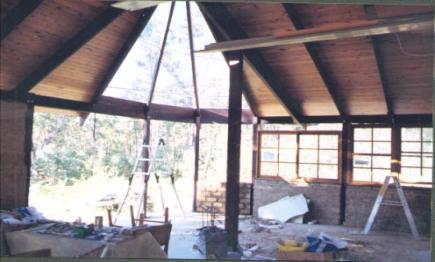 We
used Passive thermal design principles in designing the house. These include facing the longest house
dimension to the north (when located in the southern hemisphere), most windows
located on the northern side, longer dimensions east/west, slab on ground floor,
and solid and massive internal walls.
We
used Passive thermal design principles in designing the house. These include facing the longest house
dimension to the north (when located in the southern hemisphere), most windows
located on the northern side, longer dimensions east/west, slab on ground floor,
and solid and massive internal walls.
· The
ability of mudbricks to absorb heat (during the day) and let it out slowly (at
night) was used to help heat the house in winter. This is done by carefully designing the house orientation, walls,
and eves so that they catch sun during winter, but are shaded in summer
·
These principles will result in lower
energy costs and greenhouse gas emissions
Other features that
are installed, or will be soon to aid good thermal performance all year round
are:
·
Eves to be designed so that hot summer
sun is kept out of windows, but Winter sun can shine through Windows
·
High R rating insulation used in all
ceilings spaces
·
Thick curtains especially on the
northern side
·
Solar hot water system.
·
Ceiling ventilation – this must be a
smart system that works when appropriate (ie when the in-ceiling space becomes
very hot)
·
Trees and hedges to be planted to the
West of the house to minimize wind in late Winter and hot afternoon sun in
Summer
Thermal performance so far (with only
some of these features installed) is excellent and we expect that the house
should only require additional heating or cooling from a small heat source in
winter.
Walls
Most houses in western countries now have 2 skins in their outside walls (eg brick veneer, double brick). This helps with insulation, wiring and pipes, and it helps keep out water and wind. For our mudbrick walls we decided that this was unnecessary and have used one thickness only. The mudbricks are laid cross ways in the outside walls so they are 300 mms thick. For the inside walls the bricks are laid end on so they are 200 mms thick. We found that the walls insulate very well, and it is easy to cut channels or holes out to install pipes and wiring.
Floor
There are many types of
floor systems available. Points we
considered included : thermal design principles, termite control, moisture from
the ground, cost, ease of construction, ease of 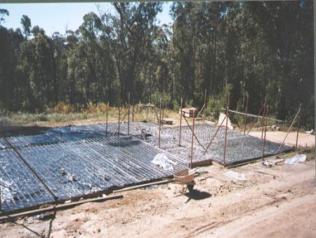 modification,
ease of constructing other parts of the house on, or with, the floor, access to
underfloor services (plumbing and cables), maintenance and covering types.
modification,
ease of constructing other parts of the house on, or with, the floor, access to
underfloor services (plumbing and cables), maintenance and covering types.
·
We chose the concrete slab-on-ground option, for the following
reasons:
o
good thermal performance as the slab tends to remain at the same
temperature as the ground it lays on (approx 15 deg Cent) with the result that
less energy is required to heat or cool the house to a comfortable temperature
for humans. Many local councils now
have regulations specifying concrete slab on ground construction for all new
houses.
o
Concrete is a well known material that is easy to work with,
resilient, waterproof and strong, and therefore a good base on which to
construct very heavy mudbrick walls.
Mudbrick walls are quite heavy, and substantial footings are required to
support them It is also easy to
incorporate concrete footings with a concrete slab. Its disadvantages are it is relatively expensive, and has a poor
environmental rating in its manufacture and installation.
o
A 100 mm (4 ins) thick concrete slab provides excellent
resistance to termites if joins, gaps and cracks are attended to by a
specialised system (we used Termimesh – a fine stainless steel mesh)
·
We did consider constructing the slab from Mudbricks, rather
than concrete. However, this would
have been more difficult to protect from in-ground and above-ground moisture,
would not have offered as good protection from termites, would have taken a lot
longer to construct, and is an unknown quantity for support of walls. This system would have been a lot better
from an environment impact perspective.
Overall we decided that there were too many unknowns and it would have
been too difficult, and added too much time to the project.
Roof
·
Roof
tiles are a popular choice for houses in much of Europe and Australia. However, they have a number of
disadvantages including high weight (increasing further by absorption during
rain or snow) which requires more substantial and costly roofing support, high maintenance requirements
(especially after winds, rain and ageing), and higher costs for initial
purchase and installation.
·
We
chose Colorbond because it has none of these problems. Sarking would be used directly under the
Colorbond to slightly improve insulation, and mimimise water condensation
problems
·


 In general more than 50% of heat loss and gain in
houses is through the ceiling and roof.
To minimise this problem Batt type insulation would be used in the
ceiling space for all rooms.
In general more than 50% of heat loss and gain in
houses is through the ceiling and roof.
To minimise this problem Batt type insulation would be used in the
ceiling space for all rooms.