| Traveling on the backroads north to Columbia, I crane my neck, searching for familiar names on the street signs. Most of them I've traveled down, only months before. I knew them all, each road corresponding to images of homes and shops we'd stopped at.
I assumed my summer job with the Berkeley County tax collector would be an office job, and to a certain extent it was. There was endless filing, typing, and faxing. But then came the maps - hundreds of huge aerial photographs of the county shaded in purple-blue. Each map was divided into numbered plots of land, indicating where ownership changed. Every day we'd receive printed levies that showed us who owed taxes on their land, mobile homes, or buildings. With a black pen we'd mark the corresponding plots on the maps.
For every one day spent in the office, I spent two out in the field delivering the delinquent tax notices. Some days I drove, other days I navigated, depending on which co-worker I was paired with. We'd collect our levies, maps, sunglasses, and water bottles and walk out the side door to the Cherokee. All county automobiles gleamed white with the official seal on the door, but I could always pick out ours from the sea of similar vehicles. It was the one splashed with mud.
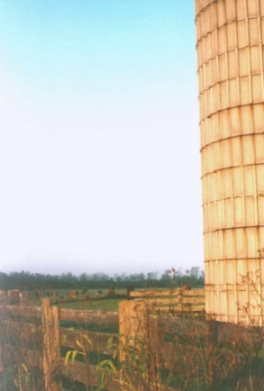
We'd cover the same area for days sometimes, searching for residents. Some were easy - numbered mailboxes protruding from tall grasses, guiding us to the right place. Other times we would drive the length of a dirt street repeatedly, scanning for a rooftop among the cornstalk horizon.
| 
|
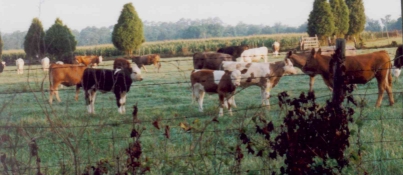
| It was drives like those that revealed so much to me. There was life, life I knew existed somewhere, that I was just beginning to see. Far beyond the sounds of the highway manifested what truly defined Berkeley County. Down winding paths named Polecat Alley and Zion Road, tractors waited, anchored to the edges of fields. Old coloreds from a distant generation rocked on rickety porches, their tired eyes rekindling a gleam as their gaze followed our Jeep. There were cabins draped in Confederate battle flags, almost swallowed by the forest, as if to discourage our discovery of them. Pigs greeted us at the end of their pens with snorts and grunts, while chickens slowly cantered across the path in front of our tires. There were trailers, nearly half a century old, rotting from every exposed crevice.
|
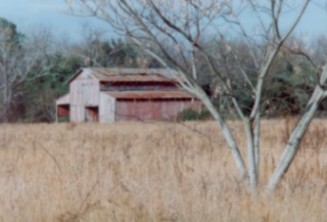
| The division between quaint and dilapidated was often subtle. I love the old in the things we came across: old houses, old people, old ways, old establishments. I'd swear my grandfather used to hunt in the miles of woods that covered the whole of some maps I held, while ancient pines and oaks met my view when I looked up. I could imagine my grandma was born in any number of white, one-room houses we levied on. It was the breath of the living past that I could feel, and I breathed deeply in it. The old makes life slow to almost a blur, and that is something rare in the present world. But what I hated was when the two collided - one not replacing the other, but instead living on top of the other in a parasitic fashion. And it was always the modern that smothered the old. The struggle to keep up with the fast pace of life sometimes left no time for concerns requiring patience and care. Shutters hanging askew from one corner spoke to me of neglect. Rusted cars, long naked of any original trace of color, spoke to me of neglect. The eyes of half-naked children, gaunt, not necessarily from hunger but from lack of human touch, spoke to me of neglect. Much like the joy I felt in the beauty of the old things of Berkeley County, yet to the opposite extreme, I felt a great sadness in the things left hollow by inattention.
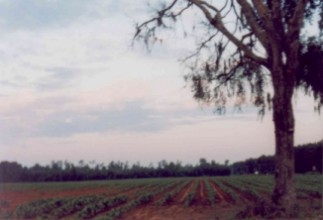
It's the ability of the land and people that surround me to evoke such feelings that strike me so much. Before my summer as a deliverer of delinquent tax notices, I knew I was missing a connection to the land I lived in. But I didn't realize exactly how deep that chasm ran until I began to fill it. What I've gained, what is now inextricably part of my being, is a sense of familiarity with the land and people I've lived with all my life. I can finally say 'home' and mean it.
| 
|
|