13th April, 1998
My flight to Narita airport departed in the early morning, at 9am, which meant I had to check in at 7am! However, compared to Matt, who had to get up at 3am, I was fortunate. In fact, Matt didn’t sleep at all that night, as he was frantically packing.
I knew that Matt’s flight should arrive at Narita at around 7am, and therefore he had to wait more than six hours for my flight, which arrived safely at 2pm. Upon clearing the immigration and customs, I saw Matt waiting for me. There was a pretty girl beside him! It was Aya, Matt’s penfriend from Chiba, who came to the airport to meet him. She helped us to arrange our accommodation. We managed to get a reservation at the Suzuki Ryokan at a reasonable 8000 Yen per night. [When Matt returned to the UK and told his Japanese friend Masa about this accommodation, Masa laughed a lot and commented, "Matt, that’s TOO cheap!"]
I was a bit surprised that Matt was happy to stay in a traditional Japanese inn, because he had told me that he could never sleep tatami style. He later explained to me that initially, he had thought tatami style meant sleeping directly on the floor, instead of a mattress!
We said goodbye to Aya, and boarded the Narita Express to go to Tokyo. An hour later, we arrived at the Tokyo station where we needed to change to the Yamanote line, to go to Nippori station. We spent more time finding our way around the busy Tokyo station and working out what to do, than on the actual six-stop journey to Nippori!
Disaster struck when we arrived at Nippori station. Partly due to my overconfidence in my navigational abilities, we managed to get hopelessly lost. We tried lots of directions, and still couldn’t find our ryokan. We even stumbled upon a cemetery! We were really tired by then, since we were wearing our huge backpacks. Eventually, we backtracked to the station, and found our ryokan within two minutes.
The innkeeper of the ryokan spoke no English, but she managed to convey the rules with snippets of Japlish and copious amounts of hand waving. Our room was reasonable, and had air-conditioning. After settling down, I handed over the digital camera, which Matt had asked me to buy for him in Hong Kong. He was so excited about it (particularly the price – it was 40% cheaper in Hong Kong) that he decided to take the instruction manual as his bedtime reading that night.
After we have cooled down a bit, we went out for dinner. As a side effect of our earlier disorientation, we had already located some reasonable restaurants. We chose a Chinese restaurant, and it wasn’t too difficult for me to read the menu, because many items were written in kanji – the set of Japanese characters borrowed from Chinese. Of course, I couldn’t pronounce them in Japanese, so Matt’s studying came to the rescue. He was able to order by saying "please give me this and that"! Not particularly elegant, but it worked.
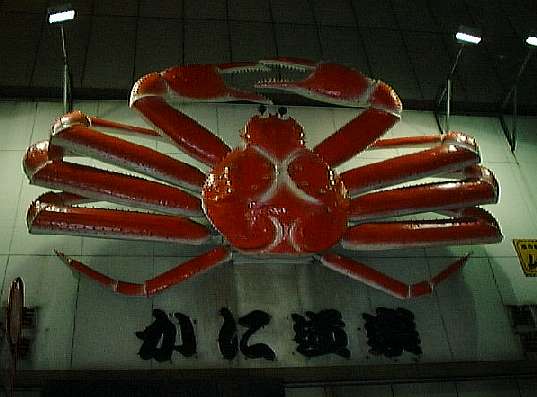
A huge crab outside a restaurant in Shinjuku
After dinner, we decided to get a glimpse of Tokyo’s night life by going to Shinjuku, Tokyo’s business and entertainment centre. When we left the subway station, we were immediately dazzled by the flashy neon lights displays all around us. We wandered around aimlessly, just to soak in the atmosphere.
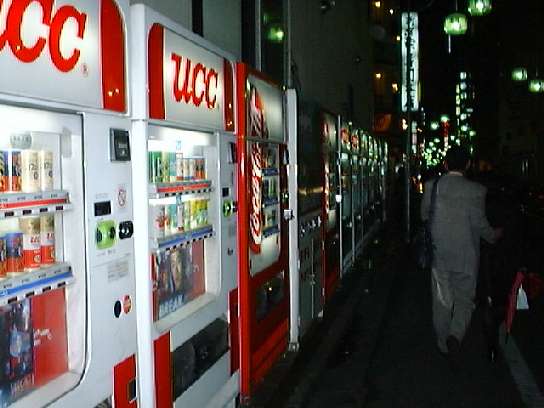
A huge array of vending machines
There were many shops, pachinko parlours, arcade centres, huge video screens and of course, vending machines. The omnipresence of these outdoor vending machines and the variety of items sold astounded us. Maybe it explained why shops in Japan seemed to close so early. We were genuinely disappointed when things started closing at 7pm. By 9:30pm, the majority of shops and department stores had already closed, even if they were in the busy entertainment districts.
Finally, we were worn out, so we took the JR Yamanote Line back to our ryokan. Matt had fun reading the instructions of his digital camera before sleeping.
14th April, 1998
The effect of walking around cemeteries with heavy luggage showed when we didn’t wake up until rather late. After buying some breakfast at Seven Eleven, and reserving our shinkansen seats to Kyoto for tomorrow, we started our Tokyo sightseeing – the Ueno-koen Park. The park boasted a big zoo and a number of museums. We read our guidebooks and generally thought that the museums were of medium interest, so we picked the best-sounding one to visit: the Tokyo National Museum.
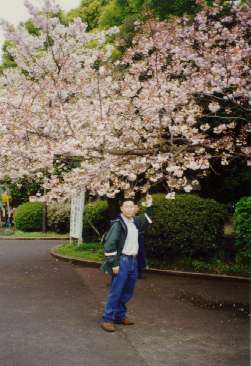
Yours truly, taking a picture with these sakura
While walking through the park, we chanced upon some famous Japanese cherry blossom, called sakura. It was extremely beautiful. They can only be seen for a few days each year, so we felt very lucky. When we arrived at the museum, we discovered that the admission was rather expensive, because of a special exhibit in which we had no particular interest, so we decided not to visit after all.
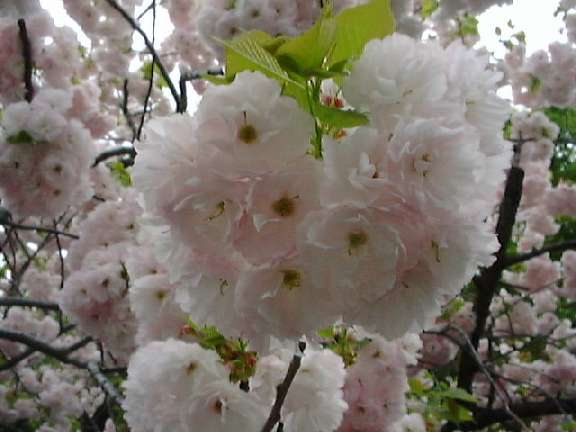
A close-up picture of these cherry blossoms
We went to Ueno Zoo, and we saw most of the animals we expected to see. But there were a lot of more unusual animals, including penguins, polar bears, flamingos, and most notably, pandas! The two pandas were really lazy and they were sleeping all the time. The zoo was quite enjoyable and we spent a lot of time there. When we finished, it was already time for lunch. On our way out of the park, we stumbled across the "Samurai walking his dog" statue. It was mentioned in our guidebooks, and we agreed that it was quite funny.
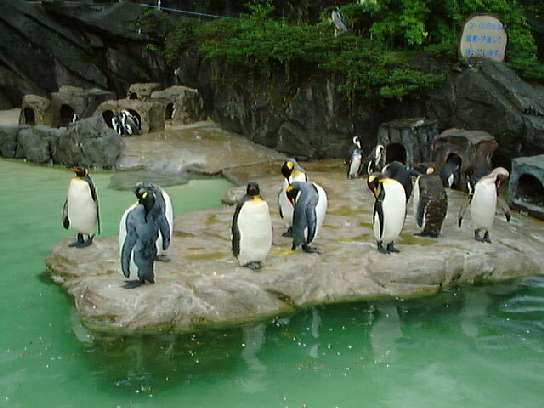
Penguins in Ueno Zoo
We had our lunch in a restaurant in the railway station. This time, ordering our meal didn’t go quite so smoothly - we weren’t able to match the plastic replicas of food displayed outside the restaurant with the items printed on the menu. Eventually, we decided to have the same meal as a man at an adjacent table, and surprisingly, Matt’s Japanese was good enough to tackle this problem!
After lunch, we went to the "heart of old downtown" – Asakusa. The big attraction was the Senso-ji Temple, reputedly the liveliest Buddhist temple in Japan. The Raimon gate marked the entrance, where a 3.3m-tall lantern weighing 100kg was hanging. The path from the gate to the temple itself was lined with shops, selling all kinds of food and souvenirs. Inside the temple, people undertook a strange ritual while they worshipped. They would go to a huge pot where joss sticks were burning, and try to waft the smoke onto their faces or clothes. This action was intended to bring good luck.
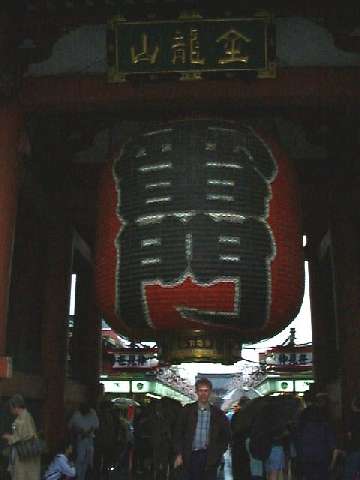
The huge lantern at the entrance of the Raimon gate
A rest and a drink in McDonalds followed before we went to Yasukuni Jinja. It was famous (or infamous) because ashes of Japanese soldiers killed in WWII (and hence some very notorious war criminals) were stored there. Whenever the Japanese Prime Minister or other Japanese officials visited the shrine, it would cause uproar in neighbouring countries.
When we finished the shrine, Matt wanted to see the adjacent Nippon Budokan. Apart from budo, which of course was played there, the Budokan was also a famous concert venue. Previous performers included even the Beatles. Next stop was the Ginza. In Japanese, Ginza means a place with lots of shops and streets. There were many huge department stores and shops, lots of them selling designer clothes from abroad. We went to a few of these department stores, and bought a gift at Matsuzakaya.
As predicted by our guidebook, we had difficulty finding a place for dinner in the Ginza. There were lots of expensive restaurants with hundreds of smartly dressed business people crammed into rows like sardines, but these were a bit intimidating for us. After spending more than an hour looking for somewhere to eat, we eventually gave up and returned to Nippori and had a simple beef with rice dinner in Yoshinoya. We should have listened to the advice of Lonely Planet and avoided Ginza when trying to find somewhere for dinner.
15th April, 1998
After a good sleep, we woke up refreshed. We began packing and were ready within plenty of time. We went from Nippori to Tokyo to catch our shinkansen to Kyoto. It was an ordinary but pleasant train ride. We slept a while longer, and bought our lunch. Matt had a bento box and enjoyed it. I was a bit sceptical about it though, so I had some sushi and dim sum instead.
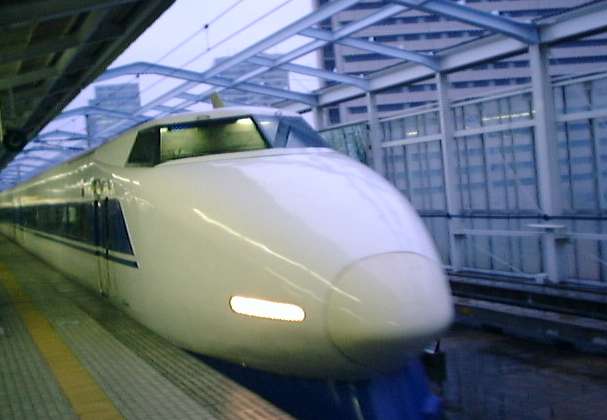
Shinkansen
We finally arrived at Kyoto. Any visitors who, like me, expected to see temples all around a medieval town, would initially be disappointed. It was less busy than Tokyo, for sure, but the railway station was probably the most modern, clean, and generally nice that we had ever seen. There were lots of underground shops and the station was simply vast. So vast in fact, that we were a little bit lost when we tried to find the tourist information centre. We soon regained our bearings, however, and arrived at the TIC. The very helpful staff reserved a room for us. When we asked which subway station we should go to, they explained (to our slight alarm) that we’d need to use the bus system.
It is generally agreed that bus travel is difficult for travellers, as mass transit systems are generally the best sign-posted. The city of Kyoto did its best to ensure tourists could use their buses, by providing detailed bus routes at the railway station. While it gave us great satisfaction to eventually master the bus system, our heavy luggage made sure that our first attempt was no fun. We were told to take bus number 5 to go to our hotel, the Sun Hotel. We tried to ask the driver to tell us when to get off, but he wasn’t very helpful. I followed the turns the bus made, and my confidence grew as it seemed to match the route printed on the bus map. Eventually, we even managed to get off at the right stop, and we found our hotel in no time.
The check-in time was not until 3pm, so we left our luggage with the hotel so that we could see some sights in the meantime. We sat in the hotel lobby to decide the first attraction to go to. We wanted to choose somewhere nearby that didn’t require a bus ride. We finally selected the Nijo-jo (Nijo Castle).
What seemed like a short distance on the map actually made for an hour’s walking! Our legs were very tired when we finally arrived. En-route, we stumbled across the Museum of Kyoto – it sounded interesting, but we simply couldn’t believe our misfortune when we discovered it closed on the third Wednesday of each month! We comforted ourselves by imagining the museum to be very uninteresting.
This castle, which was nominated as a World Heritage a few years ago, was originally built in 1603 to be the official Kyoto residence of the first Tokugawa Shogun Ieyasu. The most important sight was the Ninomaru Palace. Lots of the rooms inside were decorated with beautiful screen paintings and the whole experience of visiting the palace was made more interesting by their placing of life-sized models of shoguns, feudal lords, female attendants, and guards in the appropriate places. The "Nightingale Floor" was quite amusing. From the entrance of the palace to the Grand Chambers, the wooden floors made a strange bird-like sound whenever somebody walked on them – a medieval intruder alarm!
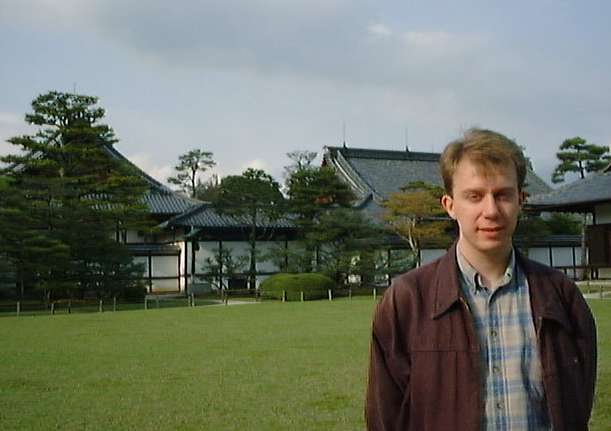
Matt, at Ninomaru Garden of Nijo Castle
After finishing the palace, we had a walk around the Ninomaru Garden but enjoyed it only a brief time before returning to our hotel to check-in. While we were resting, I had been working hard to understand the bus route map, and we took a bus back to our hotel. We certainly didn’t fancy another long walk!
Once we had checked-in, we decided to see a traditional Japanese arts show in Gion Corner. We opted to see the later show at 8:40pm, leaving us ample time for dinner beforehand. We first visited the beautiful Yasaka Shrine, which featured one of tallest torii gates in Japan. It was strange visiting a shrine in the darkness of evening, but some of the buildings were illuminated and hence very pretty. We went to a restaurant and ordered the by-now-familiar dish of "ka-tsu-don" (pork fillets with rice).
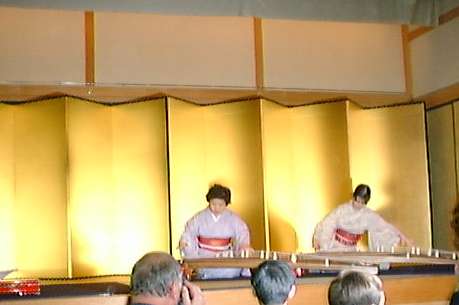
Koto music at Gion Corner
After dinner, we strolled to Gion Corner for the show. The admission was a steep 2800 Yen. The show consisted of seven parts, each illustrating a traditional Japanese art. It started with a tea ceremony, followed by koto music (Japanese harp) , flower arrangement, gagaku (court music), kyogen (ancient comic play), kyomai (Kyoto style dance), and finally bunraku (puppet play). The kyogen was probably the most interesting part, because of the exaggerated actions of the actors and the strange voices they used. We enjoyed the 55-minute show, although perhaps the admission was steep. It was perhaps disappointing that it didn’t include kabuki drama, probably the most famous traditional Japanese art.
16th April, 1998
After a quick breakfast, we began the day’s sightseeing with Ginkaku-ji. Just when I thought I had mastered the bus system in Kyoto, a mishap occurred. We took a bus that I thought would take us to the temple; instead, it terminated two stops after we got on the bus! We kept saying "Ginkaku-ji" to the driver and he must have taken pity on the silly foreigners, as he directed us to another bus stop and waived our fares.
One (correct) bus ride and thirty minutes later, we arrived at Ginkaku-ji (Silver Pavilion Temple). It was easy to tell if we were at a place of interest in Japan, by the hordes of schoolchildren wearing the distinctive Japanese uniforms.
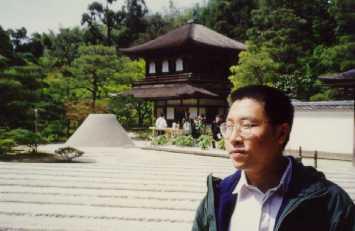
The sans silver Ginkaku-ji
The temple was initially built in 1482 by a shogun by the name Yoshimasa Ashikaga, as his villa. After he died, Ginkaku became a temple for the Zen sect, according to his will. The name of the temple came from the fact that the original plan was to cover the building with silver leaf ("gin" means silver in Japanese). However, this plan never came to fruition. The garden was very beautiful, but we felt tourists in a hurry could skip this temple. There was no public admission to the temple itself, although it did offer the consolation of a panoramic view of Kyoto from a small hill.
After we finished, we returned to the railway station for lunch and to reserve seats on tomorrow evening’s shinkansen to Hakata. After lunch, we went to the nearby Higashi-Honganji Temple. It was apparently the largest wooden building in Kyoto, although certainly not its finest temple overall. There seemed to be some kind of ceremony or Buddhist convention in progress. We could go inside, but weren’t allowed inside the temple itself. In fact, some ushers politely asked us to get out of the way, when we were almost trampled down by hundreds of worshippers filing into the temple. There was a strange dance ceremony in progress. A lot of girls were dancing in strange costumes, in time to some music being played on enormous wooden xylophones. The sound from the xylophones was quite deep and rhythmical.
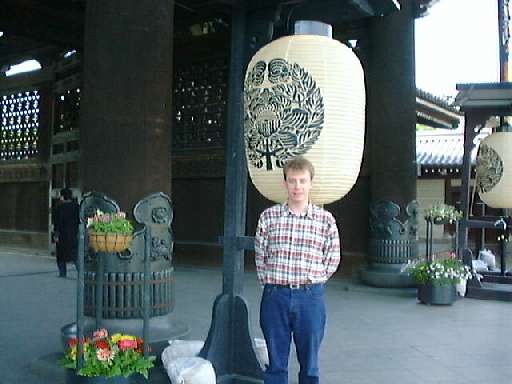
Matt fancied taking a picture at the entrance of Higashi-Honganji Temple
Eventually, time was up and we needed to rush to the Imperial Palace. They have two guided tours for foreigners, at 10am and 2pm. As usual, we were running slightly late and almost missed the deadline. Visitors needed permission to enter the palace. According to the Lonely Planet book, Japanese people usually had to wait for 3 months or longer for the admission, but fortunately, foreign tourists (who couldn’t wait so long) were given preferential treatment. The process was supposed to take fifteen minutes, but since we were running late, some pleading glances got our passes stamped within two minutes!
We only had to produce our passport before the tour started and we were allowed in. In the entrance area, I noticed a sign in kanji saying that photography was not allowed, although there was no English translation. Some other members of our group took pictures right in front of the official tour guide, and were not stopped, so we decided to follow suit. Sometimes there were advantages in being an illiterate foreigner!
The original palace was destroyed by fire. The site for the present palace was chosen in 1790, and it was completed in 1855. Our guide explained the functions of some of the palace rooms to us. She was most excited when she explained about the palace’s main gate. Apparently, only important guests were allowed to use it to enter. In modern time, Prince Charles, Princess Diana and President Ronald Regan had used that gate. Our map described the palace as "most noted for its striking simplicity", and we couldn’t have agreed more.
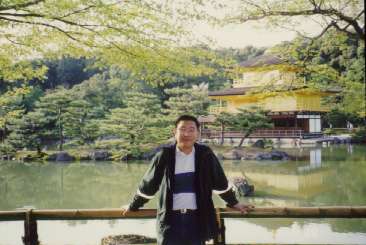
The very beautiful Kinkakuji
Our final stop of the day was Kinkaku-ji (Temple of the Golden Pavilion). Like its Ginkaku counterpart, it started out as a villa. When Yoshimitsu died, it was made into a Zen temple. Unlike its Ginkaku counterpart, the second and third floors of the building really were covered with gold-leaf. Of course, the gold-leaf we saw wasn’t original. It had been extensively repaired in 1987, and the present gold-leaf was five times thicker than the original. Together with the mirror pond, they made a wonderful scene, and we took quite a lot of pictures as a result.
After a brief rest at our hotel, we went out for dinner. After dinner, we browsed in the area around our hotel. Matt bought a Japanese computer games magazine (called "Login"). Matt admitted that he couldn’t read it, but it was a nice thing to have anyway.
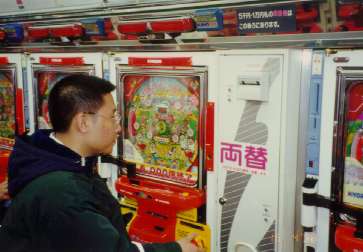
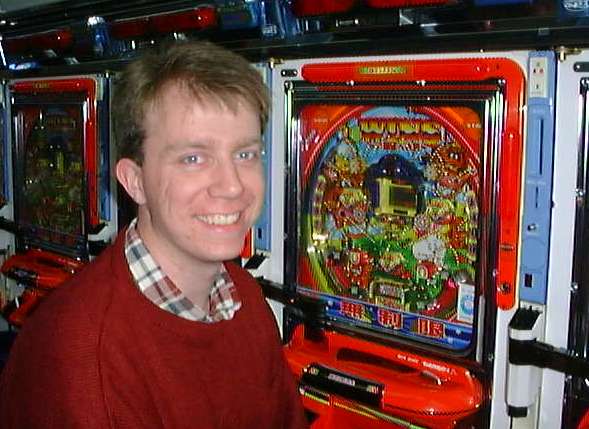
We both tried our luck at this pachinko parlour, but sadly we failed to make our fortunes.
For fun, we visited a pachinko parlour. We had entered one in Tokyo but we left when we finally couldn’t work out what to do. This time, we were determined to give it a go. We watched some of the players, and finally understood the routine. You needed to insert a 500 Yen coin into the machine, and a large pile of marbles was dispensed. You placed the marbles in the machine, and turned a knob to select how hard they would be propelled around the course, a bit like a pinball tables. Depending on where the marbles went, you would win bonus marbles. Of course, you needed to continuously win more marbles than you lost, to be successful. We both had a try, but failed to make our fortunes. We even took pictures of each other playing, but eventually were told off by the manager – possibly our flashes disturbed the other players.
Matt wanted to do one more thing before returning to the hotel – to make some "print club" photo labels to stick on postcards to his friends. Such machines were in plentiful supply. Unfortunately, it was only after inserting the 300 Yen fee that Matt realised the machine he had selected would print labels with comical hair alterations. Back at our room, I looked at Matt’s stickers again and laughed, and decided that I couldn’t miss this chance, and went out again to make some for myself!
17th April, 1998
We had a hectic day today. We had planned to visit Kiyomizu Temple and Sanjusangendo Temple in the morning, have a half-day trip to Nara in the afternoon, and then rush back to Kyoto for our evening train to Hakata. We packed our things in the morning, and went to the railway station to store them in lockers.
From station, we took a bus to Kiyomizu Temple. The bus was absolutely packed – it seemed like everyone had had the same idea as us. The temple was built on a steep hillside and its entrance was on "Teapot Lane", so-called because of the numerous shops lining the approach, which sold Kiyomizu ceramics.
After our brief stay in Japan, the crowds of schoolchildren at the temple did not surprise us. It wasn’t hard to see why this was a popular spot. It was beautiful, and its location commanded a grand panoramic view of the whole city. Three separate streams of water formed waterfalls near the temple. According to my guidebook, these three streams represented wealth, intelligence and beauty. People were supposed to choose two out of three to drink to be bestowed with those virtues; anyone greedy enough to drink all three would get no reward at all.
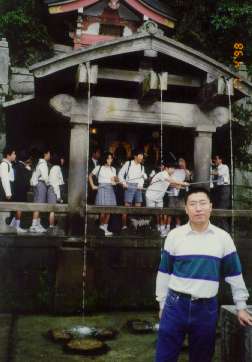
Me at Kiyomizu Temple
Our final attraction in Kyoto was Sanjusangendo (which means hall with thirty-three bays). The number "33"' was derived from the belief that Kannon could disguise himself with 33 different figures. There were altogether 1001 statues of Kannon in the hall. We were unsure as to whether we should enter, given the admission price and the fact that our train to Nara would depart quite soon, but eventually we entered and were impressed by what we saw. However, we did miss the bus to go back to the railway station, and we were forced to wait for the next rapid train.
It was a shame that we arrived at Nara so late (2:30pm-ish) as it meant we couldn't see everything we wanted. There was a very convenient circular bus route in Nara that went round all the major attractions. It was an old city, even older than Kyoto, and from 710 to 784 AD, was the capital of Japan.
Our first visit in Nara was the Kasuga Taisha Shrine. It was considered one of the three great Shinto Shrines of Japan, but unfortunately, it was close to public when we were there. It seemed that a marriage ceremony was in progress. Disappointed that we couldn’t go in to see the shrine, we decided to pay a visit to the nearby treasure room. Unfortunately, the small number of exhibits didn’t justify the admission.
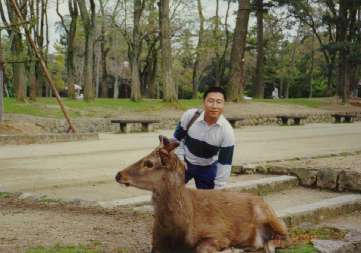
A deer, taking a picture with me
Seeing as we were short of time, we quickly left and crossed Nara Park to Todaiji Temple. Our route to the temple crossed through the Deer Park, and there were hundreds all around. Matt told me that English deer were far shyer than their Japanese counterparts. Lots of people were having fun taking photos with the deer. Some of the cheekier deer amused themselves by harassing schoolgirls!
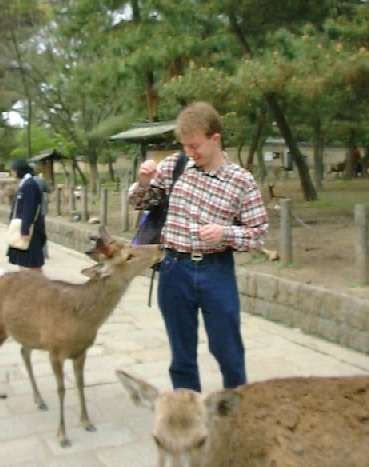
Poor Matt being harassed by a deer while being pictured
Todaiji was the one of the biggest attraction in Japan, having Japan’s biggest Buddha statue. The temple was temporarily closed because of a VIP was visiting it. We couldn’t guess the identity of the VIP, but a lot of schoolchildren shouted and waived when they saw him.
On our way back to the station, we briefly passed through Kofukuji Temple, but we didn't have time to visit it. We managed to miss two trains, including a rapid train, and we had to go back to Kyoto on a slow service. It was the last one we could take without the risk of missing our shinkansen to Fukuoka that evening.
As we needed to go back to the lockers to reclaim our luggage before getting on the shinkansen, we didn't have time to buy dinner, and we were forced to eat on the train again. I bought a bento on the train owing to indecision. Matt enjoyed his, but I vowed I wouldn’t repeat my mistake.
A few hours of train later, we arrived at Hakata Station in Fukuoka, and managed to locate our nearby hotel quite quickly, without getting lost. We were in our room within 20 minutes of leaving the station! That night, Matt was really excited about meeting his penfriend. Eventually, Akiko called and told us that they would meet us at the hotel reception at 10:30am the next morning.
18th April, 1998
This morning, we were planning to meet Matt’s penfriend Akiko, and her boyfriend Tei. I woke up particularly early and went out for a walk as I had a lot of time to spare. I bought some stamps in the post office and paid a short visit to Sumiyoshi Shrine. Apparently, it was the oldest shrine in Kyushu. Unfortunately, it started raining and eventually it became quite heavy, so I was quite soaked when I returned to our room. I briefly dried myself and then went downstairs with Matt to wait for Akiko.
While we were waiting, a man from the reception desk came over to us and asked us to move from room 898 to room 798. We weren’t so happy about this, having fully unpacked the night before. However, we didn’t even try to ask the man why we needed to move, as this was beyond both Matt’s Japanese and his English. So, we returned to our room, and packed all our belongings (rather haphazardly), and moved them to a room one floor lower. The room was identical in every respect (it was even exactly underneath our previous room), except that smoking was allowed here, and hence it was a bit smelly and dirty. Of course, we didn’t want a smoking room! By the time we returned to the lobby, Akiko and Tei had already arrived.
I was glad that Matt had friends in Japan. He was really excited about meeting Akiko and Tei, after having exchanged so many letters with Akiko. He said that he couldn’t help being a little bit nervous, as this was the first time he had met them! It was really good to have some experiences that were not solely from the perspective of a tourist. Akiko and Tei were very pleasant, and gave us a warm and friendly greeting. After our introductions, Matt suggested that we went somewhere to sit down and have a drink.
We went to a kind of café bar in the railway station concourse. We sat down and talked about a lot of things. Akiko showed us a copy of Newsweek. She explained to us that there was an article in that issue about the best places to live in Asia, and surprise, surprise, Fukuoka was rated as the best city to live in all of Asia! The cover of the magazine showed Canal City - a huge, modern and smart shopping complex in Fukuoka.
The night before, I told Matt that I would like to visit Space World (a very exciting theme park), when we were in Fukuoka. I suggested that we went there together, but unfortunately, we didn’t have enough time. After we finished our drinks, we decided to visit the Canal City that was shown on the magazine cover.
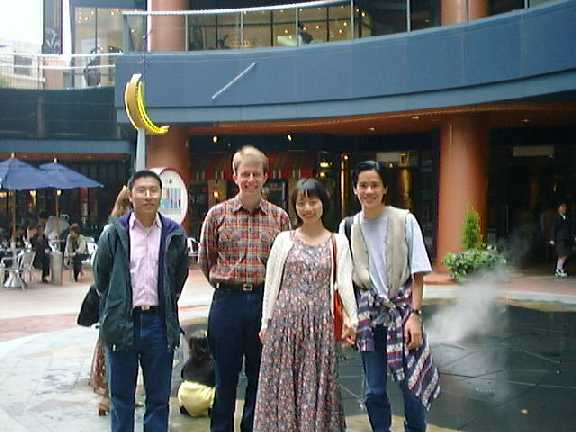
Canal City was a 20-minute walk from the station. As we entered, we saw a large array of print club machines. Aki was quite excited and suggested we took a picture of the four of us. The machine speedily printed a sheet of small stickers, which we divided amongst us. The picture was great, except for two small problems. Firstly, the machine cut a border around the picture so that it could easily be peeled away, which caused the top of Matt’s head to be missing. Secondly, for some reason, my head was much bigger than everybody else’s. It was because I was closest to the machine, I promise!
We then browsed in a department store for a while. We looked upstairs for the video game on which Matt worked, but they didn’t seem to stock it. Aki demonstrated a "rape alarm"; it made an embarrassingly loud noise until she managed to switch it off again. We saw some devices for measuring blood pressure and played with them for a while. Aki tried to measure Matt’s blood pressure, but the machine read "0" all the time, so we concluded that Matt was already dead. Matt was particularly amazed with the range of electronic goods on offer, and their low prices. The most amusing item we saw was a "virtual fish tank". In reality, it was a video of fish playing on a large screen TV behind a real tank of bubbling water. No more feeding the fish or cleaning their smelly tank!
Matt wanted to buy a CD of Japanese music, so our next stop was the audio department. He wanted songs sung in Japanese, which was actually a little bit tricky, as a lot of Japanese groups seemed to sing in English. Even with the expert assistance of Aki and Tei, Matt wasn’t able find a good one. Eventually, he realised that the in-store music was roughly what he was looking for. Aki asked an assistant what was playing, and Matt bought it. His foreign credit card seemed to cause the assistant a few difficulties, although these were swiftly solved. The CD had an English title – "Time to Destination" by "Every Little Thing", even though the music was in Japanese.
Matt had been considering whether to purchase a personal CD player at the aggressive Japanese prices. Now that he had a CD, it was a must! However, we had previously read in our guide book that Den Den Town in Osaka was the number one place in Japan for competitively priced electronic goods, so Matt would have to wait for a few days before he could listen to his newly purchased CD.
It was then time to have lunch. The day before we had eaten soba noodles, so this time when Aki and Tei asked what we would like to eat, we suggested the other famous type of noodles - udon. They took us to a restaurant famous for this type of udon noodles. We found them extremely tasty! We were sad that we never managed to find such tasty noodles again.
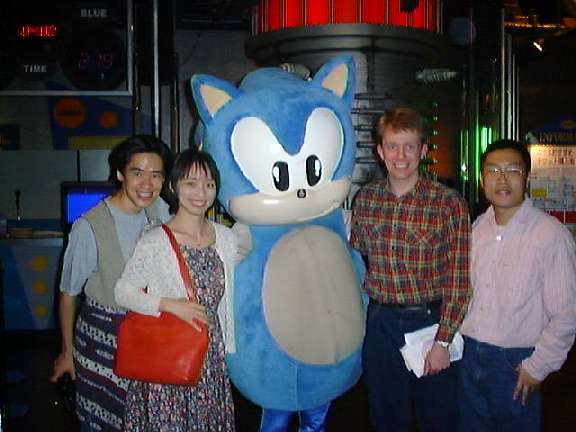
All of us at Sega Joypolis
After lunch, we took a few pictures by the canal, before making our way to Sega Joypolis. Joypolis was basically a huge arcade centre with lots of interesting rides and games. We bought a 3-coupon-plus-admission ticket, which allowed us to try three of the major attractions without paying extra. First we played Q-tag, which was like Laser Quest in England. This wasn’t Matt’s favourite choice of game, as he had played it a lot at home. Aki and Tei had never played it before, and I had only played twice before when I was in England.
There were a few differences with Q-tag compared with Laser Quest in England. First, players had to wear huge protective helmets. Secondly, the "maze" was really brightly lit and had only a few obstacles, so it was really easy to spot people. Thirdly, people obeyed the "no running" instructions religiously; everybody was walking around really slowly! I’m not going to mention the results here, but I can tell you that I blamed Matt afterwards. The best way to score a lot of points was to shoot was your opponents’ guns, and he didn’t remind me.
Next we tried a "virtual reality" ride. Incredibly, I had seen it before, but Matt and others enjoyed it quite a lot. Finally, we went to the star attraction - the Lost World game. We had played a smaller-scale version before in an arcade centre in Kyoto, but this one was much better. This one had a big screen and the seat moved around to give impressions of movement. We needed to play in pairs, and I paired with Tei while Aki played with Matt, so that we’d be able to understand any Japanese messages that were displayed. Tei and I managed to score a healthy 40%. Aki and Matt initially claimed to be the winners with a staggering 60%. However, we couldn’t stop laughing when we learned that in reality, they had achieved a rating of just 6%!
When we finished the Lost World, it was time to leave and go to Aki's home. We went back to that station and took a local train. At this local station, the conductor was a bit confused by our JR pass - presumably, not many tourists passed through this station. Aki's father picked us up from the station and very soon, we were in Aki's house. We were led to the dining room, and we sat down by bending our knees - that was our stereotype vision of how Japanese sat. Aki and Tei were a bit amused by our antic, and proceeded to explain that it was not actually necessary to sit like that and that we could sit however we wanted, as long as it was comfortable!
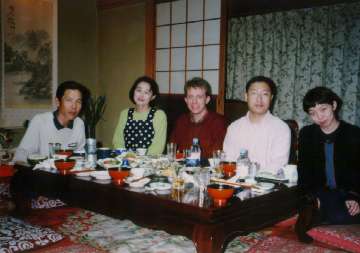
A picture with Akiko's family at their home
Aki then introduced us to her mother, Keiko, and two of her younger sisters, Risa and Sanae. We were then served a fantastic feast, which we ate with Akiko’s family and Tei. We had many many delicious dishes! We had fish caught by Aki’s father, mussels and sushi (this was the most special and delicious sushi we ate in Japan). Matt had great difficulty in eating tofu with chopsticks. His grip wasn’t gentle enough, because each time he tried to pick up some tofu, the chopsticks cut it again. When his bowl was quickly turning into a mound of tiny chopped tofu pieces, Akiko had to come to his rescue. Aki told us that Risa was planning to go to Oxford to study some English, but her English seemed to be very good already.
After our wonderful dinner, we went upstairs and listened to some music in Aki’s room. We saw lots of photos from Aki’s last trip with Tei to Shanghai (his home city), with her cousin. Aki’s mother brought us some coffee and some delicious strawberries! Aki had fun taking pictures of us with a video camera. Matt received a wonderful picture of Aki and her friend wearing colourful Japanese clothing at a wedding reception, and an interesting book entitled, "Living Japanese Style". We even checked e-mail on the PC in Akiko’s twin sister’s room! We had lots and lots of fun chatting, but eventually it was time to leave.
Aki's father again drove us all back to the station. The next day we would have a day-trip to Nagasaki, but we arranged that we would return early, so that we could meet for dinner. We waved goodbye to Aki and her father, and caught the train back to Hakata with Tei.
19th April, 1998
Today was our day-trip to Nagasaki. This city was probably best known for its sad atomic bombing, but it was also the only port city to remain open to Europe and China during the period of Japan’s isolation from 1641 to 1858. Foreign influence and architecture could be seen everywhere in Nagasaki, from the English Glover Garden and the Dutch Huis Ten Bosch theme park (though it was nearer to Sasebo), to the Chinese Koushibyo (Confucian Shrine).
We took an early morning train and arrived there at about 10:30. We decided to go to the tourist information centre (just opposite the railway station) to get maps and information on Nagasaki. Unfortunately, it was closed on Sundays, but the leaflets and maps were still there, and we helped ourselves. We sat down and read the information to decide where to go. We decided that buying a 1-day streetcar (tram) pass would be a good option. It was a great way to get around in Nagasaki, as the streetcar routes covered almost every place of interest to tourists.
We went to a nearby hotel to buy the pass (because the TIC was closed). Matt tried to buy the passes, but we were a bit alarmed when it seemed that the receptionist was trying to check us in! Finally, we got the idea across and bought the passes. Whenever Matt had problems speaking, every Japanese person would turn to me for help, expecting me to be able to speak Japanese! The only thing I could do was to start speaking English, so that they knew I wasn't Japanese at all.
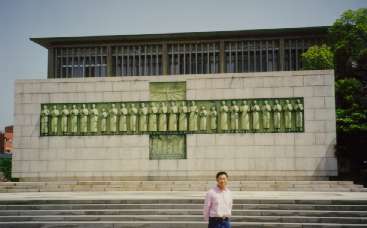
The Martyrdom of the 26 Saints
We started our sightseeing with the site of the Martyrdom of the 26 Saints, built in memory of the 26 Christians persecuted and killed in 1597, when Christianity was outlawed. There was a small museum, but we were hesitant as to whether we would enter. Finally, we decided that the 250-yen admission wasn't too high and we went in. The exhibits were quite interesting, as they also provided some insight into the history of Nagasaki at that time.
Matt was very interested to see the Fukusai-ji Zen Temple, owing to its unusual architecture. The temple itself was in the form of a gigantic turtle. On the back of the turtle, an 18m statue of the goddess Kannon towered over the nearby landscape. We had to walk a long way across a steep hill to get there. En-route, we passed through a Japanese cemetery, and took some pictures near a Japanese flag.
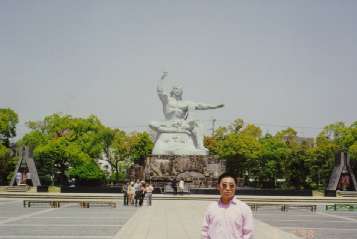
The Peace Park
It was then time to have lunch. We found a small local restaurant where we ordered our familiar katsudon. Afterwards, we jumped on a streetcar and headed for the Peace Park. The first sight to strike us was the Peace fountain, built in memory of people who experienced extreme thirst (caused by the heat) after the atomic bomb was dropped. Next came the Peace Statue. Its right hand pointed to the heavens, indicating the threat of nuclear power, while the extended left hand symbolised eternal peace on earth.
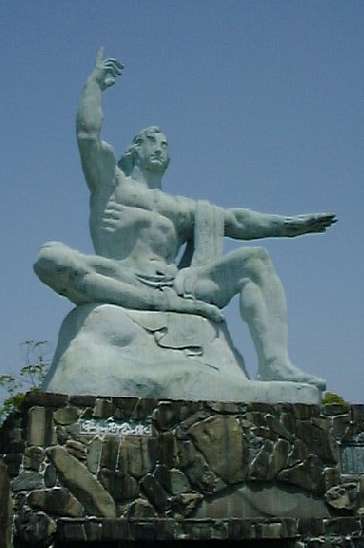
The Peace Statue
Leaving the park and crossing the road, we found Urakami Cathedral. It was destroyed by the atomic bomb but subsequently rebuilt. It had become a symbol of peace since its reconstruction. As we entered the cathedral, we found out that a marriage ceremony was being held. What a day to visit it! We decided to leave promptly before we were swamped by the emerging crowd.
Next, we went to the Atomic Bomb museum. It showed the destruction caused by the atomic bombing, the events leading up to the bombing, Nagasaki's postwar restoration, as well as the history of atomic weapons. The atomic bomb, called "Fatman", was dropped in Nagasaki on 9th August, 1945. On display were some clocks that were shattered by the blast, with their hands stopped at exactly 11:02 - the moment of the explosion. We learned all about the terrible suffering of the civilians who perished or were injured in the aftermath. After leaving this distressful museum, we went to the atomic bomb epicentre, where the atomic bomb exploded 500 metres above the ground.
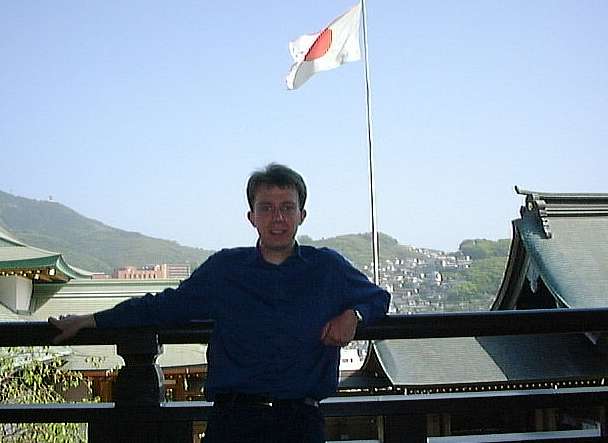
Matt being pictured at the top of Suwa Shrine.
It was time to go and we took the tram to Suwa Shrine. It provided an excellent panoramic view over the whole of Nagasaki. We took a few pictures, and next, went to Koushibyo - the Confucian shrine. There was a museum of Chinese history inside the temple. The shrine was like an exotic spectral island in the midst of a typical Japanese neighbourhood. According to our leaflet, it was the only Confucian temple in the world built outside China by Chinese hands, and that even today the land upon which it stands is Chinese territory (the land rights being controlled by the Chinese embassy in Tokyo.)
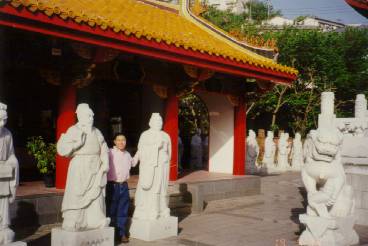
Me, with two of the Confucius Wise Men's statues
Highlights of the temples included the Gate of Rites, the 72 Confucius Wise Men's Statues, Da Cheng Hall, and the Museum of Chinese History. There were quite a few interesting items, like the model of the world's first seismograph, invented by the Chinese, as well as a variety of national treasures on loan from the its namesake museum in Beijing. After seeing the statue of Confucius we were about to leave, but something went wrong. There was a route for visitors to follow, but we hadn’t realised, and were following our own path. The temple attendant urged us to go into the museum, even though we had already been! Unable to communicate this fact, we had to walk all around the whole museum again, to avoid offending him.
Next, we went to the nearby Glover Garden. We had a good view of Nagasaki harbour on our way. We decided that English gardens were not something particularly special for us (particularly for Matt) and that we couldn't possibly justify the admission with only 15 minutes left before we had to return to the station. We took a couple of pictures and left. Before going back to that station, we went to Meganebashi (Spectacles Bridge). It was the first arched stone bridge in Japan, and was so called because with the shadow in the water, it formed two perfect circles and looked exactly like a pair of glasses.
In the Nagasaki’s railway station, Matt called Tei to arrange our meeting place. While on the train, I had been thinking if I could revise our itinerary to include Space World. We had allowed three days to see Nagasaki and Hiroshima, but Matt agreed that maybe we could also visit Hiroshima in just one day. So, instead of leaving Hakata tomorrow morning, we would instead go to Space World and travel to Hiroshima in the evening instead. The only problem was that Aki and Tei would probably not be able to come with us (as it would be Monday the next day) and we'd have liked to go there with them. We felt bad that we didn’t think of this in advance, otherwise we could have visited Space World and Nagasaki in the other order.
When Matt informed Akiko and Tei of our new schedule, Tei decided to skip class tomorrow and go with us to Space World!!! This was of course, very kind of Tei. Aki was very concerned as to whether he should really skip classes. Matt wanted to go back to our room for a brief time, after our heavy day’s sightseeing. When we came down again, we found Aki's twin sister Yuriko was waiting for us as well!
We all climbed into Yuriko’s car. Matt was the last to enter, and he had the passenger’s seat in the front. However, now that everyone was in the car, the extra weight made the door touch the pavement, and Matt couldn’t close it! He had to get out again, and apply sideways pressure to the car in order to get the door to move.
Yuriko drove us to Tenjin for dinner. As well as being the business centre in Fukuoka, Tenjin is also THE place to go for shopping, eating and entertainment. They took us to a Tokugawa restaurant, most famous for yakitori cuisine. Yakitori means barbecued chicken, but we also had barbecued pork, beef, chicken skin, green pepper, and liver, among other things. The chunks of chicken were arranged on bamboo skewers and broiled over a charcoal fire, dipped in a specially prepared sweetened barbecued soy sauce, before they were served. They were very good.
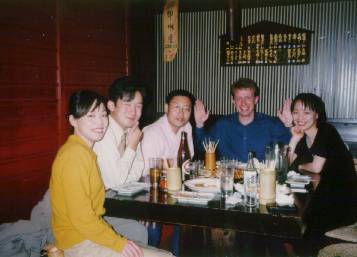
A picture of me and Matt with Aki, Yuriko and her fiancé Masaharu
Aki told us that yakitori was usually not for a full meal, but more like an accompaniment for drinks. Despite this, she ordered enough for us to have a very generous dinner. Aki also persuaded us to try some sake (Japanese rice wine). I tried some but it proved far too strong for me, so I reverted to beer. Matt, on the other hand, quite liked it, and had more until his face was red like a fire! Partway through our meal, Yuriko's fiancé Masaharu joined us. I was a bit amazed that he had to work on Sunday, but he told me that he had Wednesdays off instead. When we finished the meal, Aki gave us some wonderful presents. I received a T-shirt, and Matt received a wonderful wooden doll and a bell for his mother. We also received a set of Japanese chopsticks (hashi) each, so maybe Matt will be able to become more proficient at eating Tofu! We were very happy that Aki and Yuriko took us to this yakitori restaurant. We thoroughly enjoyed the occasion, and we must admit that we could never have gone to this kind of restaurant ourselves. It would have been impossible to use our method of ordering food (pointing to the items we wanted!)
After dinner, they took us back to the hotel, and Aki helped us to make our reservation for a hotel in Hiroshima. It was hard to say goodbye, but suddenly Aki realised that if we were to go to Space World tomorrow, she could meet us again in the railway station before we took the shinkansen to Hiroshima. So, we would see Tei tomorrow at 9am at the reception, to go to Space World!